.png)
Geoeconomics in the skies | How India can join the global aviation elite

Normally, a robust aviation sector acts as a catalyst for exponential growth through multiplier effects in countries with abundant natural resources and assured domestic demand. But, unusually and surprisingly, aviation has become an economic resource in itself for some countries that have neither natural resources nor the quintessential factors of production, boosting their growth phenomenally and making them geopolitical powers. The magic lies in ‘geoeconomics’. Today, Dubai in the United Arab Emirates, Singapore in Southeast Asia, and Turkey—the bridge between Europe and Asia—have become geopolitical powers largely due to sustained investment in aviation programmes, building world-class airports catering to 100–200 million passengers globally every year, one-third of whom are transit passengers. While Dubai Airport's (DXB) annual direct revenue is roughly $3.8 billion, its overall economic impact adds approximately $22–26.7 billion annually to Dubai's GDP. Similarly, Singapore's Changi Airport Group's revenue reached US$2.4 billion for FY 2026. As masters of global air connectivity, these countries wield a tremendous amount of political and economic influence in the world.
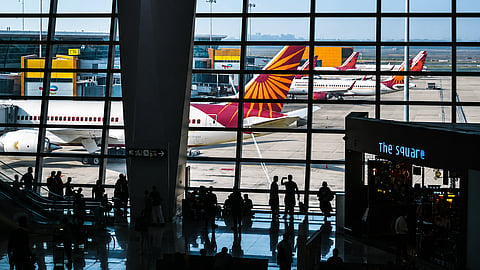
Can India also leverage its aviation sector to take advantage of geoeconomics? The answer could be in the affirmative, in view of the sector's pre-pandemic growth of more than 10 per cent CAGR. Tremendous growth has been observed in India's aviation sector in recent years. Dozens of modern airports are coming up across the country under UDAN, transporting around 174 million O-D passengers (the third highest globally), though the sector is primarily dominated by domestic travel (78 per cent), which largely sustains the industry (IATA, June 2025). Aviation (airlines, airports, MRO, ground handling, etc.) directly adds to GDP through revenues, taxes, and spending. In India, it contributed cumulatively about USD 53.6 billion and supported 7.7 million jobs overall, as per recent assessments. Delhi is aiming to increase its capacity to 100 million passengers by 2030. But can it replicate the Dubai or Singapore model?
Dubai International (DXB) is an example of turning one's disadvantage into an advantage with the help of vision and strategy. A desert was transformed into an international aviation hub to connect 80 per cent of the world's population within an eight-hour flight radius. Hundreds of secondary cities with no direct international connectivity were provided access by the state-run Emirates Airline. The UAE, through the massive expansion project at Al Maktoum International Airport, has built a system of structural dependency for the world worth billions. Singapore is just a city-state of 5.9 million people, with no noteworthy natural resources or a significant domestic market. Surprisingly, Changi Airport catered to 70 million passengers in 2025. It is not just an airport but a huge national, man-made economic asset facilitating the global flow of people, capital, and cargo. Similarly, Turkey leveraged its strategic location by expanding Istanbul Airport into one of the best-connected airports in the world, providing political and commercial access to markets that other countries could not. In 2025, Istanbul Airport served 84 million passengers, of whom 36 million were transit passengers who never stepped out of the terminal. It connects 309 destinations across 110 countries, including many in Africa that most Western airlines have shied away from. It has surpassed even Heathrow, Charles de Gaulle, and Frankfurt, not to mention major airports in the United States. China handled around 1.5 billion passenger trips in 2025 and is reportedly investing heavily in international aviation as part of its Belt and Road Initiative.
Airports are no longer mere gateways; they are instruments of 'soft power' and influence, along with being drivers of income. Infrastructure investment, operational strategy, and the accumulation of connectivity will determine which country moves ahead of the others in the race. Analysts believe that the future global balance of power will depend not only on military capabilities or political influence but also on who succeeds in building mega aviation networks and world-class terminals, outsmarting the existing aviation hubs.
India, with 65–68 per cent of its population in the working-age group, strong economic fundamentals, and a huge domestic market—not to mention political stability—is definitely poised to emerge as one of the world's major aviation hubs within the next decade. India occupies a central position in South Asia by virtue of its geography and can serve as a bridge between the East and the West. It has proximity to the Middle East, Europe, Africa, and Southeast Asia. Remittances flow from its diaspora, while trade links with Gulf nations ensure natural traffic flows. Projections forecast that India will emerge among the world's top three aviation players in the long term. Reportedly, plans to develop Delhi, Mumbai, and Bengaluru as transit hubs to challenge Gulf carriers are already underway.
Airports in India have doubled from 74 in 2014 to 159 by 2024. Under the UDAN scheme, hundreds of regional routes have become operational, connecting Tier-2 and Tier-3 cities through more than 90 airports and over 600 routes. According to the PIB, ₹4,023.37 crore as Viability Gap Funding (VGF) has been disbursed to promote connectivity to underserved and remote regions. The positive effects are, of course, visible in tourism, healthcare access, and overall trade. Private players like Adani have undertaken major capex projects involving the construction and expansion of multiple airports. GMR's airports in Delhi and Hyderabad are making huge investments in expansion, developing aerocities and cargo terminals that are clearly visible to passengers during take-off or landing. The National Civil Aviation Policy (NCAP) 2016 targets massive growth in passenger traffic and cargo movement. The market continues to be sustained by low-cost flights, whose demand is assured by the growth of the middle class and rising disposable incomes.
However, to compete with Dubai or Singapore, India has to address certain structural challenges in the sector. First, current operations are insufficient even to handle point-to-point domestic traffic efficiently, while transit traffic remains limited, with nearly 85 per cent still routed through Gulf hubs. Second, service quality, immigration and security delays, skill shortages, dependence on overseas MRO services, and high operating costs make the competition stiff. Third, unpredictable profits, fuel price shocks, regulatory issues, and the near monopoly of a few operators such as IndiGo and Air India make airline economics complex and less attractive. Last but not least is the uncertainty arising from policy issues such as ownership rules, taxation, bilateral agreements, and coordination between the Centre and the states.
The ongoing Middle East conflict has dented Dubai's reputation as a secure and invulnerable aviation hub. India, as a peaceful country with zero tolerance for terrorism, commands respect among nations and can emerge as an ideal alternative international aviation transit point. As a fast-growing economy with enormous natural resources, India should embark on a mission to fill this vacuum by creating world-class aviation hubs. Superior infrastructure, coupled with operational efficiency, is the need of the hour to ensure hassle-free connectivity, faster processing, high-end amenities, and large cargo-handling facilities. Open policies are needed to encourage liberal bilateral agreements, tax incentives, and integration with broader ecosystems in tourism, finance, trade, and real estate (including aerotropolises). A route expansion strategy must be pursued aggressively to guarantee enhanced ease of doing business. Needless to say, a far-sighted vision that transforms airports into economic assets capable of fuelling growth and enhancing India's geopolitical influence should be the guiding force. India can do it.
Views expressed are personal

