.png)
‘No excuse and no justification’: Supreme Court orders panel to probe Delhi protest allegations

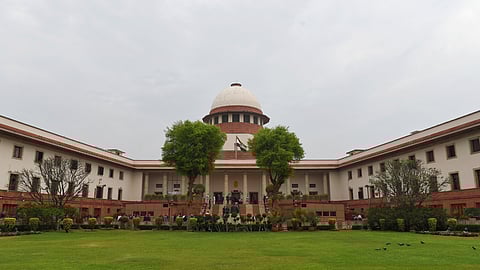
The Supreme Court on Tuesday said it would constitute a high-powered committee comprising retired apex court and high court judges, a former DGP, and an ex-CBI director to examine allegations of police excesses against student protesters in Delhi recently and violence against police personnel.
A bench of Chief Justice Surya Kant and justices Joymalya Bagchi and V Mohana said an order for constituting the committee would be released on Wednesday after it receives suggestions from different parties on other members to be included in the panel.
It said the high-powered committee will be entrusted with the task of fact-finding and it will be provided with all the necessary facilities.
"We are quite sure that the committee will give an immediate voice and audience to any victim who approaches it. We will await the recommendations which the committee will make from time to time, and the necessary legal consequences would follow," the top court said, after counsel for several petitioners submitted they were targeted by the authorities and public for participating in the protest.
Also Read | '5k cops tried to manage 30k+ protesters': Delhi Police defends July 20 action in Supreme Court
Panel to examine allegations against protesters and police
The court said that the committee will also look into allegations concerning sexual assault and online harassment of female protestors and victimisation of other vulnerable persons through social media.
"Whosoever is responsible, there can be no excuse and no justification. It must be taken seriously and taken to its logical conclusion. That is why we are constituting a high-powered committee. The committee will look into each and every aspect of these matters," CJI Kant said.
The top court further said that it would direct the handing over of video footage and CCTV recordings of the violence during the July 20 Parliament march in Delhi to the high-powered committee for examination.
SC seeks details of FIRs against student protesters
The bench was hearing a batch of pleas alleging police excesses against student protesters during the agitation spearheaded by the Cockroach Janta Party (CJP) and allegations of violence against police personnel.
The bench asked Solicitor General Tushar Mehta to furnish details of FIRs implicating the student protesters, which are to be quashed, indicating that the court may exercise its plenary powers under Article 142 of the Constitution.
"It is the life of students, which is at stake. We have to consider this. They have a future ahead. They have the right to protest under Article 19," the bench told a counsel, opposing quashing of cases against student protesters without them tendering an apology.
Mehta said police had identified more than 2,800 "anti-social elements", who had been involved in heinous offences in the past, as responsible for the violence during the July 20 protest.
Facial recognition, surveillance questions remain with SC
Senior advocates Menaka Guruswamy, Vrinda Grover and N Hariharan, appearing for several victims of violence said that police were not authorised to use surveillance techniques, facial recognition and other digital tracking methods and store data with a private entity, as it was a violation of their privacy.
The bench said the constitutional questions concerning facial recognition technology, surveillance, privacy and Article 21 will ultimately be decided by the court itself, and not by the committee.
"The committee will only examine the factual questions, including whether the use of force was excessive. Pursuant to its report, the larger legal and constitutional questions concerning facial recognition technology will be considered by this court," it said.
Mehta clarified that the facial recognition technique used by the police does not scan the faces of all the persons, but flags only those persons, who were earlier involved in some heinous crime and their data was available with the National Crime Records Bureau (NCRB).
Court recalls right to peaceful protest
On August 3, the top court clarified that the expression "criminal antecedents" in its order on releasing student protesters referred only to those involved in grave and heinous offences, and said states could close or withdraw FIRs against the remaining students in accordance with law.
The clarification came after the Centre submitted that it was "serious" about not pursuing FIRs against students who participated in the NEET examination paper leak protests, including the July 20 Parliament march in Delhi, provided they did not have criminal antecedents.
Also Read | 'Who are they to interfere?' Supreme Court questions BCI over NALSAR graduates' enrolment ban
The apex court had earlier observed that police excesses or a 'lathi charge' cannot be justified merely because there is an agitation and underlined that the right to peaceful protest was "absolutely guaranteed".
July 20 march ended in clashes
One petition before the top court seeks nationwide guidelines to regulate police action during public protests, including a prohibition on the deployment of plainclothes personnel for crowd-control duties.
The CJP-led march on July 20 in Delhi saw clashes between protesters and security personnel, who used lathis and teargas shells to disperse crowds attempting to move towards Parliament.
The student-led protests, which spread to several cities, were centred around the resignation of Union Education Minister Dharmendra Pradhan.
The agitation, which began at Jantar Mantar on June 20, was called off on July 25 after Pradhan resigned and the government accepted the CJP's other demands.

