.png)
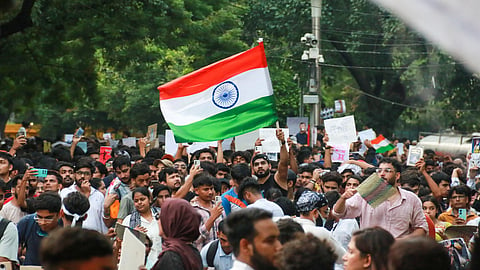
'5k cops tried to manage 30k+ protesters': Delhi Police defends July 20 action in Supreme Court
The Delhi Police has defended its handling of the July 20 “Sansad Chalo” protest, telling the Supreme Court that force was used only after the gathering stopped being peaceful and protesters allegedly breached multiple layers of barricades while attempting to move towards Parliament.
In a counter-affidavit filed before the Supreme Court, Deputy Commissioner of Police Sachin Sharma said around 5,000 police personnel were deployed to manage more than 30,000 protesters spread across nearly three kilometres. The police said the confrontation left over 240 police and uniformed personnel and around 200 protesters or members of the public injured.
Police says response was ‘graded’
The affidavit was filed in response to petitions seeking a court-monitored investigation into alleged police excesses. The matter is being heard by a bench led by the Chief Justice of India.
Also Read | 'He is active & young': Union minister Athawale invites CJP founder Abhijeet Dipke to join RPI(A)
According to the police, its personnel initially tried to regulate the crowd, but the situation escalated after groups allegedly crossed successive barricades and moved towards Parliament despite not having permission for such a march.
The police said the gathering consequently took the form of an unlawful assembly. It also argued that photographs, videos and media or social media reports relied upon by petitioners were selective and did not show the complete sequence of events.
Police rejects nail-studded lathi claim
On allegations that officers used lathis fitted with nails, the police said available videos showed only one such object, but claimed it was being carried by a protester.
The affidavit disputed the description of the object as a nail-studded police lathi, saying it was a stick carrying the National Flag. Police also alleged that some protesters attacked individual officers, pulled off their protective equipment and pushed them onto stone pavements.
The force further said 2,873 people at the protest site had criminal cases registered against them, including allegations involving serious offences. Their antecedents, it said, would be examined by a Special Investigation Team.
Plainclothes officers, facial recognition defended
The police also defended deploying plainclothes personnel carrying lathis, describing them as “spotters” from various specialised units who had merged with the crowd during the situation.
Also Read | FDA went ‘overboard’ in Pune shop case, Bombay HC orders Rs 5 lakh compensation
On facial recognition technology, the police called its use a “proportionate policing measure”. It said the system was used to identify people with previous serious criminal records and that no action was taken solely on the basis of a facial-recognition match.
The police has left the question of whether the force used was excessive to the court's proposed fact-finding mechanism, while maintaining that its response was necessary and proportionate.


