.png)
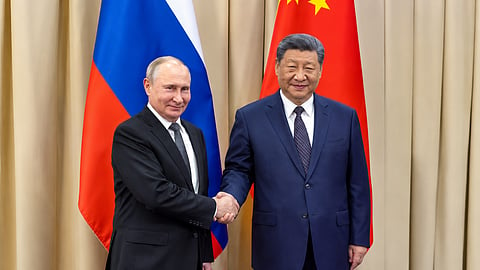
Xi, Putin target Western trade policies ahead of high-stakes meeting with Trump in China
Chinese President Xi Jinping on Wednesday called for greater international cooperation and open trade, while Russian President Vladimir Putin criticised Western sanctions, as the two leaders prepared for a high-stakes trilateral meeting with US President Donald Trump in China.
The remarks were delivered at the Asia-Pacific Economic Cooperation (APEC) summit in Shenzhen, a day before the three leaders are scheduled to meet on Thursday. Their discussions are expected to cover major geopolitical and economic issues, including Russia's war in Ukraine, the US conflict with Iran, trade disputes, artificial intelligence and nuclear weapons.
Xi used his address to business executives to present China as a stable economic partner amid growing trade tensions with Washington. His appeal for free and open trade came against the backdrop of US President Donald Trump's tariff policies and fresh restrictions on China's access to advanced artificial intelligence chips supplied by companies such as Nvidia.
"We must firmly uphold the rules-based multilateral trading system with the World Trade Organization at its core, support free and open trade and investment, maintain the stability and smooth operation of global industrial and supply chains," Xi said.
He also pledged to resist protectionism and called for countries to strengthen cooperation in trade and investment.
Xi's call for open trade amid US-China tensions
Xi's remarks came shortly after Washington announced additional restrictions on China's access to advanced AI chips, threatening to further strain an already fragile trade truce between the two countries. Beijing has warned that it would retaliate against the latest measures.
The Chinese President's appeal appeared aimed at positioning Beijing as a reliable trading partner at a time when Trump's administration has increased tariffs and adopted a more assertive foreign policy approach.
However, China's own trade policies have faced criticism from Western governments, particularly over its annual trade surplus exceeding $1 trillion. Critics argue that Beijing's economic policies favour manufacturing and exports over domestic consumption, contributing to imbalances in global trade.
China maintains that its economic model is appropriate for a developing economy seeking to catch up with the world's wealthiest countries. The US, European Union and other Western partners have also expressed concern that Beijing's dominance of global supply chains could provide it with considerable geopolitical leverage.
Putin says Western sanctions have failed to weaken Russia
Speaking after Xi, Russian President Vladimir Putin criticised Western economic policies and sanctions imposed on Moscow following its invasion of Ukraine in 2022.
Putin described Europe as being in a "humiliating decline" and argued that sanctions intended to weaken Russia had instead made its economy stronger.
"Experience has shown that the traditional tools of economic dominance and de facto coercion have largely run their course, having lost much of their intimidating power," Putin said.
"While sanctions, tariffs, and export restrictions may still exert a certain deterrent effect, they are incapable of halting growth, let alone crushing the economies of competitors," he added.
Putin also described the global situation as increasingly turbulent, pointing to a fragmenting world economy and rising military and political risks. He said disagreements between countries could be addressed through dialogue and expressed hope that the upcoming meeting with Trump and Xi would deliver significant benefits.
His remarks came after Ukraine destroyed the Kerch road bridge connecting Crimea to Russia, dealing a major blow to Moscow's war effort, which has now entered its fifth year.
Trump, Xi and Putin set for trilateral talks
The three leaders are scheduled to meet on Thursday on the sidelines of the APEC summit in Shenzhen. Trump arrived in China from Manila, where he had been meeting regional allies.
The discussions are expected to cover Russia's war in Ukraine, the US conflict with Iran, trade tensions, artificial intelligence and nuclear weapons. The possibility of the three countries addressing other international flashpoints has also raised expectations surrounding the meeting.
The proposed trilateral gathering has drawn comparisons with the 1945 Yalta Conference, where the leaders of the United States, Britain and the Soviet Union discussed the post-Second World War international order and arrangements that formalised spheres of influence.
The comparison has raised concerns among smaller countries in Europe and Asia that major powers could reach agreements affecting their security and interests without their participation.
The Kremlin has dismissed the Yalta comparisons as "games of political scientists", although it acknowledged that the meeting could have a significant impact on international affairs. Beijing has described the proposed trilateral talks as being of groundbreaking significance and said they could promote global peace.
Despite the high stakes, analysts expect Washington and Beijing to maintain relatively stable relations. Trump and Xi are also expected to meet again at the Group of 20 summit in Miami in December, which would mark their fourth meeting this year.
The upcoming talks will bring together the leaders of the world's three major powers at a time of heightened geopolitical tensions, trade disputes and competing economic interests.


