.png)
Who are the Houthis? Inside the rebel group's war with Saudi Arabia
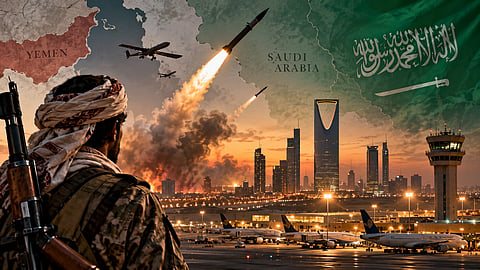
Iran-backed Houthi rebels have claimed responsibility for missile and drone attacks targeting key Saudi military and civilian infrastructure, including Riyadh's King Khalid International Airport. The latest strikes have raised questions about Saudi Arabia's air defence capabilities and renewed concerns over the widening conflict in the Middle East.
The group has claimed that a ballistic missile "accurately hit" Riyadh airport, while also reporting a drone attack on King Khalid Air Base in southwestern Saudi Arabia. However, the Saudi-led military coalition said it intercepted a ballistic missile fired towards the capital.
"Interception and destruction of a ballistic missile launched by the terrorist Houthi militia towards Riyadh," Major General Turki al-Malki, a spokesman for the coalition, wrote on X.
The attacks have brought renewed attention to the Houthis, their military capabilities and their long-running conflict with Saudi Arabia.
Who are the Houthis?
The Houthis, also known as Ansar Allah, are a political, religious and military movement that controls much of northwestern Yemen. The group emerged in the 1990s as a revival movement for the Zaydi sect of Shia Islam, whose traditional heartland lies in northern Yemen.
The movement expanded its influence after Yemen's 2011 Arab Spring protests. In 2014, Houthi fighters seized the capital, Sanaa, forcing the internationally recognised government towards Aden.
Led by Abdul Malik al-Houthi, the group has since developed a formidable arsenal of drones and missiles capable of striking targets well beyond Yemen.
Why are the Houthis fighting Saudi Arabia?
Saudi Arabia intervened militarily in Yemen in 2015 to counter the Houthis and restore the internationally recognised government. The conflict led to years of fighting, devastating airstrikes and a major humanitarian crisis.
Despite the Saudi-led campaign, the Houthis retained control over much of the country's northwest. They also carried out attacks on Saudi and Emirati oil facilities and other critical infrastructure.
A United Nations-brokered truce in 2022 helped maintain relative calm for several years, but hostilities have since intensified amid the wider regional conflict involving Iran, the United States and Israel.
How do the Houthis threaten global trade?
The Houthis began attacking commercial shipping in the Red Sea in November 2023, saying the strikes were intended to support Palestinians during Israel's war in Gaza.
Their position near the Bab el-Mandeb Strait gives them leverage over a key maritime corridor connecting the Red Sea with the Gulf of Aden. Attacks on vessels have forced some shipping companies to reroute cargo around Africa, increasing travel times and costs.
The disruption has become particularly concerning for Saudi Arabia, which has relied more heavily on its Red Sea export routes amid instability around the Strait of Hormuz.
How strong are the Houthis, and what are their links to Iran?
The Houthis possess drones, short-range weapons and long-range ballistic missiles capable of reaching targets across the region. Their use of different weapons in coordinated attacks can also complicate interception by air defence systems.
Iran supports the movement as part of its regional network of allies, known as the Axis of Resistance. Washington has accused Tehran of supplying weapons, funding and training, while the Houthis deny being an Iranian proxy and say they develop their own weapons.
Their stronghold in Yemen's mountainous terrain, combined with their missile capabilities and strategic position near major shipping routes, has made the group difficult to defeat militarily.


