.png)
UN nuclear watchdog board 'reports' Iran to the UN Security Council for the first time in 20 years

The UN nuclear watchdog’s governing board on Wednesday referred Iran to the United Nations Security Council for the first time in two decades over Tehran’s failure to cooperate fully with a long-running investigation into uranium traces discovered at undeclared locations. The move marks a significant escalation in international pressure over Iran’s nuclear programme at a time when tensions between Tehran and Washington have again intensified.
Twenty-three members of the International Atomic Energy Agency’s 35-member Board of Governors voted for the resolution at its headquarters in Vienna. China, Russia and Niger opposed the measure, eight countries abstained and one did not vote because it was in arrears. The resolution was brought by the United States, Britain, France and Germany. The board had already found Iran in non-compliance with its nuclear non-proliferation obligations in June 2025, citing Tehran’s failure to provide satisfactory explanations about nuclear material detected at undeclared sites.
Uranium traces under scrutiny
The investigation centres on uranium traces detected by IAEA inspectors at locations that Iran had not declared as nuclear sites. Western governments have long suspected that the findings could be connected to nuclear weapons-related work carried out by Iran before 2003. Tehran rejects accusations that it has pursued nuclear weapons and insists its atomic programme is exclusively peaceful.
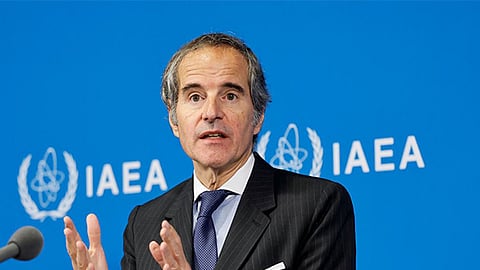
The resolution asks IAEA Director General Rafael Grossi to report the latest decision, along with earlier resolutions on Iran, to members of the agency as well as the UN Security Council and General Assembly. It also calls on Tehran to urgently address its non-compliance and take measures required by the watchdog to provide assurances that nuclear material has not been diverted for prohibited purposes.
Inspectors lack access
Concerns have intensified since Israeli and US strikes hit Iranian nuclear facilities during the 12-day war in June 2025. IAEA inspectors have not been given access to the nuclear sites affected by those attacks, leaving the watchdog unable to establish the current condition of facilities and nuclear material there. Crucially, the agency has also been unable to verify the status of Iran’s stockpile of uranium enriched to near weapons-grade levels since the strikes.
According to the IAEA, Iran had accumulated 440.9kg of uranium enriched to 60 per cent purity. Weapons-grade uranium is generally enriched to around 90 per cent, meaning material at 60 per cent is technically only a relatively short step from that threshold. Grossi has previously said the stockpile could, if Iran chose to further enrich and weaponise it, provide enough material for as many as 10 nuclear weapons. He has stressed, however, that possessing such material does not mean Iran has built a nuclear bomb.
Sanctions threat returns
Referral to the Security Council raises the possibility of further international measures, including sanctions and asset freezes. However, punitive action through the Council faces significant political obstacles because Russia and China, both permanent members with veto power, opposed the IAEA resolution.
The nuclear confrontation is unfolding alongside a wider military escalation involving Iran and the United States. Fresh strikes and counter-strikes have further complicated diplomatic efforts to resolve the nuclear dispute, increasing concerns that the confrontation over Tehran’s atomic programme could become intertwined with the broader conflict.

