.png)
Trump’s renewed outreach to Kim Jong Un fails as North Korea rejects summit conditions: Report
US President Donald Trump’s renewed efforts to revive diplomacy with North Korean leader Kim Jong Un have failed to secure a breakthrough, with discussions over a possible meeting during his recent Asia trip reportedly collapsing after Pyongyang set conditions Washington was unwilling to accept.
According to a Wall Street Journal report, Trump made several attempts over the past year to re-establish contact with Kim through established communication channels. The US president also tried to send a personal letter to the North Korean leader through Pyongyang’s mission to the United Nations in New York, but the outreach did not result in direct engagement.
The newspaper reported that US officials continued exploring the possibility of a face-to-face meeting during Trump’s recent visit to Asia. However, the proposed summit did not materialise after North Korea put forward demands that the US administration found difficult to accept. The specific conditions have not been disclosed.
A Trump administration official told the newspaper on Saturday that no efforts had been made to arrange a meeting with Kim. The White House has also reiterated that it remains committed to North Korea’s denuclearisation.
Washington considers a different approach to negotiations
The Wall Street Journal reported that US officials had discussed proposals that could potentially pave the way for renewed negotiations with Pyongyang.
These reportedly included a formal declaration ending the Korean War, which concluded with an armistice in 1953 but has never been formally ended through a peace treaty. Washington also considered opening liaison offices as an initial step towards establishing diplomatic relations.
Another proposal involved issuing a statement that would neither formally recognise North Korea as a nuclear-armed state nor demand the immediate dismantlement of its nuclear programme.
In exchange, the US hoped to secure restrictions on future nuclear and ballistic missile testing by North Korea.
Such proposals would represent a significant departure from decades of American policy centred on the complete denuclearisation of the Korean Peninsula, the report said, citing experts.
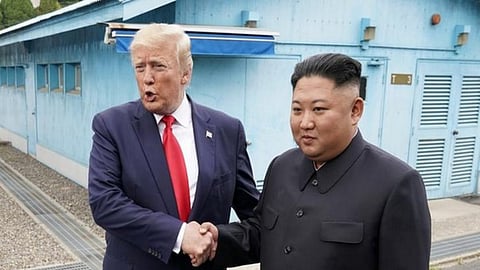
Trump and Kim held three meetings during the US president’s first term, including historic summits in Singapore and Vietnam, followed by a meeting at the Korean Demilitarised Zone in 2019. The encounters temporarily eased tensions, but negotiations eventually collapsed without a lasting agreement on North Korea’s nuclear programme.
North Korea’s nuclear arsenal and missile reach expand
North Korea’s military capabilities have grown considerably since Trump and Kim last met in 2019, complicating Washington’s efforts to secure a diplomatic breakthrough.
According to the Wall Street Journal, the country’s estimated nuclear stockpile has increased from around 20 to 30 warheads to approximately 60. Its solid-fuel intercontinental ballistic missiles are also reportedly capable of reaching the United States.
The US Intelligence Community’s Annual Threat Assessment has previously concluded that Kim has no intention of abandoning his strategic weapons programme. The assessment stated that “Kim has no intention of negotiating away his strategic weapons programs”.
The Pentagon has also described North Korea’s nuclear capabilities as a “clear and present danger of nuclear attack on the American Homeland”.
North Korea has continued to develop its missile capabilities, including solid-fuel systems that can be launched with less preparation than conventional liquid-fuel missiles. The expansion of its arsenal has strengthened Pyongyang’s position and reduced the prospects of negotiations based on the immediate abandonment of its nuclear weapons.
Military cooperation with Russia strengthens Pyongyang
North Korea has also deepened its military relationship with Russia following Moscow’s invasion of Ukraine.
Western governments have accused Pyongyang of supplying artillery shells, missiles and military personnel to support Russia’s war effort. Both countries have denied the allegations.
The growing partnership with Moscow has added to North Korea’s strategic leverage, while its expanding nuclear and missile capabilities have prompted renewed debate in Washington over the objectives of future negotiations.
Victor Cha, a former White House adviser and North Korea negotiator quoted by the Wall Street Journal, said many experts now believe that future talks may have to focus on arms control rather than complete denuclearisation.
“For someone like me, it’s kind of like screaming in a forest. Nobody is really paying attention,” Cha said, describing the limited attention given to the evolving debate over North Korea’s nuclear programme.
The latest failed summit effort highlights the widening gap between Washington’s stated goal of denuclearisation and Pyongyang’s insistence on retaining its strategic weapons, even as both sides continue to explore the possibility of renewed engagement.


