.png)
Trump, Xi set for high-stakes White House meeting as trade, Taiwan and AI dominate agenda
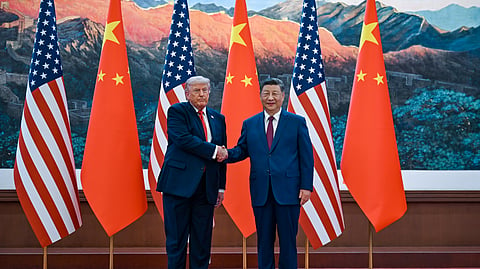
US President Donald Trump expects to discuss “almost everything” with Chinese President Xi Jinping when the two leaders meet at the White House on September 24, with trade, Chinese cars, Boeing aircraft, artificial intelligence (AI), the war in Ukraine, Gaza and US defence production expected to feature in the talks.
Trump has also defended steep tariffs on Chinese vehicles, saying the measures have kept Chinese cars out of the US market. He said tariffs ranging from 100% to 150% had prevented Chinese automobiles from entering the country.
The meeting, if held as scheduled, would be the second in-person meeting between Trump and Xi in 2026, following their talks in Beijing in May. Trump announced in July that Xi would visit Washington on September 24, although China has yet to formally confirm the date and details of the visit.
Chinese cars and Boeing among key economic issues
Asked whether he would allow Chinese automobiles into the United States, Trump said he had so far kept them out through tariffs.
“I’m the one that kept them out,” Trump said, contrasting the US position with Europe, which he claimed was being “decimated” by Chinese cars.
The issue comes amid broader tensions over market access and trade. Trump and Xi are expected to discuss tariffs, investment and Chinese investment in the United States, alongside other economic issues.
Boeing aircraft are also expected to feature in the discussions. Asked whether he expected an agreement with China over its purchase of Boeing aircraft, Trump said: “Yeah. I get every deal.”
China had already agreed in May to an initial purchase of 200 American-made Boeing aircraft for Chinese airlines, according to the White House. The commitment was described as China's first purchase commitment for American-made Boeing aircraft since 2017.
The two countries also established US-China boards for trade and investment during the May discussions, while China committed to addressing US concerns over rare earths and other critical minerals. Beijing also agreed to purchase at least $17 billion a year of US agricultural products in 2026, 2027 and 2028, on a prorated basis for 2026.
Taiwan emerges as a major flashpoint
Economic issues are expected to compete with Taiwan for attention at the White House meeting.
According to Kyodo News, Xi has threatened to cancel the meeting if the proposed US arms sale to Taiwan goes ahead. China has conveyed to the Trump administration that Taiwan remains a “red line”.
Xi had raised the issue during his May meeting with Trump. On May 15, he warned that mishandling Taiwan could push US-China relations into a dangerous situation.
“The Taiwan question is the most important issue in China-US relations,” Xi told Trump, warning that mishandling it could cause the two countries to “collide or even come into conflict”.
China regards Taiwan as a breakaway province and has not ruled out using force to bring the island under its control.
The United States, meanwhile, has continued to support Taiwan's ability to defend itself. A senior US diplomat said in June that a proposed $14 billion arms sale to Taiwan would not depend on China's approval, despite earlier suggestions that the issue could be used as leverage in talks with Beijing.
AI talks take centre stage amid technology rivalry
AI and technology competition are also expected to be prominent at the summit.
Trump and Xi discussed AI and technology competition during their May talks, although the two sides did not announce major agreements on the issue. The US and China have since been preparing for their first official bilateral discussions on AI safety, with talks tentatively scheduled for September.
Those discussions are expected to examine risks associated with advanced AI, including AI-directed cyberattacks, while exploring possible cooperation between laboratories in the two countries. The dialogue is being viewed as an important step ahead of the Trump-Xi summit.
Trump has stressed the importance of maintaining the US lead in AI. He said in September that “whoever wins AI wins”, describing the technology as a revolution and saying the contest was currently between the United States and China.
Ukraine, Gaza and Iran add geopolitical weight
The agenda is also expected to extend beyond bilateral relations.
The war in Ukraine and the Gaza conflict are expected to be discussed, while the Iran war will form an important backdrop to the meeting. China could potentially play a mediating role in regional conflicts.
During their May meeting, Trump and Xi discussed Taiwan, trade, the Iran war, AI and technology competition. The talks lasted around two days but did not produce major new agreements on those issues.
The White House said at the time that Trump and Xi agreed that Iran should not be allowed to obtain a nuclear weapon and called for the reopening of the Strait of Hormuz.
China's potential role in the Middle East has gained added attention after Xi called at the BRICS summit in New Delhi for the grouping to play a peacemaking role in the Middle East conflict.
Trump downplays Chinese spying concerns
Trump was also asked about reports that Chinese entities may have provided Iran with satellite imagery of US and allied airbases in Jordan.
He played down the issue, saying China conducts intelligence activities similar to those carried out by the United States.
“They do what we do,” Trump said. “When they say that China spies on us, I say, you’re right, and we spy on them too.”
The comments came after a report alleged that Iran obtained satellite imagery of a US base in Jordan from Chinese entities before a July attack that killed three American troops. The report did not identify the specific Chinese entities or establish that the Chinese government was directly involved. China has rejected what it described as baseless accusations.
White House summit comes amid fragile US-China ties
The September meeting would mark the first visit by a Chinese president to the White House in almost a decade and comes at a particularly sensitive moment in US-China relations.
The two countries continue to compete over trade, technology, AI, defence and access to strategic supply chains, even as both governments seek areas of cooperation.
Trump has said he is not concerned about the possibility of the meeting being cancelled despite tensions over Taiwan and proposed new US arms sales to the island.
Recent economic signals suggest both sides also have an incentive to preserve dialogue. China bought around 1 million tonnes of US soybeans in early September, bringing its purchases close to half of its annual commitment under the trade agreement covering purchases through 2028.
With tariffs, Taiwan, AI, strategic technology, global conflicts and defence production all potentially on the table, the September 24 meeting could become a major test of whether Washington and Beijing can stabilise relations while their broader strategic rivalry continues.


