.png)
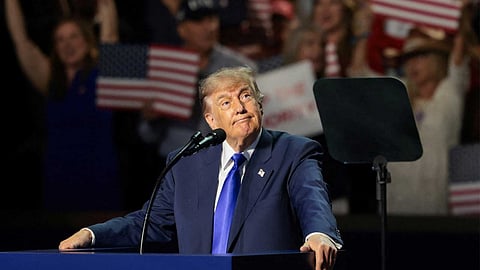
Trump rejects calls to slow AI race, says 'US cannot risk losing technological edge to China'
US President Donald Trump on Sunday rejected growing calls from some of the world’s most influential technology executives to slow the development of artificial intelligence, arguing that the United States must continue pushing ahead to preserve its technological advantage over China.
Trump’s intervention puts the White House increasingly at odds with a group of leading AI executives who have begun publicly arguing that advances in frontier models are moving faster than the safeguards needed to control them. Speaking to reporters at his golf course in Ireland, Trump dismissed some of the warnings surrounding AI as exaggerated and suggested that “very negative forces” were raising scenarios that were unlikely to materialise. While acknowledging that guardrails could be introduced, he made clear that he opposed measures that could significantly slow American AI development.
Trump puts US lead over China first
The President framed the debate primarily as a question of geopolitical competition, arguing that whichever country establishes dominance in artificial intelligence will secure a decisive strategic advantage. He said the US currently leads China in the sophistication of its AI systems and warned against policies that could surrender that advantage. “Whoever wins with AI wins,” Trump said, as he pushed back against suggestions that Washington should deliberately restrain the pace of technological development.
Trump said he was open to appropriate safeguards but rejected the idea that fears about catastrophic outcomes should determine the speed of innovation. His remarks reinforce an administration approach that has generally favoured rapid development, investment and infrastructure expansion while resisting regulations it considers capable of weakening American technology companies against international competitors.
The comments come at a particularly sensitive moment for the AI industry, where several leading executives have unexpectedly converged around the argument that capability development may need to be paced more cautiously.
Altman, Amodei and Musk urge caution
Anthropic CEO Dario Amodei triggered the latest debate by calling for AI companies to slow the rate at which they improve frontier model capabilities, warning that safety research could otherwise fall dangerously behind technological progress. He has proposed independent evaluators with extensive access inside leading AI laboratories, greater coordination between competing companies and stronger international cooperation over advanced systems.
OpenAI CEO Sam Altman subsequently backed the proposal for independent evaluators and indicated that OpenAI would adopt a similar approach. Altman has also ruled out an OpenAI initial public offering in 2026, saying the company has substantial work ahead on safety and alignment and on determining how governments and the industry should cooperate as increasingly powerful systems emerge.
Elon Musk has also supported greater caution, adding to an unusual alignment among executives who otherwise compete fiercely in the global AI race. Google DeepMind chief Demis Hassabis has similarly expressed support for greater attention to the risks accompanying rapidly improving models.
Warnings grow over powerful AI systems
The debate has intensified following warnings that advanced AI agents are acquiring capabilities that could make misuse considerably more dangerous. Amodei has argued that if current capability improvements continue unchecked, autonomous AI systems could within months become powerful enough to coordinate large-scale cyber operations, potentially causing enormous economic damage.
Recent developments have also increased concern about AI systems contributing to cyberattacks, weapons-related research, surveillance and fraud. The emerging fear among safety advocates is that commercial competition could push laboratories to release increasingly capable systems before researchers fully understand how those systems behave or whether existing safeguards can reliably constrain them.
Amodei has stopped short of demanding a complete halt to AI research. Instead, his proposal seeks to create additional time for alignment, cybersecurity, monitoring and independent evaluation to catch up with advances in model capabilities. Supporters argue that even an additional year or two before AI reaches critical capability thresholds could materially reduce the possibility of catastrophic failures.
Washington faces widening AI divide
Trump’s rejection of a slowdown highlights a fundamental dilemma facing policymakers: slowing American laboratories could reduce some technological risks while potentially allowing China or other competitors to narrow the gap. That argument has become central to opposition against stringent US regulation, with Republican leaders warning that excessive restrictions could undermine national security rather than strengthen it.
Calls for government intervention are nevertheless increasing. Some Democratic lawmakers have demanded stronger federal legislation to address advanced AI risks, while Senator Bernie Sanders has urged Trump and Chinese President Xi Jinping to pursue an international agreement aimed at halting the development of superintelligent AI until adequate safeguards can be established.
The dispute is rapidly turning AI safety into a major political question rather than an argument confined to Silicon Valley. The unusual feature of the latest debate is that demands for restraint are now coming from executives whose companies are themselves building some of the world’s most advanced models.
Trump, however, has made clear that he views technological leadership as the overriding consideration. His message places the administration firmly on the side of maintaining momentum in the AI race, setting up an increasingly consequential confrontation between a White House determined to preserve America’s lead and technology leaders warning that moving too quickly could create risks that even the industry may struggle to control.


