.png)
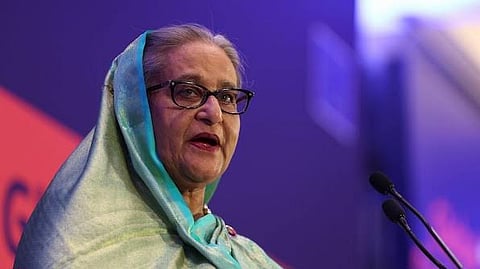
Sheikh Hasina vows to return to Bangladesh by December despite death sentence, arrest threat
Former Bangladesh prime minister Sheikh Hasina has reiterated that she will return to her country from India in December, insisting that she does not need the backing of any foreign government to make the journey. The ousted leader said on Thursday that her decision remained unchanged despite the possibility of arrest, imprisonment, torture or death upon her return.
In an email interview with the Associated Press, Hasina was asked whether she expected countries such as India and the United States to exert pressure on Bangladesh to guarantee her safe passage home. She said she valued international friendships but did not seek the intervention or approval of any foreign power.
“I value friendship and cooperation with all nations. That has always been our (Bangladesh's) foreign policy. But I do not need the blessing of a foreign power to return to my own country,” she said.
“If death is my destiny, I would rather die on the soil of my own country, among my own people. So, I will return to Bangladesh. That decision has not changed,” she added.
Hasina fled Bangladesh in August 2024 after a student-led uprising forced her out of office. She has remained in India since then and has repeatedly said she intends to return in December 2026. She has not disclosed the precise arrangements for the journey.
Hasina says she is prepared to face arrest or death
The former prime minister acknowledged that returning to Bangladesh could expose her to serious risks. During a virtual press conference in Delhi earlier this year, she said she could be killed, arrested or tortured immediately after landing in the country.
“Now I have decided. Yes, I know. If I go back, the moment I will land they can kill me, or they can arrest me and torture me,” she had said.
She also thanked the Indian government and people for providing her shelter after she left Bangladesh, maintaining that leaving her country had not been part of her plans.
In an interview with Hindustan Times in September, Hasina said she intended to return by December and would announce the specific date, time and point of entry later.
“I have said I intend to return by December because Bangladesh’s political crisis cannot be allowed to continue indefinitely. I will announce the specific date, time and point of entry in due course,” she had said.
She maintained that her return was not intended to help her regain political power but to stand alongside the people of Bangladesh. Hasina also said the decision was hers, although its political implications were being discussed within her party.
The timing of the return of other Awami League leaders living abroad, she added, would depend on consultations within the party and an assessment of the security situation.
Death sentence and extradition demand
Hasina was sentenced to death in absentia by Bangladesh's International Crimes Tribunal in November 2025 after being found guilty of crimes against humanity over the crackdown on student-led protests in July and August 2024. The United Nations has estimated that nearly 1,400 people were killed during the violence.
Hasina has denied wrongdoing, rejected the verdict and questioned the legitimacy of the proceedings. Bangladesh has repeatedly sought her extradition from India, but New Delhi has not handed her over.
Hasina alleges persecution of Awami League members
Hasina has accused the Bangladesh Nationalist Party (BNP)-led government of continuing a campaign against Awami League leaders and workers. She alleged that party members were being killed, arrested and targeted through criminal cases, while their families faced attacks, harassment and displacement.
In her September interview with HT, she claimed that more than 600 cases had been filed against her and described the legal proceedings as politically motivated.
She also questioned the decision to ban the Awami League, arguing that the party should be allowed to participate in elections and that voters should determine its political future.
“Why did they ban the Awami League? If the Awami League has done a lot of bad things, let the people decide,” she said.
The Awami League was barred from contesting Bangladesh's February 2026 general election, which was won by the BNP. Tarique Rahman became prime minister on February 17, and his government has maintained the restrictions on the Awami League's political activities. The party remains outside Parliament and cannot operate formally as a registered political party.
Hasina has also warned about what she described as the growing influence of extremist groups in Bangladesh, saying developments in the country could have consequences for regional security and neighbouring states.
Hasina questions proposed fighter jet deal
The former prime minister also criticised the BNP government's reported plan to acquire Chinese J-10CE fighter jets under a deal worth $2.3 billion.
She questioned the proposed expenditure at a time when Bangladesh was facing power and gas shortages, rising prices and wider economic difficulties. Hasina also warned that the growing influence of hard-line groups could further complicate the country's political and security situation.
Her latest remarks come amid continuing tensions between Dhaka and New Delhi over her presence in India, the extradition demand and the future of the Awami League. Bangladesh's home minister has said the government would not allow instability over reports of Hasina's planned return, while reiterating that Dhaka wants her extradited.


