.png)
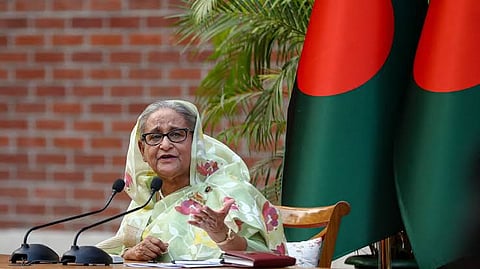
Sheikh Hasina blasts Bangladesh PM for skipping BRICS Summit; says it damaged national interest
Former Bangladesh Prime Minister Sheikh Hasina has sharply criticised Prime Minister Tarique Rahman's decision to skip the BRICS summit hosted by India last month, describing it as an "immature" move that undermined Bangladesh's national interests and deprived the country of opportunities for economic cooperation.
In an exclusive interview with PTI, the 78-year-old Awami League leader, who has been living in New Delhi since the collapse of her government in August 2024, questioned whether Rahman's refusal to attend the summit was influenced by her presence in India. She argued that foreign policy should be guided by national interests rather than personal considerations or short-term political calculations.
Hasina also declared her determination to return to Bangladesh despite facing a death sentence, maintaining that the threat of arrest, imprisonment or danger to her life would not prevent her from continuing what she described as her struggle to restore democracy and the rule of law.
𝗕𝗥𝗜𝗖𝗦 𝗮𝗯𝘀𝗲𝗻𝗰𝗲 𝗮 𝗹𝗼𝘀𝘁 𝗼𝗽𝗽𝗼𝗿𝘁𝘂𝗻𝗶𝘁𝘆
New Delhi had invited Rahman to attend the BRICS summit on September 12 and 13 in his capacity as the current chair of BIMSTEC, the Bay of Bengal Initiative for Multi-Sectoral Technical and Economic Cooperation. However, the Bangladesh Prime Minister opted not to participate.
Hasina said the decision was unfortunate because engagement with BRICS could have helped Bangladesh strengthen economic ties with major emerging economies and explore cooperation in trade, investment, infrastructure, technology and development.
"It was deeply unfortunate that Bangladesh chose not to participate. In my view, it was an immature decision and one that did not serve Bangladesh's national interest," she said.
"BRICS is not simply a diplomatic gathering. It brings together major emerging economies and creates opportunities for cooperation in trade, investment, infrastructure, technology and development," she added.
Hasina maintained that Bangladesh could have gained valuable experience and opened new avenues for economic and social development through participation in the summit. She recalled attending the BRICS summit hosted by India in October 2016 during her tenure as prime minister.
𝗛𝗮𝘀𝗶𝗻𝗮 𝗾𝘂𝗲𝘀𝘁𝗶𝗼𝗻𝘀 𝗥𝗮𝗵𝗺𝗮𝗻'𝘀 𝗺𝗼𝘁𝗶𝘃𝗲𝘀
The former premier questioned whether her continued presence in New Delhi had influenced Rahman's decision, arguing that bilateral relations should not be shaped by political sensitivities involving an individual.
Drawing a historical parallel, Hasina recalled that Rahman's father, former Bangladesh President Ziaur Rahman, had visited India in 1979 when she was living in Delhi following the assassination of her father, Sheikh Mujibur Rahman, and several members of her family in August 1975.
She also recalled being in London when Ziaur Rahman travelled there in 1980, noting that her presence had not prevented him from undertaking either visit.
"So why should my presence in Delhi prevent Ziaur Rahman's son, Tarique Rahman, from coming to India today? What is the real reason behind such a decision?" she asked.
Hasina said relations between two countries could not be determined by personal considerations or political sensitivities involving one individual.
"India is our closest neighbour and an important historic partner, but BRICS engagement is also about Bangladesh's own place in the international community," she said.
The remarks come against the backdrop of renewed diplomatic friction between New Delhi and Dhaka following Hasina's virtual media interaction from the Indian capital on August 5. Bangladesh subsequently reiterated its demand for her extradition and sought to link the issue with Rahman's proposed visit to India.
India distanced itself from the interaction, stating that it had neither played a role in organising the event nor endorsed Hasina's remarks.
𝗖𝗮𝗹𝗹𝘀 𝗳𝗼𝗿 𝗯𝗮𝗹𝗮𝗻𝗰𝗲𝗱 𝗳𝗼𝗿𝗲𝗶𝗴𝗻 𝗽𝗼𝗹𝗶𝗰𝘆
Hasina criticised what she described as the Rahman government's approach to international relations, arguing that Bangladesh needed an independent and balanced foreign policy that prioritised national development.
She invoked Sheikh Mujibur Rahman's principle of "friendship to all, malice to none", maintaining that Bangladesh should cultivate constructive relations with all major international partners without allowing one relationship to undermine another.
"During my tenure, we maintained strong relations with India while also expanding cooperation with China, Russia, Japan, the United States, Europe and many other partners," she said.
"Friendship with one country never required hostility towards another," she added.
The Awami League leader said India remained Bangladesh's closest neighbour and historic partner because of its role during the Liberation War, while China continued to be an important development partner. She also highlighted the importance of Japan, the United States, Europe, ASEAN countries and the Muslim world.
"The problem is not engagement with China or any other country. The problem begins when one relationship is used against another," she said.
Hasina alleged that anti-India rhetoric was being encouraged for domestic political purposes and that major foreign policy decisions were being taken without sufficient transparency.
She argued that a responsible government should expand Bangladesh's international opportunities rather than limit them.
𝗔𝗹𝗹𝗲𝗴𝗲𝘀 𝗱𝗲𝗺𝗼𝗰𝗿𝗮𝘁𝗶𝗰 𝗰𝗿𝗶𝘀𝗶𝘀
Turning to Bangladesh's domestic political situation, Hasina alleged that the country was experiencing a grave national crisis marked by restrictions on democratic participation, political persecution and weakening institutions.
She accused the authorities of using the judiciary for political revenge, restricting media freedom and failing to protect minorities. She also claimed that extremist organisations had regained space and that the economy had suffered.
"The judiciary has been used for political revenge. Media freedom has been restricted. Law and order have weakened. Minorities feel unsafe. Extremist forces have regained space. The economy has suffered," she said.
Hasina maintained that the exclusion of the Awami League from political activity had deprived millions of Bangladeshis of their democratic rights.
She alleged that party leaders had been imprisoned or forced into hiding, while supporters had suffered the loss of homes, businesses, jobs and livelihoods because of their political affiliations.
"A country cannot return to stability by excluding such a large section of its own people," she said.
The former premier argued that the political crisis extended beyond the Awami League and affected the broader democratic framework of Bangladesh.
Her allegations concerning political persecution, the judiciary and the security situation represent her assessment of developments under the current government.
𝗩𝗼𝘄𝘀 𝘁𝗼 𝗿𝗲𝘁𝘂𝗿𝗻 𝗱𝗲𝘀𝗽𝗶𝘁𝗲 𝗱𝗲𝗮𝘁𝗵 𝘀𝗲𝗻𝘁𝗲𝗻𝗰𝗲
Hasina said she remained determined to return to Bangladesh despite the risks arising from the death sentence imposed on her by a Bangladeshi court.
Although she did not disclose when or how she intended to return, she insisted that personal safety would not determine her political decisions.
"The risks are very clear. There may be arrest, imprisonment and even danger to life. But fear cannot decide my duty," she said.
Hasina described the death sentence as the outcome of a politically motivated judicial process and maintained that she had not received a genuine opportunity to defend herself.
"A death sentence imposed through a politically motivated process, without a genuine opportunity to defend oneself, cannot be called justice," she said.
She recalled the assassination of her father, mother, brothers and other family members in 1975, her return to Bangladesh in 1981 despite military rule, and several attempts on her life, including the August 21, 2004 grenade attack.
The former premier said these experiences had strengthened her resolve to continue political activity despite threats to her safety.
"This is not the first time death has come close," she said, maintaining that her primary concern was what she described as the destruction of justice in Bangladesh.
𝗔𝘄𝗮𝗺𝗶 𝗟𝗲𝗮𝗴𝘂𝗲 𝘄𝗶𝗹𝗹 𝗻𝗼𝘁 𝗮𝗯𝗮𝗻𝗱𝗼𝗻 𝗰𝗼𝘂𝗻𝘁𝗿𝘆
Rejecting suggestions that the Awami League had been politically eliminated, Hasina asserted that the party retained an extensive organisational presence across Bangladesh.
She said many party leaders had left the country not by choice but because they feared for their lives, while others remained under pressure within Bangladesh.
"The Awami League will not abandon Bangladesh, its people or its political movement. We will return to the people because our struggle is with them and for them," she said.
Hasina argued that the party's organisational roots extended across every division, district and village, and that restrictions on its formal activities could not erase its political support.
She also maintained that political prisoners should be released, cases she described as false should be withdrawn and democratic rights should be restored.
𝗗𝗲𝗺𝗮𝗻𝗱𝘀 𝗳𝗿𝗲𝗲, 𝗶𝗻𝗰𝗹𝘂𝘀𝗶𝘃𝗲 𝗲𝗹𝗲𝗰𝘁𝗶𝗼𝗻𝘀
Hasina said Bangladesh's political future must be determined through free, fair and inclusive elections in which all political forces are allowed to participate.
She maintained that restoring the rule of law, protecting minorities, countering extremism and reviving the economy were essential to returning the country to stability.
"In a democracy, power must come only through the people's vote. If the people choose the Awami League in a free, fair and inclusive election, we will serve them. If they choose otherwise, their verdict must be accepted," she said.
The former premier asserted that her eventual return would form part of a wider campaign to restore voting rights and constitutional governance.
"My return is part of the struggle to restore democracy, voting rights and the rule of law. I want to stand beside the people of Bangladesh, fight for their rights, and help restore democracy, security and development in my country," she said.
Hasina concluded that the future of Bangladesh must be decided by its citizens rather than through political exclusion or intimidation.
"The people, not force or fear, must decide who governs Bangladesh," she said.


