.png)
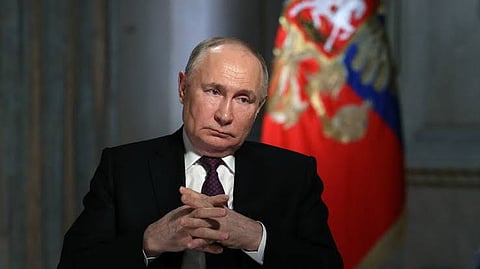
Russia intercepts 139 drones targeting Moscow ahead of Putin-Trump-Xi summit in China
Russia intercepted around 139 drones targeting Moscow overnight and into Monday morning, the city's mayor Sergey Sobyanin said, as Ukraine intensified its long-range strikes against Russian infrastructure ahead of a high-profile meeting between Russian President Vladimir Putin, US President Donald Trump and Chinese President Xi Jinping.
Sobyanin announced the interceptions in a series of posts on Telegram, saying Russian air defence systems had neutralised the drones approaching the capital. Emergency services were deployed to locations where debris from the intercepted drones had fallen.
"Emergency service specialists are working at the site where the debris fell," Sobyanin said in his latest update.
The reported drone attack comes amid an escalating exchange of strikes between Russia and Ukraine, with Kyiv stepping up attacks on strategic Russian facilities. Ukrainian forces recently targeted a major Russian petrochemical plant, an oil refinery and a military production facility as part of their campaign to strike sites deep inside Russian territory.
Putin, Trump and Xi to meet in Shenzhen on November 19
The drone interceptions come just days before an unprecedented trilateral meeting involving the leaders of Russia, the United States and China.
Beijing confirmed on Monday that Xi Jinping would host Putin and Trump in the southern Chinese city of Shenzhen on November 19, on the sidelines of the Asia-Pacific Economic Cooperation (APEC) summit scheduled for November 18 and 19.
The meeting will mark the first time the three leaders have held talks together in a trilateral format. The Kremlin and the White House had previously confirmed the proposed gathering.
However, China's foreign ministry did not disclose the agenda or provide further details about the discussions.
The meeting is expected to carry considerable diplomatic significance, although expectations of major breakthroughs remain limited. The three leaders are understood to have different priorities, with Washington seeking discussions on nuclear arms reduction and the conflict involving Iran.
US officials have indicated that the Ukraine war is unlikely to feature in the trilateral discussions, despite Moscow's ongoing military campaign against Kyiv.
Ukraine war unlikely to feature in discussions
Washington is pursuing a separate diplomatic process involving Ukraine and Russia to find a way to end the nearly five-year-old conflict. US officials have maintained that the trilateral meeting is not expected to become a platform for discussions on the war.
The exclusion of Ukraine has also emerged as a point of diplomatic sensitivity, particularly among European countries.
German President Frank-Walter Steinmeier recently said Xi had expressed "irritation" when the possibility of discussing the Ukraine conflict during the three-way meeting was raised.
Speaking to German broadcaster ARD, Steinmeier said the Chinese president had made it clear that the conflict was primarily a European matter and that European countries should have a place at the negotiating table.
"He explicitly pointed out that this is a European conflict, in which the Europeans must also be at the table," Steinmeier said.
China's position reflects its reluctance to have discussions about the Ukraine war take place in a format that excludes European governments, which have been directly affected by the conflict.
Zelensky warns against a new Yalta-style arrangement
The proposed meeting has also raised concerns in Kyiv about the possibility of major powers discussing the future of Ukraine without involving the country itself.
Ukrainian President Volodymyr Zelensky has warned that the Shenzhen gathering could resemble the 1945 Yalta Conference, where the leaders of the Allied powers discussed the post-Second World War order and the division of influence in Europe.
Zelensky fears that the three countries could attempt to negotiate a new arrangement over international spheres of influence without giving smaller nations a say in decisions affecting their sovereignty and territorial integrity.
The comparison has added to concerns surrounding the symbolism of the meeting, particularly as Russia continues its war against Ukraine.
Meanwhile, discussions on nuclear arms control could prove another significant aspect of the gathering. China has traditionally maintained that the United States and Russia, which possess substantially larger nuclear arsenals, should reduce their stockpiles before Beijing considers participating in similar negotiations.
With no detailed agenda announced by Beijing, it remains unclear whether the November 19 meeting will produce any concrete agreements or primarily serve as an opportunity for the three leaders to discuss broader international issues.


