.png)
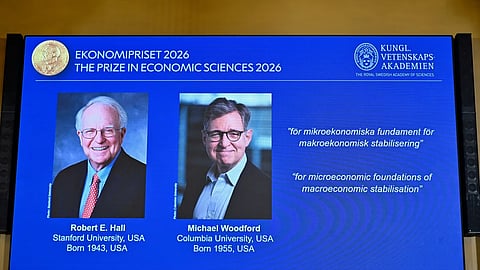
Robert Hall, Michael Woodford win Economics Nobel for work on managing economic crises
American economists Robert E Hall and Michael Woodford were awarded the 2026 Nobel Memorial Prize in Economic Sciences on Monday for pioneering research that reshaped how governments and central banks understand economic behaviour and respond to financial crises, inflation and other major shocks.
The Royal Swedish Academy of Sciences announced the award in Stockholm, recognising the economists' contributions to models that explain how households and businesses make decisions about spending, saving, investment and pricing based on expectations about the future.
Their research provided a theoretical foundation for modern economic stabilisation policies, helping policymakers understand why traditional approaches sometimes fail and how monetary and fiscal measures can be designed more effectively.
"The laureates' research has made it possible to manage major macroeconomic crises far more effectively than before," the Nobel committee said in a paper explaining their contributions.
"It has been hugely beneficial during the pandemic and the energy crises of recent years," it added.
Hall, 83, is affiliated with Stanford University in California, while Woodford, born in 1955, is associated with Columbia University in New York.
Speaking to the Nobel committee by telephone from New York, Woodford expressed surprise at receiving the honour.
"It's a tremendous honour. It's a surprise," he said.
𝗥𝗲𝘁𝗵𝗶𝗻𝗸𝗶𝗻𝗴 𝗲𝗰𝗼𝗻𝗼𝗺𝗶𝗰 𝗽𝗼𝗹𝗶𝗰𝘆
For decades, governments relied heavily on economic principles associated with British economist John Maynard Keynes, whose ideas gained prominence during the Great Depression.
The Keynesian approach advocated government intervention during economic downturns, including lower interest rates, tax reductions and increased public spending, to encourage consumption and investment.
However, the simultaneous rise of inflation and unemployment during the 1970s challenged the assumption that policymakers could reliably manage one by accepting changes in the other.
"This is the Keynesian recipe, and it worked well — until it didn't," said Timo Boppart of the Nobel economics committee.
The period of stagflation exposed limitations in conventional economic models and prompted economists to reconsider how individuals and businesses respond to government policies.
Hall and Woodford developed separate but complementary approaches that incorporated the expectations and decisions of households and firms into broader economic analysis.
"Economic outcomes are the result of millions of decisions made at the microlevel by households and businesses," the Nobel committee said.
Their work helped establish a framework in which economic outcomes are understood through the choices of individuals and businesses rather than solely through aggregate national indicators.
𝗛𝗮𝗹𝗹'𝘀 𝘄𝗼𝗿𝗸 𝗼𝗻 𝗰𝗼𝗻𝘀𝘂𝗺𝗲𝗿 𝗯𝗲𝗵𝗮𝘃𝗶𝗼𝘂𝗿
Hall's research focused on how consumers decide whether to spend or save, particularly in response to expectations about their future income.
He demonstrated that households generally make consumption decisions by considering not only their present financial circumstances but also their expectations of future earnings.
Consumers who anticipate higher incomes may spend more, while those expecting financial difficulties are more likely to restrain expenditure.
However, because expectations change as new economic information becomes available, Hall showed that future consumption patterns are extremely difficult to predict accurately.
His findings challenged the assumption that consumer spending could be forecast reliably using past economic trends.
Olivier Blanchard, who served as chief economist of the International Monetary Fund during the 2008 financial crisis, said the unpredictability of consumption posed difficulties for economic forecasting.
The finding "is not good news for forecasters, or policymakers," Blanchard said, adding that it must nevertheless be considered when assessing the effects of economic policies.
Hall also examined how financial constraints influence household spending.
In a 1982 paper co-authored with economist Fredric Mishkin, he found that approximately 80% of households made consumption decisions based on expectations about the future, while the remaining households largely depended on their current income.
The research highlighted how financially constrained families may be unable to borrow or draw upon savings when economic conditions deteriorate.
Ivan Werning, an economist at the Massachusetts Institute of Technology, said the prize recognised research that advanced macroeconomic understanding by examining the decisions of families and firms over time.
𝗪𝗼𝗼𝗱𝗳𝗼𝗿𝗱'𝘀 𝗿𝗲𝘀𝗲𝗮𝗿𝗰𝗵 𝗼𝗻 𝗺𝗼𝗻𝗲𝘁𝗮𝗿𝘆 𝗽𝗼𝗹𝗶𝗰𝘆
Woodford's work examined how businesses set prices and make investment decisions based on their expectations of future interest rates, production costs and competitors' pricing.
His research demonstrated that companies respond not only to current economic conditions but also to what they believe central banks and governments will do in the future.
A business expecting higher costs or rising prices among competitors may increase its own prices in anticipation, potentially contributing to broader inflationary pressures.
These findings helped establish the importance of clear and credible communication by central banks about their monetary policy intentions.
Central banks, including the US Federal Reserve, increasingly adopted forward guidance, communicating their likely policy direction to influence market expectations and economic behaviour.
However, Federal Reserve Chair Kevin Warsh has questioned whether central bank communication has become excessive and has sought to scale back some forms of forward guidance.
Woodford's research also offered insights into managing supply shocks, particularly sudden increases in energy prices that can simultaneously raise inflation and weaken economic growth.
His models suggested that monetary tightening, including higher interest rates, could sometimes be necessary to prevent inflation from becoming entrenched, even when an economy was experiencing pressure from rising production costs.
The Nobel committee said these insights had improved policymakers' ability to respond to supply disruptions compared with the approaches used during the oil crises of the 1970s.
During the announcement, Woodford said his research had emphasised understanding the behaviour of people participating in markets and making spending decisions.
𝗣𝗿𝗶𝘇𝗲 𝘄𝗼𝗿𝘁𝗵 𝟭𝟮 𝗺𝗶𝗹𝗹𝗶𝗼𝗻 𝗸𝗿𝗼𝗻𝗼𝗿
The economics award, formally known as the Sveriges Riksbank Prize in Economic Sciences in Memory of Alfred Nobel, was established by Sweden's central bank in 1968 and first presented in 1969.
Unlike the five original Nobel Prizes, the economics award was not included in Alfred Nobel's will. However, it is presented alongside the other prizes on December 10, the anniversary of Nobel's death in 1896.
This year's prize carries an award of 12 million Swedish kronor, approximately USD 1.2 million, to be shared equally by Hall and Woodford.
The economics prize was the final Nobel announcement of 2026, following last week's awards in medicine, physics, chemistry, literature and peace.
Hall's recognition also marked the second Nobel award involving a Stanford University professor this year. Karl Deisseroth shared the medicine prize with Peter Hegemann and Georg Nagel for research that helped develop light-based techniques to study brain activity.
The Academy said the work of Hall and Woodford had established the foundations for economic models now used by governments and central banks worldwide, improving their ability to manage recessions, inflation and other disruptions.
Their contributions, it said, demonstrated how understanding the decisions of individual households and businesses could help policymakers manage the wider economy more effectively.


