.png)
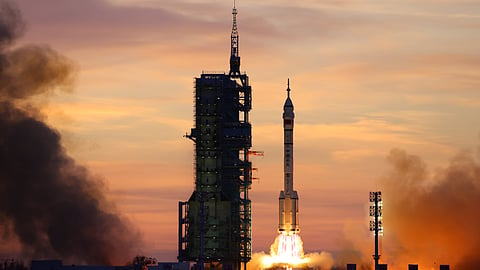
Pakistan's first astronaut reaches orbit aboard China's Shenzhou-24 mission
Pakistan has entered a new chapter in its space programme after astronaut Muhammad Zeeshan Ali travelled into orbit aboard China's Shenzhou-24 spacecraft on Wednesday, becoming the country's first citizen to undertake an orbital space mission.
The spacecraft, carrying Ali and two Chinese astronauts, lifted off from the Jiuquan Satellite Launch Centre in the Gobi Desert at 5.48 am IST, atop a Long March-2F rocket. It entered its planned orbit successfully, with Chinese officials declaring the launch a complete success.
The mission is a landmark for Pakistan and a significant development in China's efforts to expand international participation in its human spaceflight programme. Ali is also set to become the first foreign astronaut to visit China's Tiangong space station.
A week in orbit, conducting scientific experiments
Ali, a 40-year-old former Pakistan Air Force pilot, is travelling as a payload specialist alongside Chinese astronauts Tang Hongbo and Wu Yi.
He is expected to spend approximately a week aboard Tiangong, where he will participate in scientific experiments and routine station activities. The mission is expected to involve around 90 experiments and technology tests.
Among the planned research activities are experiments in biotechnology and materials science, including work involving photosynthetic cyanobacteria. The findings could contribute to a better understanding of how biological systems and materials behave in microgravity.
The crew will also undertake routine operations and maintenance of the space station, along with scientific research and technology demonstrations.
Ali is expected to return to Earth aboard the Shenzhou-23 spacecraft, which had docked with Tiangong earlier this year.
From suborbital tourism to an orbital mission
Pakistan's latest achievement marks a major step beyond its previous participation in space tourism.
In 2023, Pakistani entrepreneur and adventurer Namira Salim became the first Pakistani to travel to space aboard a Virgin Galactic suborbital flight. The journey took her briefly beyond the recognised boundary of space before she returned to Earth.
Ali's mission is fundamentally different. Rather than making a brief suborbital trip, he is travelling to an orbiting space station hundreds of kilometres above Earth, where he will live and work alongside professional astronauts.
The distinction places Pakistan among countries whose citizens have participated in orbital human spaceflight, although the country has not independently developed the infrastructure required to send astronauts into space.
Years of selection and training
The mission followed an extensive selection and preparation process.
Around 200 candidates reportedly applied for Pakistan's astronaut programme before the field was narrowed to two finalists, Muhammad Zeeshan Ali and Khurram Daud, both associated with the country's military.
The two candidates were selected in April 2026 to begin training in China. They underwent intensive preparation covering spacecraft systems, space station operations, emergency procedures, survival techniques, scientific experiment protocols and physical conditioning.
Ali also completed extensive Chinese-language training to prepare for communication and operational coordination with his Chinese crewmates.
He was confirmed as the astronaut selected for the mission shortly before the launch.
China opens Tiangong to international astronauts
The flight is also a milestone for Beijing.
China completed the basic configuration of its Tiangong space station in 2022, establishing an independent orbital laboratory after the country was excluded from participation in the International Space Station programme.
Since then, Tiangong has hosted long-duration astronaut missions, scientific research and technology demonstrations. Beijing has repeatedly presented the station as a platform for international cooperation.
The inclusion of a Pakistani astronaut is the first practical demonstration of that ambition through a crewed mission. It reflects China's growing confidence in its human spaceflight programme and its intention to make Tiangong an alternative destination for international research in low Earth orbit.
With the International Space Station expected to approach the end of its operational life in the coming years, China is seeking to strengthen Tiangong's role in global space research and cooperation.
A new phase in China-Pakistan space partnership
The mission represents the most visible expression yet of the expanding space cooperation between China and Pakistan.
The two countries have worked together on satellite technology, communications, Earth observation and remote sensing. Their human-spaceflight collaboration has now taken the partnership into a new domain.
The joint mission follows a bilateral space cooperation agreement signed in February 2025 and comes as Pakistan and China mark 75 years of diplomatic relations.
For Pakistan, the flight is being seen as a demonstration of national ambition and a source of inspiration for students and researchers. Images of a Pakistani astronaut conducting experiments aboard an orbital station are expected to draw public attention to science, technology and space exploration.
For China, the mission strengthens its position as a partner capable of enabling other countries to participate in human spaceflight without having to develop every element of the required infrastructure independently.
A milestone in South Asian space history
Ali's journey also invites comparison with India's first human spaceflight.
In April 1984, Indian Air Force Wing Commander Rakesh Sharma travelled aboard the Soviet Soyuz T-11 spacecraft and spent eight days at the Salyut 7 space station. His mission became a defining moment in India's scientific history.
Pakistan's orbital mission comes more than four decades later, in a vastly changed international space environment. Today, partnerships and shared missions allow countries to participate in human spaceflight through cooperation with established space powers.
The successful launch of Shenzhou-24 has therefore secured a place for Pakistan in the history of orbital human spaceflight.
As Ali begins his work aboard Tiangong, the mission marks more than a symbolic achievement. It opens a new chapter in Pakistan's space ambitions and strengthens China's bid to make its space station a centre for international collaboration.
For both countries, the journey represents a step towards a future in which cooperation in space extends from Earth orbit to possible missions to the Moon and beyond.


