.png)
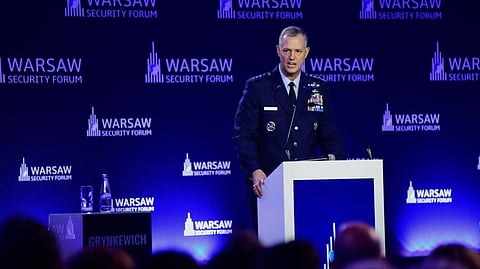
NATO ready to fight tonight if attacked, top commander warns Russia
NATO's top military commander declared on Monday that the alliance was "ready to fight tonight" if attacked, warning that its combined military forces would block any initial assault, prevent an enemy advance and, if necessary, destroy the forces supporting an offensive.
Speaking at the Warsaw Security Forum, NATO Supreme Allied Commander US General Alexus Grynkewich outlined what he described as the alliance's "Theory of Victory" amid mounting concerns in Europe over suspected Russian sabotage operations, drone incursions and the possibility of a limited military confrontation.
His remarks came as European intelligence agencies warned that Moscow could attempt to test NATO's collective defence commitments through covert operations or a limited incursion designed to expose divisions among member states.
However, Grynkewich stressed that he did not consider a conflict either imminent or inevitable, arguing that military preparedness and continued diplomatic communication remained essential to preventing war.
𝗡𝗔𝗧𝗢 𝗼𝘂𝘁𝗹𝗶𝗻𝗲𝘀 𝗱𝗲𝗳𝗲𝗻𝗰𝗲 𝘀𝘁𝗿𝗮𝘁𝗲𝗴𝘆
"My theory of victory is simple," Grynkewich told the conference.
"We will block the initial attack. If the attack persists, we will blunt it and prevent any enemy advance. And if required, we will break the enemy's forces and the operational war-fighting system arrayed against us."
The NATO commander said the alliance would deploy its combined land, sea and air capabilities to prevent an adversary from seizing or holding territory belonging to a member state.
He indicated that any military response would extend beyond attacking forces to include the logistical, operational and command systems sustaining an offensive.
The strategy would rely on an integrated network of sensors, autonomous systems and conventional military capabilities to detect threats and respond rapidly.
Grynkewich did not specify the location, nature or scale of a potential Russian attack for which NATO was preparing.
He maintained that the alliance did not seek confrontation but would be capable of recognising an approaching military threat and responding before an adversary could achieve its objectives.
𝗘𝘂𝗿𝗼𝗽𝗲 𝗳𝗮𝗰𝗲𝘀 𝗿𝗶𝘀𝗶𝗻𝗴 𝘀𝗮𝗯𝗼𝘁𝗮𝗴𝗲 𝗳𝗲𝗮𝗿𝘀
The warning followed a series of suspected sabotage operations across Europe that Western officials have attributed to Russia.
In September, German authorities accused Moscow of involvement in an alleged plot to attack a Ukrainian aircraft at Leipzig airport using an explosives-laden drone.
British officials also reported thwarting a suspected Russian operation targeting a drone facility outside London, while Estonian authorities blamed Moscow for a fire at a defence company.
The incidents form part of a broader pattern of suspected covert activity since Russia launched its full-scale invasion of Ukraine in February 2022.
According to an Associated Press tally, Western officials have attributed at least 211 incidents to Russia during that period.
The allegations encompass suspected sabotage and other hostile operations intended to disrupt European infrastructure, defence capabilities and support for Ukraine.
Russia's involvement in individual incidents has been alleged by Western governments and security agencies, and the circumstances of the cases vary.
𝗜𝗻𝘁𝗲𝗹𝗹𝗶𝗴𝗲𝗻𝗰𝗲 𝗮𝗴𝗲𝗻𝗰𝗶𝗲𝘀 𝘄𝗮𝗿𝗻 𝗼𝗳 𝗶𝗻𝗰𝘂𝗿𝘀𝗶𝗼𝗻𝘀
Denmark's Defence Intelligence Service has assessed that there is a "low but growing risk" of Russia launching a limited military attack against one or more NATO countries bordering Russian territory.
The agency warned that Moscow could use covert operations, limited strikes or deliberately ambiguous incidents to test whether NATO members would respond collectively.
Its assessment suggested that Russia might attempt to acquire Ukrainian drones and use them in attacks against European targets to conceal its involvement.
Polish Prime Minister Donald Tusk has also warned that Russia could escalate its activities through drone or rocket strikes against European countries supporting Ukraine.
Tusk suggested that Moscow might portray such incidents as accidental in an attempt to weaken the willingness of NATO countries to come to the defence of an ally.
The Danish intelligence assessment indicated that the purpose of such operations could be to divert European resources away from Ukraine and create divisions within the alliance.
However, Danish intelligence officials also acknowledged that Russia's continuing military involvement in Ukraine would make a large-scale attack on NATO difficult.
𝗗𝗿𝗼𝗻𝗲 𝗱𝗲𝗳𝗲𝗻𝗰𝗲𝘀 𝘂𝗻𝗱𝗲𝗿 𝘀𝗰𝗿𝘂𝘁𝗶𝗻𝘆
Despite Grynkewich's assurance of NATO's readiness, some alliance members have encountered difficulties in military exercises designed to simulate drone warfare.
Several countries have also faced challenges detecting and responding to drones entering their airspace.
Multiple attack drones have crashed in NATO countries bordering Russia, Ukraine and Belarus, raising concerns about the ability of existing air defence systems to counter relatively small and inexpensive unmanned aircraft.
In May, residents of the Lithuanian capital, Vilnius, were instructed to seek shelter after a drone entered the country's airspace.
NATO spokesperson Colonel Martin O'Donnell said member states were increasingly deploying ground-based sensors and other technologies to improve their ability to detect and counter drone threats.
He acknowledged that the network connecting detection systems with weapons capable of intercepting drones was still being established.
According to O'Donnell, the integrated system had not yet intercepted any drones.
The development of more effective counter-drone capabilities has become an important priority for European defence planners as the war in Ukraine continues to demonstrate the growing role of unmanned systems in modern warfare.
𝗨𝗦 𝗰𝗼𝗺𝗺𝗶𝘁𝗺𝗲𝗻𝘁 𝗿𝗲𝗮𝗳𝗳𝗶𝗿𝗺𝗲𝗱
The warnings have emerged amid questions over the United States' military commitments to Europe under President Donald Trump.
Earlier this year, Trump announced plans to withdraw American troops from Europe, while the US-led war involving Iran has contributed to shortages of advanced air defence missiles available to European allies.
The US president's agreement to purchase Russian diesel in an effort to reduce domestic fuel prices ahead of the midterm elections has also unsettled European governments seeking to maintain pressure on Moscow.
Grynkewich acknowledged that decisions about troop deployments ultimately rested with political leaders but insisted that the United States remained committed to NATO.
"No one should question the US commitment to the alliance," he said.
The general emphasised that NATO members needed to coordinate a coherent response to suspected Russian operations and communicate clearly to Moscow the limits of acceptable behaviour.
He argued that one of the most effective responses to increased Russian sabotage and other hostile activity would be to strengthen support for Ukraine.
𝗣𝗿𝗲𝗽𝗮𝗿𝗲𝗱𝗻𝗲𝘀𝘀 𝘁𝗼 𝗽𝗿𝗲𝘃𝗲𝗻𝘁 𝘄𝗮𝗿
Although Grynkewich outlined a forceful military response to any attack, he repeatedly stressed that NATO's objective remained deterrence rather than confrontation.
He said maintaining open channels of communication was necessary to prevent misunderstandings from escalating into military conflict.
The commander maintained that NATO would be unlikely to be caught by surprise if Russia attempted a direct military assault.
His remarks reflected the alliance's effort to demonstrate military readiness while avoiding an escalation of tensions with Moscow.
European intelligence assessments suggest that Russia's more immediate threat may lie in sabotage, cyber operations and limited provocations rather than a full-scale military offensive against NATO territory.
For the alliance, the challenge is to strengthen its ability to respond to such incidents without allowing ambiguity over responsibility or disagreements among member states to undermine collective defence.
Grynkewich's central message was that credible military preparedness, coordinated political responses and sustained support for Ukraine remained essential to deterring aggression and preserving peace in Europe.


