.png)
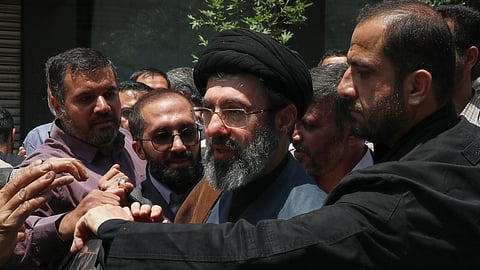
Mojtaba Khamenei praises Iran forces, says 'enemies pushed away from Strait of Hormuz'
Iran’s Supreme Leader Ayatollah Mojtaba Khamenei on Monday praised the country’s fighters for what he described as preventing “enemy forces” from “roaming freely” in the Strait of Hormuz, claiming hostile forces had been pushed farther away from the strategically vital waterway.
In a message carried by Iranian state media, Khamenei said Iran’s adversaries could no longer approach the strait as freely as before and claimed they now remained no closer than the Arabian Sea. He went further, declaring that the Arabian Sea would “soon” also be rid of them, in remarks that underscored Tehran’s defiant posture amid continuing military and diplomatic tensions with the United States.
Message marks Nasrallah anniversary
Khamenei’s statement was issued to mark the second anniversary of the killing of longtime Hezbollah leader Hassan Nasrallah. Nasrallah was killed in an Israeli air strike in Beirut on September 27, 2024, after leading the Iran-backed Lebanese group for more than three decades.
The Iranian leader praised Nasrallah and sought to portray developments over the past two years as evidence that Tehran and its allies had resisted attempts by their adversaries to reshape the regional balance of power.
Khamenei said the period when Iran’s enemies could operate freely in the region would not return. His remarks reflected Tehran’s broader narrative that military pressure had failed to force Iran into submission despite the heavy losses suffered by its leadership and armed forces since the conflict began earlier this year.
Hormuz remains flashpoint
The comments come with the Strait of Hormuz remaining at the centre of the confrontation between Iran and the United States. The narrow waterway connecting the Persian Gulf with the Gulf of Oman is one of the world’s most important energy transit routes and has experienced a dramatic decline in commercial shipping since the war began on February 28.
Before the conflict, around 125 large commercial vessels crossed the strait each day, carrying oil, liquefied natural gas and other cargo. Recent shipping data has shown traffic falling to only a fraction of normal levels, while attacks on commercial vessels have further heightened concerns over maritime security.
The disruption has had implications well beyond the region because roughly a fifth of the world’s daily crude oil and LNG supplies normally passes through the waterway.
Diplomatic opening falters
Khamenei’s warning also comes as attempts to find a diplomatic formula for ending the confrontation remain uncertain. Tehran recently indicated that it could reopen the Strait of Hormuz within seven days if Washington eased military pressure and lifted its blockade on Iranian ports.
Iranian officials have argued that the United States must demonstrate that it genuinely intends to pursue a diplomatic settlement before negotiations can advance. Tehran has said a proposal for ending hostilities was passed to Washington through mediators earlier this month.
Foreign Minister Abbas Araghchi, however, said on Monday that Iran remained fully prepared if fighting with the United States resumed, after Washington rejected Tehran’s proposed seven-day roadmap for reopening the strait. US President Donald Trump has meanwhile indicated that further talks could take place, leaving diplomacy and renewed military confrontation as competing possibilities.
Leader remains out of sight
Khamenei’s latest intervention is also notable because he has remained absent from public view since becoming supreme leader following the death of his father, Ayatollah Ali Khamenei. The elder Khamenei was killed in the opening US-Israeli attacks on Iran on February 28, ending his more than three-decade tenure as the country’s supreme leader.
Mojtaba Khamenei was injured in the same attack and was subsequently selected to succeed his father in March. He has not made an in-person public appearance since then, with Iranian authorities attributing his absence largely to continuing security threats.
His prolonged absence has attracted considerable attention inside and outside Iran, particularly after he did not attend the public funeral ceremonies for his father and other family members killed in the February attack. Iranian officials have nevertheless continued to release written messages and statements attributed to him, while President Masoud Pezeshkian was reported by Iranian state media to have met him in August.
Iran maintains defiant posture
Monday’s message signals that Khamenei is seeking to project continuity in Iran’s regional and military posture despite the leadership upheaval caused by the war. His remarks also directly linked Iran’s ability to contest access to the Strait of Hormuz with the broader confrontation involving the United States and its regional partners.
The immediate focus remains on whether diplomatic efforts can produce an agreement capable of restoring normal navigation through Hormuz. With shipping traffic severely disrupted and Tehran and Washington continuing to exchange warnings, the strait remains both an economic pressure point and one of the most dangerous potential theatres for another escalation in the conflict.


