.png)
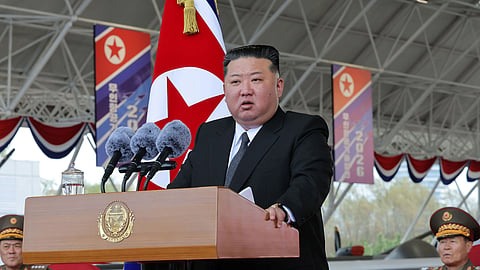
Kim Jong Un personally receives 10 foreign ambassadors in first such move in over 30 years
North Korean leader Kim Jong Un has personally received diplomatic credentials from 10 newly appointed foreign ambassadors, marking the first time in more than three decades that the country's top leader has directly performed the diplomatic protocol.
The ceremony took place on Sunday, November 22, at the headquarters of the Central Committee of the ruling Workers' Party of Korea in Pyongyang. The rare engagement was attended by ambassadors from Russia, Sweden, Indonesia, Vietnam, Brazil, the Czech Republic, India, the Philippines, Thailand and Bangladesh.
According to North Korean state media, Kim met the envoys individually, accepted their credentials and posed for commemorative photographs with them. Foreign Minister Choe Son Hui was also present at the ceremony.
The development marks an unusual moment in North Korea's diplomatic activities, particularly given that the responsibility for receiving credentials from foreign ambassadors had traditionally been handled by a senior state official rather than the country's leader.
A departure from decades-old diplomatic protocol
Kim's decision to personally receive the credentials follows a constitutional amendment adopted in March this year, which transferred the authority to accept credentials from foreign diplomatic representatives to the head of state, a position held by Kim as chairman of the State Affairs Commission.
Under the previous arrangement, the chairman of the Standing Committee of the Supreme People's Assembly performed the responsibility. North Korea's founding leader Kim Il Sung had personally received credentials from foreign ambassadors, but the practice changed during the rule of his successor, Kim Jong Il.
The latest ceremony therefore represents the first time in more than 30 years that a North Korean leader has directly carried out the procedure. It also marks Kim's first formal reception of foreign ambassadors' credentials under the revised constitutional framework.
The move has drawn attention to Kim's role in the country's diplomatic engagements and is being viewed by observers as an effort to reinforce his position as head of state, both domestically and internationally.
Kim outlines North Korea's foreign policy position
Following the presentation of credentials, Kim addressed the ambassadors and outlined Pyongyang's position on international relations, sovereignty and national security.
He described the international environment as increasingly unstable and unpredictable, citing global security concerns and political and economic uncertainty. Kim argued that developments in East Asia's political and military environment required North Korea to strengthen its capabilities to safeguard its security and maintain peace.
He also defended the country's military build-up as a matter of national sovereignty and security, while insisting that Pyongyang did not seek regional dominance or territorial expansion.
North Korea, he said, was prepared to develop relations with countries that respected its sovereignty and were willing to maintain friendly ties. Kim also reiterated the principles of independence, peace and friendship as the basis for the country's foreign policy.
The reception of ambassadors from 10 countries, including traditional partners such as Russia and Vietnam, as well as India, Brazil and several European and South-east Asian nations, has also drawn attention to the range of diplomatic relationships represented at the event.
The engagement comes at a time when Pyongyang's international relations and its ties with major powers remain under close scrutiny. By personally receiving the ambassadors, Kim has taken a more direct role in a formal diplomatic process that had largely been handled by another senior state official for decades.


