.png)
Iran mocks Saudi defence pact with Türkiye, Pakistan; calls it a ‘paper agreement’
Iran has sharply criticised Saudi Arabia’s newly signed joint defence agreement with Türkiye and Pakistan, with a senior Iranian lawmaker warning Riyadh that relying on external military partnerships would not guarantee its security.
Ebrahim Rezaei, a member of Iran’s Parliament and its National Security and Foreign Policy Commission, said Saudi Arabia should reconsider its regional policies instead of depending on other countries for protection.
His remarks came after Saudi Arabia, Türkiye and Pakistan signed the Mecca Joint Defence Agreement on Friday, under which an armed attack on any one of the three countries would be treated as an attack on all three.
Iran questions Saudi strategy
Rezaei described the newly announced arrangement as a “paper agreement” and questioned whether it would actually provide Riyadh with greater security.
He argued that Saudi Arabia's longstanding security relationship with the United States had failed to protect the kingdom and suggested that a new arrangement with Ankara and Islamabad would fare no better.
“Saudis must know that a paper agreement with Turkiye and Pakistan will not bring them security,” Rezaei said in a post on X. He urged Riyadh to change its policies rather than seek security guarantees from other countries.
Three nations sign defence pact
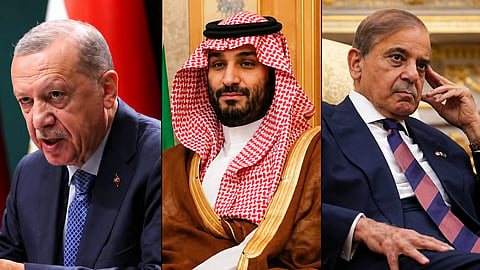
The agreement was signed in Mecca by Saudi Crown Prince Mohammed bin Salman, Turkish President Recep Tayyip Erdogan and Pakistani Prime Minister Shehbaz Sharif.
At the heart of the pact is a collective-defence commitment under which an armed attack against one member would be considered an attack against all three.
Saudi Arabia has maintained that the agreement is defensive and is not intended to create a new military or religious bloc. The three countries are expected to deepen military coordination as well as cooperation in defence technology and production.
Deal comes amid tensions
The timing of the agreement is significant as Saudi Arabia faces growing security threats linked to the wider conflict involving Iran.
A senior Saudi official said Riyadh had received intelligence indicating the possibility of coordinated attacks by Iran-aligned groups from Iraq in the north and Yemen in the south.
Saudi authorities believe civilian and economic infrastructure, including energy installations, ports and airports, could potentially be targeted.
The kingdom has already faced attacks from Yemen's Houthis, while tensions involving Iranian-backed groups in Iraq have further complicated the regional security environment.
Pakistan already tied to Riyadh
The latest trilateral arrangement builds on an existing defence partnership between Saudi Arabia and Pakistan.
Riyadh and Islamabad signed their Strategic Mutual Defence Agreement in September 2025, declaring that aggression against either country would be treated as aggression against both.
Pakistan has since indicated that the agreement is operational. Earlier this year, Islamabad warned Tehran against attacks on Saudi territory as the Iran conflict spread across the region.
Last month, a Pakistani official also told Reuters that Islamabad had conveyed to Iran that attacks by the Houthis against Saudi Arabia represented a “red line” for Pakistan.
Türkiye adds military weight
Türkiye's entry significantly broadens the arrangement because Ankara possesses one of the region's largest armed forces and a rapidly expanding domestic defence industry.
Türkiye is also a member of NATO, while Pakistan is a nuclear-armed state with longstanding military ties to Saudi Arabia.
The combination potentially gives Riyadh access to Pakistani military experience and Turkish defence technology while Saudi financial resources could support joint projects and procurement.
However, the agreement's practical military mechanisms and the circumstances under which the collective-defence provision would be activated remain crucial questions.
Iran sends political warning
Tehran's criticism suggests that the pact is already being viewed through the prism of the region's shifting balance of power.
Iran has simultaneously warned Gulf countries against facilitating attacks on Iranian territory. Recent tensions have raised fears that confrontation involving Iran and the United States could spill into neighbouring states and threaten critical energy infrastructure.
Rezaei's comments therefore amount to more than criticism of the agreement itself. They reflect Tehran's concern that increasingly formalised security cooperation between Saudi Arabia, Pakistan and Türkiye could alter the strategic environment surrounding Iran.
For Riyadh, however, the agreement represents an effort to diversify its security partnerships at a time when threats from multiple directions have intensified.
Whether the Mecca pact develops into a functioning collective-defence framework or remains primarily a political declaration will depend on how its members respond when one of them faces an actual security crisis.


