.png)
India 'indispensable' for peace in Indo-Pacific: Trump administration

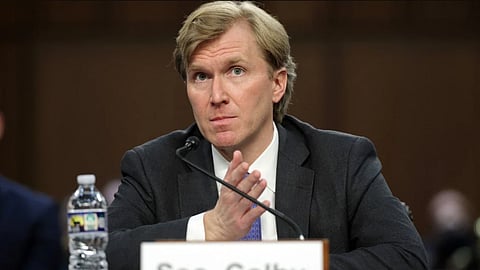
India's role is indispensable for peace and stability in the Indo-Pacific as well as to ensure a "favourable" balance of power in Asia, a senior Trump administration official said on Tuesday, laying out a broader vision for deeper defence ties between the two sides in the face of "tectonic" shift in geopolitics. Elbridge Colby, the US Under Secretary of War for Policy, in an address at the Ananta Centre listed four key points highlighting the significance of the India-US strategic engagement, asserting that "no single power" should dominate the Indo-Pacific, remarks seen as an oblique reference to China. "The United States believes that India will play a central role in ensuring a favourable balance of power in the Indo-Pacific. In this context, a strong, confident India is not only good for the Indian people. It is good for Americans as well," he said.
Colby's two-day visit to New Delhi assumes significance as it comes amid the escalating crisis in West Asia as well as mounting concerns over China's increasing military muscle-flexing in the Indo-Pacific. "First, the United States and India do not need to agree on everything to cooperate effectively. What matters is that our interests and objectives increasingly converge on the most fundamental issues," he said. "Differences and even disputes are fully compatible with deepening alignment and cooperation on strategic matters. The roots of our partnership are deeper than optics and more durable than superficial comity; they are, rather, thickly embedded in lasting strategic mutual self-interest," he said. "Both of our countries benefit from an Indo-Pacific in which no power can dominate the region. Both benefit from open trade and national autonomy. "These are the concrete, shared interests that form the foundation of our enduring strategic partnership," he argued.
Explaining his second point, Colby said both India and the US recognise the strategic centrality of military power for a stable balance in the region, and thus the defence cooperation should enhance "real capability rather than be merely totemic or driven by inertia". "In this light, one of the most encouraging developments in recent years has been the steady expansion of defence cooperation between the United States and India". Colby quoted US Defence Secretary Pete Hegseth to assert that the defence ties between the two sides have never been stronger, adding that defence industrial and technology collaboration is gaining "new momentum".
In this context, he also referred to the sealing of the 'Major Defence Partnership' framework that was firmed up in October last. "Our goals should be practical: to ensure that our forces can operate effectively together when our interests align, and in any case to see that India possesses the capabilities necessary to defend its sovereignty and contribute to a favourable regional balance of power," he said. Colby said the US is committed to working with India to hasten and "augment cooperation in areas including but not limited to long-range precision fires, resilient logistics, maritime domain awareness, anti-submarine warfare, and advanced technologies."
In his third point, the US under secretary emphasised the importance of potential co-production and co-development of military hardware. At the same time, he listed "regulatory barriers, bureaucratic inertia, and differences in procurement systems" as the real challenges. "But they are not insurmountable and we should overcome them," he added.
Colvy said even as the US is seeking to expand American military sales to India, it also recognises New Delhi's ambition to expand its indigenous defence industry. "A strong domestic industrial base enhances sovereignty and resilience. The United States supports that objective. And India is well on its way," he said. "India already boasts an impressive defence industrial base and India's leadership in cutting-edge technologies only further helps broaden our defence cooperation."
Colby, in his fourth point, noted that the US and India will not agree on every issue, but at the same time argued that any disagreement need not pose any hindrance to the cooperation. "Strong partnerships benefit from honesty, respect, and strategic clarity. The truth is that the United States and India will not agree on every issue." "Indeed, in precisely that spirit, we can say without embarrassment that India and America have not always been partners or even friendly. Our histories and strategic cultures are different, and our interests will of course at times diverge," he said.

