.png)
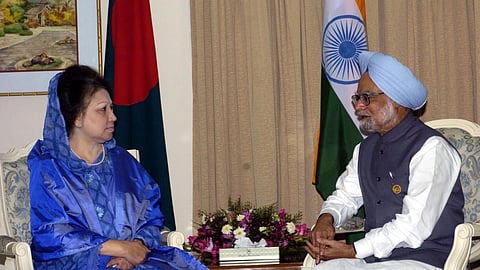
Ex-PM Manmohan Singh, Khaleda Zia among those included in Bangladesh parliament's condolence motion

Bangladesh parliament on Thursday condoled the deaths of several national and international leaders, including former Indian prime minister Manmohan Singh, Bangladesh's Khaleda Zia and slain Iranian leader Ayatollah Ali Khamenei. The maiden session of the 13th parliament adopted a motion to condole the deaths initially included 31 names, including late Pope Francis and Matia Chowdhury, a former parliamentarian and leader of deposed premier Sheikh Hasina’s Awami League. However, after the main opposition Jamaat-e-Islami insisted, names of executed 1971 war criminals, tried as hardened collaborators of Pakistani troops during the country’s Liberation War, were also included in it. The motion also included names of those killed during the July-August mass protests that toppled the Sheikh Hasina government in August 2024. The newly elected speaker Hafiz Uddin Ahmed, a veteran 1971 freedom fighter, agreed to incorporate the names of the executed war criminals as Jamaat claimed the initial list of names were “one sided.”
The motion with proposed expanded list included Jamaat’s hanged former chief Matiur Rahman Nizami, its senior leaders Ali Ahsan Mohammad Mujahid, Delwar Hossain Sayeedi, Maulana Abdus Subhan, Abdul Quader Mollah, Mir Quasem Ali, and Muhammad Kamaruzzaman. Sayeedi, however, died in prison while serving a prison term until his death while Subhan died a natural death. A separate condolence proposal was raised for hanged Bangladesh Nationalist Party (BNP) leader Salahuddin Qader Chowdhury, who too was tried for 1971 war crimes siding with Pakistani troops to prevent Bangladesh’s 1971 independence. BNP lawmaker and parliamentary Chief Whip Nurul Islam Moni endorsed the names. The first day of the parliament also saw a walkout and demonstration by the opposition over the president's address even when his speech was, in line with the practice, prepared by the government. The 13th parliament made its opening in an extraordinary manner by keeping the speaker’s chair vacant as the tradition demanded the outgoing speaker or in his/her absence deputy speaker would preside over the maiden session of the new Jatiya Sangsad. Outgoing speaker Shirmin Sharmin Choudhury had resigned and remains in an undisclosed location after dissolution of the last parliament by Muhaammad Yunus-led interim regime, which sent deputy speaker Shamsul Haque Tuku to jail.
Bangladesh constitution demands the president to address the opening sitting of the new parliament but as President Mohammad Shahabuddin approached the house to deliver his speech, Jamaat MPs created uproar and walked out of the House. Jamaat’s crucial ally National Citizen Party (NCP), on the other hand, staged demonstrations outside parliament, also targeting Shahabuddin. NCP is led by those who spearheaded the 2024 street protest toppling the Awami League government. Jamaat, on Wednesday, had expressed strong reservation against the president's address, calling Shahabuddin's inaugural speech “unacceptable” since he was an “accomplice of the autocrat”, as he was elected to the post by the Awami League-led parliament. “We think the President (Shahabuddin) does not have any right to address the parliament. He is an accomplice of the autocrat,” Jamaat’s nayeb-e-ameer or deputy chief Abdullah Mohammad Taher told another media briefing. The BNP won with a two-thirds majority in the February 12 general elections while Jamaat emerged as the main opposition, a position the far-right party gained for the first time since its founding in 1941.

