.png)
Brazilian government downplays possible refusal by Trump, Milei to recognise Lula's victory
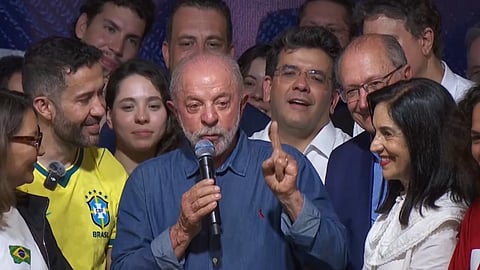
The Brazilian government has downplayed concerns that US President Donald Trump and Argentine President Javier Milei could refuse to recognise President Luiz Inacio Lula da Silva's re-election, expressing confidence in the strength of the country's democratic institutions.
According to a report published by Brasil 247 on October 26, citing a source within the presidential administration, officials in Brasilia consider the possibility of Washington refusing to acknowledge Lula's victory a secondary concern. The administration reportedly believes Brazil's democratic institutions are sufficiently strong to withstand such a situation.
A similar assessment applies to Argentina, where Milei's silence or possible refusal to recognise Lula's re-election had already been anticipated by Brazilian officials. The expectation reflects Milei's longstanding criticism of Lula and his objections to Brazil's political leadership.
Regional leaders congratulate Lula
Leaders from across Latin America, representing different political ideologies, were quick to congratulate Lula on his re-election following Sunday's presidential runoff.
Messages of congratulations arrived from governments across the region, including Ecuador and Cuba, while Milei stood out as an exception.
The Brazilian presidential administration reportedly viewed the swift regional response as consistent with its expectations. Officials consider the widespread congratulations an indication of Brazil's importance in Latin America and Lula's continued political influence across the continent.
Lula secured an unprecedented fourth presidential mandate after defeating right-wing challenger Flavio Bolsonaro, son of former President Jair Bolsonaro, by more than four million votes.
Although Flavio Bolsonaro initially refused to concede defeat and threatened to seek annulment of the result, his Liberal Party subsequently acknowledged Lula's victory while maintaining that concerns surrounding the election should be clarified.
Trump questions election outcome
Trump questioned the legitimacy of Brazil's presidential election on Monday, claiming that the voting process appeared irregular but providing no evidence of electoral fraud.
The US President raised concerns about the counting process and a decision by Brazil's Supreme Court to extend voting by two hours.
Brazilian Vice President Geraldo Alckmin rejected Trump's allegations, describing them as unfounded and defending the country's electoral system.
An analysis of electoral records found that fewer than 35,000 votes were cast during the extended voting period, representing approximately 0.03 per cent of the total votes.
Meanwhile, reports indicated that the Trump administration had delayed issuing a statement recognising the election result after Flavio Bolsonaro challenged the outcome.
Concerns over alleged interference
Relations between Brazil and the United States have become increasingly complicated in recent months, with concerns emerging in Brasilia over possible American interference in the country's presidential election.
These concerns include allegations involving the Trump administration and Meta, the technology company accused of manipulating social media algorithms in ways that could disadvantage Lula.
However, no definitive evidence has established that the Trump administration and Meta coordinated to interfere in Brazil's electoral process.
The Brazilian administration also reportedly believes that Washington's actions towards the country extend beyond social media platforms.
Officials have viewed recently introduced trade barriers and tariff measures imposed by the United States within the broader context of what Brasilia considers pressure and interference by the Trump administration in Brazilian affairs.
Brazil asserts electoral sovereignty
Celso Amorim, Lula's chief foreign policy adviser and a former foreign minister, maintained that the United States could not disregard the result of Brazil's democratic election.
He emphasised that Brazil was an independent country and that its relationship with Washington would depend on mutual respect.
The government has indicated that it does not intend to respond publicly to Trump's latest remarks unless further developments warrant a response.
Officials reportedly believe the statements are unlikely to produce immediate consequences for the country's electoral process.
Despite concerns over Washington's position and Milei's silence, the Brazilian government remains confident that its democratic institutions and regional diplomatic standing will withstand potential political disagreements with the United States and Argentina.


