.png)
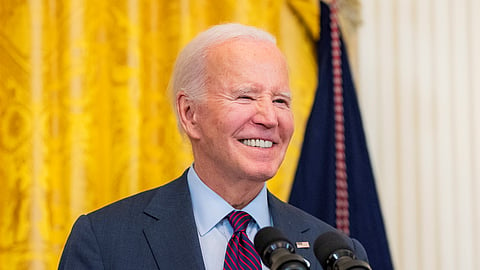
Biden’s memoir backs India as key US partner to counter China, champions IMEC
Former US president Joe Biden has described India as a crucial partner in Washington’s efforts to counter China’s growing influence, reaffirming his support for closer strategic ties between the two countries and initiatives such as the India-Middle East-Europe Economic Corridor (IMEC).
In his recently released memoir, Promise Me, America, Biden reflected on the evolution of the US-India relationship, which he said had strengthened significantly over the decades. He recalled his role in advancing the civil nuclear agreement between the two countries in 2006, during his time in the Senate, and said he had sought to take the partnership further during his presidency.
“A favourable dividend was a rapidly improving relationship with India. I had paid close attention to this relationship for decades, going back to my Senate days, and I was proud to shepherd a US-India nuclear agreement through the Senate in 2006. That had lifted the relationship to a higher level, and I fully intended to lift it some more,” Biden wrote.
While acknowledging Washington’s relationship with Pakistan, the former president argued that there were clear strategic reasons for building a stronger partnership with New Delhi.
He also credited the Immigration and Nationality Act of 1965 with helping expand Indian immigration to the United States, contributing to closer links between the two countries over time.
India among partners in Biden’s vision for the Pacific
Biden placed India within a broader coalition of countries he believes can help maintain stability in the Indo-Pacific and manage the rise of China.
In the memoir, he argued that the United States should build on the collective economic and strategic strengths of its allies and partners, including India, the European Union, Australia, Canada, Japan, South Korea, Mexico and New Zealand.
Together, he said, these countries had a combined economy of around $60 trillion, compared with China’s economy of approximately $19 trillion.
“But we have strengths, too, and just as importantly, we have our allies and partners,” Biden wrote, calling for greater military interoperability, shared commitment to democratic values and the development of a durable “Pacific community”.
He said such a grouping could be as enduring as the Atlantic community, which played a major role in preserving freedom during the second half of the 20th century.
The former president’s remarks reflect his broader approach to foreign policy, which placed renewed emphasis on alliances and partnerships as a counterweight to China’s expanding influence.
Biden backs IMEC as a strategic trade corridor
Biden also devoted considerable attention to IMEC, a proposed trade and transport corridor unveiled during the G20 summit in New Delhi in September 2023.
The initiative envisages a network of shipping and railway links connecting India with the Arabian Peninsula, the Middle East and southern Europe. Under the proposed route, goods would move from Mumbai through the Gulf region and towards the Israeli port of Haifa, before being transported by sea to ports in southern Europe.
Biden described the project as straightforward in concept but significant in its potential geopolitical and economic impact.
“It was brilliant in its simplicity,” he wrote, explaining how the corridor could combine maritime and rail transport to create a more efficient trade route between India and Europe.
He argued that IMEC would not only strengthen the ability of participating countries to compete with China, but could also bring India, Saudi Arabia, other Gulf states, Jordan, the West Bank and Israel into a shared economic network.
Biden said the project could help reduce regional divisions by creating economic interdependence, invoking the adage: “When goods don’t cross borders, soldiers will.”
However, IMEC has faced substantial delays following the October 7, 2023, Hamas attack on Israel and the subsequent conflicts in West Asia, which disrupted regional cooperation and raised security concerns along the proposed route.
Biden defends decision to withdraw US troops from Afghanistan
The memoir also contains a detailed defence of Biden’s decision to withdraw American troops from Afghanistan in August 2021, a move that drew widespread criticism after the Taliban returned to power and thousands of Afghans were left desperate to escape the country.
Biden maintained that ending the 20-year war was the right decision and said he would make the same choice again.
“I believe I made the right decision. I believed we could leave Afghanistan, redeploy our assets to meet the new threats of today, and still retain what is called an ‘over-the-horizon’ capability to enter Afghanistan at any time from outside the country to neutralise a terror threat if one arose,” he wrote.
He argued that the withdrawal allowed the United States to redirect its military resources towards emerging threats while retaining the ability to conduct counter-terrorism operations from outside Afghanistan.
“Ending the war in Afghanistan was the right thing to do,” Biden said.
The withdrawal, however, remains one of the most controversial episodes of his presidency. The evacuation from Kabul was marked by scenes of chaos, with thousands of Afghans attempting to flee as the Taliban took control and American forces completed their departure.
In Promise Me, America, Biden stands by the decision, presenting it as a necessary step to end a prolonged conflict and refocus US foreign policy on the challenges of the present.


