.png)
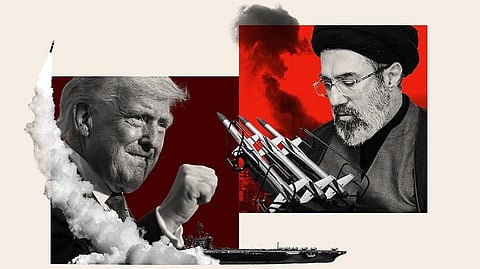
Iran warns of ‘painful’ retaliation if US attacks again, says American bases will be targeted
Iran has warned that any new US military attack will trigger sustained and “painful” retaliation against American bases and interests across West Asia, saying it has received information that Washington is preparing fresh action against the country with the backing of some regional states.
Iran’s Khatam al-Anbiya Central Headquarters, the military command responsible for coordinating the country’s armed forces, issued the warning on Sunday amid another sharp escalation in rhetoric between Tehran and Washington.
The command did not provide evidence for its assertion that a new US operation was being prepared. It said, however, that any attack would be met with strikes against American military positions and interests across the region.
Regional states warned
Iran also warned countries in the region against assisting the United States in any fresh military operation, saying states that support an attack could be treated as parties to the conflict.
The warning is significant given the extensive US military presence across West Asia, including facilities in Bahrain, Qatar, Kuwait, the United Arab Emirates and other countries.
The US State Department, meanwhile, issued a regional security alert over the weekend, warning Americans of the potential for “unforeseen escalation” and advising them to remain alert to possible flight cancellations and airspace closures.
The exchange comes as the wider conflict has increasingly spilled into other parts of the region, most recently through renewed fighting between Yemen’s Houthis and Saudi Arabia.
Trump raises pressure
US President Donald Trump has simultaneously intensified his rhetoric against Tehran while leaving open the possibility of renewed diplomacy.
Trump said Iran’s leaders faced a choice between reaching an agreement, enduring further economic deterioration or facing severe consequences for the country’s leadership.
At the same time, Trump indicated that he would be open to meeting Iranian President Masoud Pezeshkian, who is expected to travel to New York for the United Nations General Assembly this week. No meeting between the two leaders has been formally announced.
The latest exchange follows months of conflict that began with joint US-Israeli strikes on Iran on February 28. Although the intensity of direct fighting has fluctuated since then, Washington and Tehran have failed to reach a comprehensive settlement.
Tehran sets conditions
Iran has separately communicated a new set of conditions to Washington for ending the conflict and resuming negotiations. Supreme National Security Council Secretary Mohsen Rezaei said the proposals were conveyed to the US through Qatar.
Among Tehran’s demands are an end to US attacks on Iranian territory, lifting the naval blockade of Iranian ports, an end to interference in Iran’s internal affairs and an end to American cooperation with opponents of the Iranian government.
Rezaei said Tehran was awaiting Washington’s response and maintained that Iran was prepared for further confrontation if diplomacy failed.
Iranian Parliament Speaker Mohammad Bagher Ghalibaf has also said restrictions in the Strait of Hormuz would remain until Washington fulfilled its commitments.
Hormuz remains flashpoint
The Strait of Hormuz remains one of the most consequential fronts in the conflict because of its importance to global energy supplies. Restrictions on shipping and attacks connected to the wider confrontation have disrupted energy markets and contributed to higher oil prices.
Iran’s economy has also faced mounting pressure from the conflict, sanctions and restrictions on its oil exports.
Despite the hostile rhetoric, the prospect of renewed negotiations has not disappeared. Pezeshkian’s presence in New York for the UNGA could provide an opportunity for diplomatic contacts, although the two governments remain far apart on the terms for ending the conflict.
The latest Iranian warning underlines the risks of another round of direct military escalation at a time when the conflict is already widening across the region.
