.png)
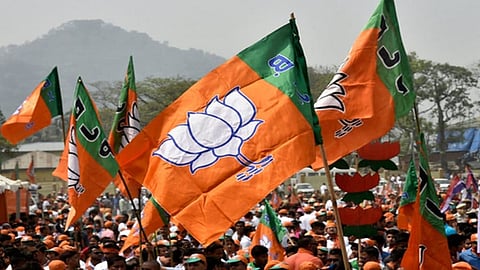
Bengal BJP to take 100-day report card to four crore voters, seeks public feedback

The BJP government in West Bengal has completed its first 100 days in office, prompting the party to launch a massive grassroots campaign aimed at taking its early governance record to at least four crore voters across the state.
Beginning Tuesday, BJP workers and functionaries started visiting neighbourhoods with a 41-page booklet detailing the decisions and initiatives undertaken during the first 100 days of the Suvendu Adhikari-led government. The document, titled West Bengal Government’s Resolution and 100 Days of Success, presents the administration’s account of policy changes, welfare measures and administrative reforms since taking office.
Unlike a conventional political campaign centred only on publicity, party workers have also been instructed to collect feedback from residents on the government's performance.
Four crore outreach target
The BJP plans to reach at least four crore people over the next seven to 10 days, making the exercise one of its biggest public-contact programmes since the Assembly elections.
Party leaders said the campaign was conceived partly as an accountability exercise because BJP representatives had approached voters seeking their support before the election and now wanted to return with an account of what the government had done after receiving the mandate.
The outreach plan was finalised at a party training camp held in New Town on Monday, where workers and functionaries were briefed on how the report card would be taken to households.
The BJP has decided against holding a major formal celebration to commemorate the 100-day milestone. Party leaders maintain that the government's performance should ultimately be judged over a longer period, particularly after completing its first year.
Promises versus performance
A major component of the booklet compares commitments contained in the BJP's Assembly election manifesto with decisions taken by the government since assuming power.
It covers welfare programmes, investment initiatives, administrative reforms, women's safety, economic empowerment and measures concerning law and order.
Among the decisions prominently highlighted is the implementation of Ayushman Bharat in West Bengal. The BJP had repeatedly criticised the previous Trinamool Congress government for keeping the central health insurance programme out of the state.
The government has also highlighted its decision to transfer land to the Border Security Force for border fencing. The measure was cleared at the first Cabinet meeting of the new administration.
Women welfare gets focus
The report card places considerable emphasis on welfare measures, particularly those directed at women.
The government has launched the Annapurna Yojana, under which it claims more than one crore women are receiving financial assistance of Rs 3,000 each.
The measure forms an important part of the BJP government's effort to demonstrate continuity in social protection while introducing programmes associated with its own electoral commitments.
The government has also raised the upper age limit for recruitment to state government jobs, with the revised provision taking effect from May 11.
These measures are being presented by the BJP as evidence that manifesto promises began moving towards implementation within the administration's opening months.
Law and order push
Law and order occupies another substantial portion of the government's 100-day narrative.
The BJP had made allegations of political violence, extortion, syndicate operations and partisan policing central to its campaign against the previous TMC government. After coming to power, the administration introduced an Anti-Goonda Bill as part of its response.
Four dedicated helplines have also been introduced for reporting extortion, illegal toll collection, syndicate-related offences and illicit liquor.
The government has additionally proposed large-scale recruitment in the police force and measures intended to reduce political interference in policing.
For the BJP, these initiatives are particularly significant because its campaign for power had been built partly around a promise to change what it described as a politicised administrative system after 15 years of TMC rule.
Investment on agenda
The government is also seeking to shift attention towards Bengal's longer-term economic challenges, particularly investment, industrialisation, infrastructure and migration of skilled workers.
Engagement with NITI Aayog has been intensified as the administration seeks greater investment and cooperation with the Centre.
Industrial development is expected to become an increasingly important test for the government as it moves beyond its initial phase, particularly given Bengal's long-running political debate over jobs and private investment.
Party functionaries acknowledge that announcements made during the first 100 days will eventually be judged by their implementation and their impact on everyday life.
First test of governance
The door-to-door campaign consequently serves two purposes for the BJP. It allows the party to publicise the government's early decisions while maintaining the grassroots political machinery that helped it win the Assembly election.
Seeking feedback also gives the organisation an opportunity to identify areas of dissatisfaction before the administration completes its first year.
The 100-day milestone is therefore being presented not as a declaration of accomplishment but as the end of the government's opening phase.
Having campaigned on a promise of changing Bengal's administrative and political culture, the Suvendu Adhikari government must now demonstrate that its early policy decisions can produce measurable results. For the BJP, the four-crore-voter outreach will provide an early indication of whether its account of the first 100 days matches the experience of the electorate.

