.png)
25 lakh govt jobs, caste census, Rs 5,000 for unemployed: Big promises in Akhilesh's manifesto
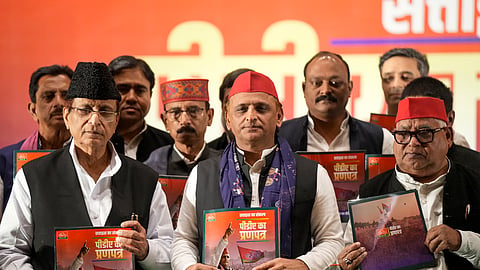
Samajwadi Party (SP) president Akhilesh Yadav on Thursday unveiled the party's manifesto for the 2027 Uttar Pradesh Assembly elections, promising 25 lakh government jobs, a caste census by 2028, 50 per cent reservation for backward classes, Dalits and minorities in specified government contracts, comprehensive farm loan waivers and a series of welfare measures targeting women, youth, farmers and economically disadvantaged communities.
Titled 'Sattais Ka Sankalp: PDA Ka Pran Patra – Jan-Man Ka Manifesto 2027', the document was released on Constitution Day in the presence of senior party leaders, including Azam Khan and Shivpal Singh Yadav.
The manifesto places the party's PDA strategy — Pichhda (backward classes), Dalit and Alpsankhyak (minorities) — at the centre of its electoral campaign, alongside commitments on employment generation, education, healthcare, agricultural reforms, social justice and governance.
Taking a swipe at the ruling Bharatiya Janata Party (BJP), Yadav said the promised good days had not arrived and claimed that the present government's tenure was nearing its end.
𝗖𝗮𝘀𝘁𝗲 𝗰𝗲𝗻𝘀𝘂𝘀 𝗮𝗻𝗱 𝟱𝟬 𝗽𝗲𝗿 𝗰𝗲𝗻𝘁 𝗣𝗗𝗔 𝗾𝘂𝗼𝘁𝗮
The Samajwadi Party has promised to conduct a statewide caste census by 2028 to facilitate proportionate representation and improve the formulation of welfare policies for historically disadvantaged communities.
The manifesto proposes reserving 50 per cent of specified government contracts for entrepreneurs and vendors belonging to PDA communities.
The party has also pledged to clear the backlog of government vacancies reserved for Scheduled Castes (SCs), Scheduled Tribes (STs) and Other Backward Classes (OBCs) by 2028.
A dedicated PDA Social Justice Commission would be established to address issues concerning representation, discrimination and access to government welfare programmes.
The party has further proposed allocating 20 per cent of the state budget under the Special Component Plan for Dalits and strengthening mechanisms to prevent atrocities against marginalised communities.
𝗧𝘄𝗲𝗻𝘁𝘆-𝗳𝗶𝘃𝗲 𝗹𝗮𝗸𝗵 𝗴𝗼𝘃𝗲𝗿𝗻𝗺𝗲𝗻𝘁 𝗷𝗼𝗯𝘀 𝗶𝗻 𝗳𝗶𝘃𝗲 𝘆𝗲𝗮𝗿𝘀
Employment generation constitutes one of the most extensive components of the manifesto.
The SP has pledged to provide 25 lakh government jobs within five years of assuming office and facilitate employment opportunities for another two to three crore young people across other sectors during the same period.
Unemployed graduates would receive monthly financial assistance of Rs 5,000 until they secure employment.
The party has proposed an annual recruitment calendar covering government vacancies, with appointments involving single-stage examinations to be completed within three months and those requiring multiple examinations within six months.
To address examination paper leaks and recruitment irregularities, the manifesto proposes stricter accountability measures under which officials and ministers concerned would be held personally responsible for lapses.
The party has also promised employment opportunities in the Uttar Pradesh Police and other state government departments for Agniveers who do not secure permanent positions in the armed forces.
𝗠𝗦𝗠𝗘𝘀, 𝘀𝗲𝗹𝗳-𝗲𝗺𝗽𝗹𝗼𝘆𝗺𝗲𝗻𝘁 𝗮𝗻𝗱 𝘀𝗸𝗶𝗹𝗹 𝗱𝗲𝘃𝗲𝗹𝗼𝗽𝗺𝗲𝗻𝘁
The manifesto proposes strengthening the micro, small and medium enterprises (MSME) sector with the objective of generating more than one crore employment opportunities by 2032.
Financial assistance of up to Rs 2 lakh would be extended to individuals seeking to establish self-employment ventures.
Specialised skill development centres would train five lakh young people annually, while career counselling and vocational training facilities at the tehsil level would target 20 lakh beneficiaries every year, with particular emphasis on young women.
The party has also proposed identifying workers vulnerable to job displacement caused by artificial intelligence and providing them with appropriate reskilling opportunities.
Additionally, the SP has promised a minimum of 150 days of rural employment and legislation guaranteeing employment opportunities in urban areas.
𝗙𝗮𝗿𝗺 𝗹𝗼𝗮𝗻 𝘄𝗮𝗶𝘃𝗲𝗿 𝗮𝗻𝗱 𝗹𝗲𝗴𝗮𝗹 𝗴𝘂𝗮𝗿𝗮𝗻𝘁𝗲𝗲 𝗳𝗼𝗿 𝗠𝗦𝗣
The Samajwadi Party has promised a complete farm loan waiver within 100 days of forming the government, with the broader objective of making farmers debt-free by 2031.
The manifesto proposes statutory backing for minimum support prices (MSP) for 23 crops and milk, based on the Swaminathan Commission's C2+50 per cent formula.
A price compensation mechanism would be introduced for agricultural produce outside the existing MSP framework, including potatoes, tomatoes and onions.
The party has also pledged to ensure payment to sugarcane farmers within 24 hours through a dedicated financial mechanism and revise procurement prices annually in accordance with cultivation costs.
Other agricultural commitments include an annual farmer pension of Rs 40,000, crop insurance compensation of up to Rs 10 lakh, waiver of outstanding agricultural electricity dues and free power for irrigation.
Under the proposed Smart Farmer Assistant Scheme, five lakh rural youth would receive specialised agricultural training.
𝗧𝗵𝗿𝗲𝗲 𝗵𝘂𝗻𝗱𝗿𝗲𝗱 𝘂𝗻𝗶𝘁𝘀 𝗼𝗳 𝗳𝗿𝗲𝗲 𝗲𝗹𝗲𝗰𝘁𝗿𝗶𝗰𝗶𝘁𝘆
The SP has promised 300 units of free electricity for eligible domestic consumers and uninterrupted power supply across Uttar Pradesh.
Farmers would receive free electricity for irrigation, alongside relief from outstanding agricultural power bills.
The manifesto also envisages an investment of Rs 1.5 lakh crore in rural infrastructure to improve connectivity and public amenities.
𝗥𝗲𝗼𝗽𝗲𝗻𝗶𝗻𝗴 𝗼𝗳 𝟮𝟲,𝟬𝟬𝟬 𝗽𝗿𝗶𝗺𝗮𝗿𝘆 𝘀𝗰𝗵𝗼𝗼𝗹𝘀
In the education sector, the SP has pledged to reopen around 26,000 government primary schools that it claims were closed under the present administration.
The party has proposed allocating 6 per cent of Uttar Pradesh's gross state domestic product (GSDP) to education and developing a separate state education policy to ensure equitable access to quality learning.
The free laptop distribution scheme, first introduced during Akhilesh Yadav's tenure as chief minister in 2012, would be revived for students passing Class 12.
All primary and secondary schools would be equipped with Wi-Fi facilities, while residential hostels for boys and girls would be established in major cities.
The manifesto also proposes free education for girls from kindergarten to postgraduate level, English-language instruction from Class 1 and restructuring higher education curricula to improve employment prospects.
Vacancies in the education sector would be filled within a year, while contractual appointments would be gradually discontinued.
The monthly honorarium of Shiksha Mitras would be increased by Rs 5,000 until their regularisation. Unaided schools would also receive a special monthly government grant of Rs 5,000.
𝗥𝘀 𝟰𝟬,𝟬𝟬𝟬 𝗮𝗻𝗻𝘂𝗮𝗹 𝗮𝗶𝗱 𝗮𝗻𝗱 𝗥𝘀 𝟱 𝗺𝗲𝗮𝗹𝘀
Under its social welfare programme, the Samajwadi Party has proposed annual financial assistance of Rs 40,000 for eligible women, elderly citizens and vulnerable individuals from economically disadvantaged households.
The party has also promised to establish Samajwadi Canteens serving affordable meals for Rs 5.
The subsidised meal programme would form part of its broader commitment to addressing food insecurity and poverty.
The manifesto identifies 2029 as the target year for achieving its hunger elimination and poverty eradication objectives.
Yadav indicated that a separate manifesto focusing specifically on women and their economic and social empowerment would be released subsequently.
𝗥𝘀 𝟭𝟬 𝗹𝗮𝗸𝗵 𝗵𝗲𝗮𝗹𝘁𝗵 𝗰𝗼𝘃𝗲𝗿 𝗳𝗼𝗿 𝗽𝗼𝗼𝗿 𝗳𝗮𝗺𝗶𝗹𝗶𝗲𝘀
The manifesto proposes expanding public healthcare expenditure to around 10 per cent of the state budget.
Families living below the poverty line would receive health coverage of up to Rs 10 lakh for serious illnesses and trauma-related treatment.
The party has also promised free medical treatment for economically disadvantaged citizens and improvements in public healthcare infrastructure.
The proposals seek to reduce out-of-pocket medical expenditure and improve access to treatment for vulnerable households.
𝗟𝗮𝘄 𝗮𝗻𝗱 𝗼𝗿𝗱𝗲𝗿, 𝘄𝗼𝗺𝗲𝗻'𝘀 𝘀𝗮𝗳𝗲𝘁𝘆
Addressing concerns surrounding law and order, Akhilesh Yadav said that an SP government would take strict action against organised crime, extortion, intimidation and offences against women.
He maintained that offenders would be dealt with irrespective of their caste, religion, community or political affiliation.
The party has positioned constitutional protections, equal treatment under the law and accountability in public administration among its governance commitments.
𝗦𝗣 𝗮𝗱𝗼𝗽𝘁𝘀 𝗲𝗮𝗿𝗹𝘆 𝗺𝗮𝗻𝗶𝗳𝗲𝘀𝘁𝗼 𝘀𝘁𝗿𝗮𝘁𝗲𝗴𝘆
The release of the manifesto several months ahead of the anticipated Assembly elections marks a departure from the Samajwadi Party's approach in previous state elections.
In 2017, the party unveiled its manifesto approximately 20 days before polling began, while its 2022 manifesto was released just two days before the first phase of voting.
The SP is also preparing additional policy documents addressing women, technology and region-specific developmental requirements.
Separate district-level manifestos covering Uttar Pradesh's 75 districts are expected to address local infrastructure, employment and civic concerns.
The manifesto comes amid ongoing seat-sharing negotiations between the Samajwadi Party and its INDIA bloc ally, the Congress, ahead of the electoral contest for the state's 403 Assembly constituencies.
While the document lays out extensive commitments across multiple sectors, the consolidated financial cost of the proposed programmes and their funding mechanisms have yet to be established from the available details.


