.png)
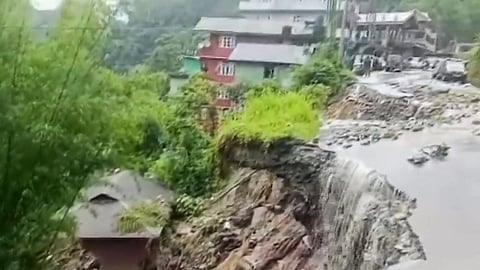
Recurring landslides threaten to render West Sikkim's Rimbi village uninhabitable
Rimbi village in West Sikkim is facing the prospect of being declared uninhabitable after recurring landslides and flash floods damaged at least 32 houses, four government quarters and several small wooden and semi-pucca structures, forcing residents to move to safer locations.
The latest destruction followed intense monsoon rainfall and a major landslide in the Singlitam-Rimbi belt of Gyalshing district. The active landslide has repeatedly shifted downhill from the steep slopes of Singlitam, carrying mud, rocks and debris towards settlements below.
The situation has worsened since August 13, when only two houses were initially affected. After a major spell of rain the following day, the number of damaged houses rose to around 30. The continuing instability has since threatened even areas that residents previously considered relatively safe.
Ground beneath Rimbi increasingly unstable
Sikkim Disaster Relief Commissioner Rinzing Chewang, who surveyed the affected village on September 25, said the repeated movement of the landslide from Singlitam could have made Rimbi unsafe for habitation.
“Rimbi may be uninhabitable after the recurring landslide from Singlitam,” Chewang said, adding that 107 people were currently staying at a relief camp at the Gram Prasasan Kendra.
Nine houses in Singlitam have also been evacuated, with the affected residents moved to a relief camp in the village.
Chewang said Rimbi could no longer be considered habitable, including areas where reinforced cement concrete structures had been built. He said a geological survey would be carried out after the monsoon to determine the causes and extent of the landslide through a multidisciplinary assessment involving different government departments.
The threat has been building for weeks. In August, the state government said an active landslide was continuously moving at Rimbi-Singlitam, placing residents, land and property at risk. Thirty households in Rimbi and eight in Singlitam were initially identified within the affected zone, with more than 150 people affected at that stage.
Floodwaters carrying mud and debris reach homes
Residents near Mit Khola, an area previously considered comparatively safe, have also been affected as floodwaters carrying large quantities of mud and debris enter inhabited areas.
The latest movement of the landslide has intensified concerns that another spell of heavy rain could cause further destruction. Local reports said the active slide took a new course and entered the village on Thursday night, while two houses were completely washed away. No casualties have been reported so far.
The state government had already evacuated vulnerable families earlier in the monsoon. By September 14, 28 houses involving 128 people had been evacuated from Rimbi and shifted to the Gram Panchayat Kendra as a precaution.
The landslides have also repeatedly disrupted connectivity. Earlier in September, a large flow of debris and water from Siksa Khola damaged the road on the Geyzing-Pelling-Yuksom route, bringing traffic to a halt. The road was subsequently restored through coordinated work by several government departments and rescue personnel.
Government announces support for displaced families
Chief Minister Prem Singh Tamang said the situation remained serious and that the safety and well-being of residents were the government's foremost priority.
He directed the concerned authorities to remain on high alert, closely monitor vulnerable areas and take all possible measures to protect residents.
“I understand the deep distress and uncertainty being faced by the residents,” Tamang said, extending his thoughts and prayers to families affected by the landslides.
The government has announced compensation of ₹1.3 lakh for families whose houses were completely destroyed by the flash floods and landslides. Other forms of damage will also be compensated according to applicable norms.
Under the Sikkim Housing Scheme, families that have lost their land will be provided with land and a house. Those who retain their land will receive assistance to construct new homes.
The government had also provided ex-gratia assistance and relief materials to 25 affected families in August after their properties, crops and land were damaged or placed at risk by the landslide.
With the slopes above Rimbi continuing to destabilise, authorities are keeping the affected settlements under close watch. A detailed geological assessment after the monsoon is expected to determine whether parts of the village can safely be inhabited again.


