.png)
Days after attack, CJP inspects Jaipur schools, gives 7-day ultimatum to Rajasthan govt
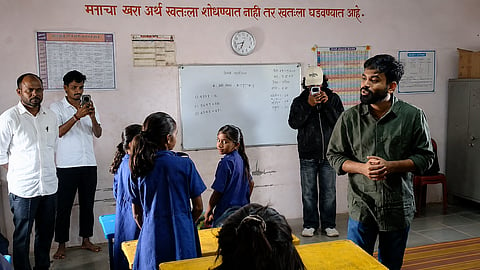
The Cockroach Janata Party (CJP) on Sunday inspected two government primary schools in Jaipur’s Shastri Nagar-Bhatta Basti area and gave the Rajasthan government seven days to address alleged infrastructure deficiencies, days after members of the outfit were involved in a confrontation during another school visit in the district.
The CJP claimed that one of the schools had a completed building that had remained closed for several years, forcing children to travel longer distances for education. At the second school, it alleged that classes were being conducted from a makeshift “cage-like” structure without a proper building or essential facilities. The group demanded that the closed school be reopened immediately and that safe infrastructure and basic amenities be provided at the other institution.
“Children cannot be expected to study in such deplorable conditions. The administration must provide safe and adequate educational facilities at both schools within seven days,” the CJP said in a statement. It warned that it would join local residents in launching a public agitation if the problems were not addressed within the deadline.
Inspection follows Bagru confrontation
Sunday’s visits came amid an escalating controversy over the CJP’s “School Thik Karo” campaign, under which its members have been visiting government schools to highlight alleged shortcomings in buildings, sanitation and other facilities.
On August 21, a CJP team visiting Government Primary School at Rampura-Kanwarpura in Jaipur district’s Bagru constituency was involved in a confrontation with local residents. CJP co-convenor Ashutosh Ranka alleged that party volunteers were assaulted by people linked to the BJP. The BJP and local residents disputed the allegations, with villagers accusing the visiting group of creating tension and intimidating residents.
Cross-FIRs were subsequently registered. One was based on a CJP member’s complaint alleging assault, while another followed a villager’s complaint accusing members of the group of arriving in large numbers and frightening residents. The political affiliation of those accused of attacking the CJP remains contested.
The school at the centre of that dispute had been operating from temporary premises after its original building was declared unsafe. Students were shifted to a room provided by a villager after the controversy. Officials have said Rs 12 lakh has been sanctioned for a new building, while another Rs 6 lakh has been allocated from the local MLA’s development fund.
Government data reveal infrastructure gaps
The controversy has drawn wider attention to conditions in Rajasthan’s government schools. State government data based on 2025-26 U-DISE figures show that 611 government schools do not have buildings of their own, including 38 in Jaipur. The figures also show that 2,047 schools lack toilets for students and 1,049 do not have drinking water facilities.
The Rajasthan government has said arrangements are being made to address drinking water and sanitation deficiencies. It has earmarked Rs 550 crore for repair and renovation of schools and another Rs 450 crore for constructing buildings for institutions operating without their own premises or from dilapidated structures.
Following the recent controversy, the BJP government also outlined a three-year infrastructure programme involving expenditure of around Rs 12,500 crore on government schools. The plan includes funds for new buildings and classrooms, repairs and construction of toilet facilities.
Entry restrictions add to political row
The CJP campaign has also become entangled in a separate dispute over a Rajasthan Education Department directive regulating the entry of outsiders into government schools. The order requires visitors to obtain permission and places restrictions on photography, videography, interviews, audio recording and livestreaming involving students and school activities.
The government has defended the regulations as necessary to protect children’s safety, dignity and privacy, including safeguards associated with the Protection of Children from Sexual Offences Act. Education Minister Madan Dilawar has said schools should not become political battlegrounds and maintained that their primary purpose is education.
Opposition parties and the CJP have questioned the timing of the restrictions, arguing that public scrutiny of government schools should not be obstructed. The government, however, has maintained that schools are public institutions but cannot function as unrestricted public spaces where anyone can enter or record children without permission.
Against this backdrop, Sunday’s inspection indicates that the CJP intends to continue its campaign despite the restrictions and the confrontation at Rampura-Kanwarpura. Its seven-day deadline now puts the focus back on the administration and whether the specific deficiencies flagged at the two Shastri Nagar-Bhatta Basti schools are addressed.


