.png)
Punjab faces paddy procurement challenge as bumper harvest threatens 180-lakh-tonne quota
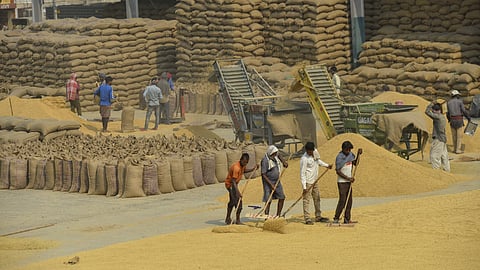
Punjab is bracing for a potentially difficult paddy procurement season, with a projected bumper harvest threatening to exceed the 180 lakh tonnes of paddy the Centre has approved for purchase. Higher production could put additional pressure on the state’s procurement operations, finances and already strained storage infrastructure.
The state’s non-basmati paddy production, which is generally procured by government agencies for the public distribution system, is expected to cross 220 lakh tonnes this season. Historically, around 90% of total production reaches mandis for procurement, raising the possibility that arrivals will surpass the sanctioned limit.
“The procurement scenario seems tougher this season, as we have been signalled by the Union ministry that the crop beyond the defined quota will not be accepted. We hope to stay within the limits; otherwise, we will seek an extension,” a senior official in the Punjab food and civil supplies department said.
The procurement season for 2026-27 began on October 1, with the state preparing its grain markets and financial arrangements to handle arrivals. However, the prospect of production exceeding the approved quantity has raised concerns about whether the state can purchase the entire marketable crop without fresh approval and additional funding from the Centre.
Haryana's experience raises the prospect of a quota dispute
Punjab’s concerns have been sharpened by the Centre’s handling of excess procurement in neighbouring Haryana last year. Against an approved quota of 36 lakh tonnes, Haryana procured 62 lakh tonnes in 2025, exceeding its limit by 26 lakh tonnes. The Centre’s refusal to accept the additional quantity has emerged as a warning for Punjab as it prepares for a potentially similar situation.
Haryana has been allocated a procurement quota of 59 lakh tonnes for the current season. Punjab officials believe the Centre’s stance towards Haryana indicates that exceeding the approved ceiling could lead to significant complications, particularly if the additional grain cannot be accommodated within the government procurement system.
Punjab’s procurement target was initially fixed at 156 lakh tonnes, matching the quantity procured during the previous season. Following representations by the state government, the Centre considered the average procurement over three years and revised the target to 171 lakh tonnes.
The state food department subsequently sought another increase, after which Punjab was permitted to procure 180 lakh tonnes.
If actual arrivals exceed the revised quota, the state may once again have to approach the Centre for permission to procure additional grain. Such a request could require a revision of the sanctioned quantity as well as additional financial arrangements to purchase the surplus paddy at the minimum support price (MSP).
Higher yields point to a bumper harvest
The scale of the challenge is linked to a significant improvement in estimated paddy yields. Punjab agriculture director Gurjeet Singh Brar said crop-cutting experiments indicated production of 67.35 quintals per hectare, compared with 58.6 quintals per hectare in the previous season.
“According to the results of crop-cutting experiments, the production is 67.35 quintals against last season’s production of 58.6 quintals per hectare. We are expecting a bumper harvest of 220 lakh tonnes or maybe more,” Brar said.
Punjab cultivated paddy across 32.76 lakh hectares during the current kharif season. Of this area, approximately 6.5 lakh hectares were under premium basmati varieties, which are not procured by government agencies for the public distribution system.
The remaining approximately 26.25 lakh hectares were under non-basmati paddy, which generally falls within the government procurement system at the MSP. With production expected to rise substantially, the volume reaching mandis could test the state’s capacity to purchase, transport, mill and store the crop.
Weather and irrigation conditions support higher output
Former Punjab Agricultural University (PAU) vice-chancellor BS Dhillon said several favourable factors could help the state record higher paddy production, even in the presence of drought conditions.
According to Dhillon, increased sunshine, a lower incidence of crop diseases, reduced nutrient leaching and the availability of adequate irrigation water can all contribute to higher yields despite deficient rainfall.
He said the authorities would need to determine how best to procure and manage the additional grain generated by the bumper harvest. PAU director of extension Makhan Singh Bhullar also said increased paddy production creates additional challenges for the government.
The expected rise in output therefore presents a dual challenge: ensuring that farmers can sell their produce while arranging the financial and logistical resources required to handle any quantity exceeding the approved procurement limit.
Existing rice stocks intensify storage pressure
Even before the current crop is fully procured, Punjab is dealing with a substantial accumulation of rice from earlier seasons. The state’s godowns already hold approximately 150 lakh tonnes of rice from the previous three seasons.
The current season’s procurement is expected to generate at least another 120 lakh tonnes of rice after milling. This could increase the overall stock considerably, further straining storage facilities and grain management arrangements.
The storage shortage has also affected the movement of paddy through the milling system. In September, the state relaxed provisions under its custom milling policy to allow mills that had completed at least 90% of the previous season’s milling to enter agreements and receive fresh paddy. Earlier, mills were generally required to complete the entire previous season’s milling before being allotted new grain.
The relaxation was intended to ease delays caused by insufficient storage space and the movement of rice out of Punjab. At the time, approximately 20 lakh tonnes of paddy remained with millers, expected to yield around 13 lakh tonnes of rice. The Food Corporation of India had indicated that it could take another month and a half to provide the required storage space, although daily rail movement was creating some room.
The shortage means Punjab must manage not only the arrival of the new harvest but also the milling and evacuation of existing stocks. Any delay in creating storage capacity could complicate procurement operations as arrivals gather pace.
₹42,786 crore credit limit approved for procurement
To finance the purchase of the current crop, Punjab has been sanctioned a cash credit limit (CCL) of ₹42,786.68 crore for procuring 180 lakh tonnes of paddy, paying farmers the MSP of ₹2,441 per quintal as stated in the state’s procurement assessment, and meeting administrative expenses.
If procurement exceeds the sanctioned quantity, the state may have to seek an increase in its CCL to fund purchases of additional grain. The financial requirement would depend on the volume of surplus paddy the Centre permits the state to procure.
Varinder Sharma, director of the Punjab food and civil supplies department, said the department had received an assessment from the agriculture department indicating that arrivals would remain within the approved limit. Procurement arrangements had been made on that basis.
“We are taking all caution so that nothing from outside the state is allowed in Punjab mandis and the state farmers are able to sell their produce,” Sharma said.
The state has also put logistical measures in place for the season. A total of 1,887 mandis have been notified, with additional procurement centres to be opened if required. The food and civil supplies department has received five lakh gunny bags for packaging grain, while district officials have been instructed to ensure basic facilities, including drinking water and medical supplies, at procurement yards.
The government has also emphasised checks to prevent paddy brought from outside Punjab from entering the state’s mandis. These measures are intended to ensure that procurement facilities and financial support remain available for Punjab’s own farmers.
With production expected to exceed 220 lakh tonnes, the central question is whether actual arrivals will remain within the 180-lakh-tonne ceiling. If the bumper harvest pushes procurement beyond that limit, Punjab could face the combined challenge of securing additional central approval, arranging more funds and finding sufficient space to store the resulting rice stocks.
