.png)
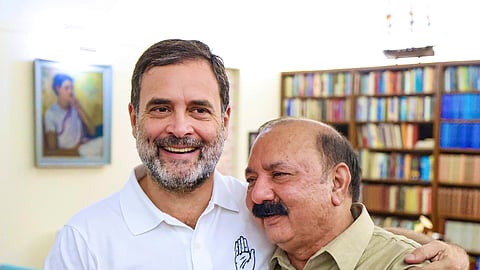
Congress names Gandhi loyalist Kishori Lal Sharma to Punjab poll panel amid factional tensions
The Congress has included Amethi MP Kishori Lal Sharma, a close associate of the Gandhi family, in its 42-member Pradesh Election Committee for Punjab, placing him alongside senior state leaders as the party prepares for the 2027 Assembly elections.
Sharma's inclusion stands out because he is the only member of the panel whose political career has largely been built outside Punjab. The 66-year-old left Ludhiana in 1983 to work with then Prime Minister Rajiv Gandhi and went on to become a key organiser for the Congress in Amethi and Rae Bareli. Despite spending four decades in Uttar Pradesh, he has said his Punjab roots remain intact and that his Aadhaar and voter ID continued to be registered in Ludhiana.
Congress president Mallikarjun Kharge approved the committee on Wednesday evening, with Punjab Pradesh Congress Committee president Pargat Singh appointed as its chairperson. The panel brings together leaders from different factions of the state unit, including former chief minister Charanjit Singh Channi, former state Congress president Amarinder Singh Raja Warring, Leader of the Opposition Partap Singh Bajwa and senior leader Ambika Soni.
The AICC general secretary in charge of Punjab, the secretaries attached to the post and state heads of the party's frontal organisations will also be members in an ex-officio capacity.
The decision comes as the Congress attempts to contain persistent factionalism within its Punjab unit and prepare for an election in which the party will seek to challenge the ruling Aam Aadmi Party. The AAP has already announced more than 70 candidates, while the Shiromani Akali Dal and the BJP are holding discussions on a possible revival of their alliance.
Why Kishori Lal Sharma's inclusion matters
Sharma's political journey has been closely linked to the Gandhi family. A graduate of Arya College in Ludhiana, he moved to Amethi with Rajiv Gandhi in 1983 and subsequently coordinated Congress activities in Amethi and Rae Bareli, the family's traditional constituencies. He also served as Sonia Gandhi's representative in Rae Bareli.
Although Sharma is now an MP from Uttar Pradesh, he has often spoken about his connection with Punjab. In an interview last year, he said he had spent 40 of his more than 62 years in Amethi and considered himself an Amethiwala.
The Congress fielded him from Amethi in the 2024 Lok Sabha elections, choosing him instead of a member of the Gandhi family. In his first electoral contest, Sharma defeated the BJP's Smriti Irani by more than 1.6 lakh votes. Irani had defeated Rahul Gandhi in the constituency in 2019.
After the result, Priyanka Gandhi Vadra congratulated him on social media, writing: "Kishori bhaiya, I always knew you'd win."
Sharma, however, rejected the suggestion that his victory was an act of political revenge against Irani. He described elections as a contest in which one candidate wins and another loses, adding that he did not view politics through the lens of revenge.
He had initially been reluctant to contest the election, but Priyanka Gandhi Vadra persuaded him. Sharma said she had reminded him that he had worked for decades during elections involving members of the Gandhi family and that it was now their turn to do something for him.
His loyalty to the family has also attracted criticism from political opponents, including Irani, who has described him as a servant of the Gandhis. Sharma has rejected that characterisation, saying he was a volunteer and not a servant of either the party or the family, while acknowledging that he was a loyalist.
He has also previously told party workers that Amethi belonged to the Gandhi family and that the Gandhi family belonged to Amethi.
On Punjab, Sharma has criticised the AAP government, alleging in May that law and order in the state had completely deteriorated. He had also maintained that the Punjab Congress was united and would contest the Assembly elections collectively.
What the Pradesh Election Committee does
The Pradesh Election Committee is an important part of the Congress's candidate-selection process for the 117-member Punjab Assembly. It recommends names to a screening committee appointed by the All India Congress Committee. The screening committee then shortlists candidates and forwards the names to the Central Election Committee, chaired by the Congress president, which takes the final decision.
The 42-member panel includes several senior leaders with experience in the state government and party organisation. Apart from Pargat Singh, Channi, Warring, Bajwa and Ambika Soni, it includes former chief minister Rajinder Kaur Bhattal, former deputy chief minister Sukhjinder Singh Randhawa and Chandigarh MP Manish Tewari.
All seven Congress Lok Sabha MPs from Punjab have been accommodated. They are Warring, Randhawa, Gurjeet Singh Aujla, Amar Singh, Sher Singh Ghubaya, Dharamvira Gandhi and Sharma. Tewari, who represents Chandigarh and previously represented Ludhiana in the Lok Sabha, is also on the committee.
Other members include Shamsher Singh Dullo, Sukhpal Singh Khaira, Vijay Inder Singla, Sangat Singh Gilzian, Sukhwinder Singh Danny, Raj Kumar Verka, Kuljit Singh Nagra, Gurkirat Singh, Om Parkash Soni, Santosh Chowdhary, Malti Thapar, Rana Kanwar Pal Singh, Bharat Bhushan Ashu, Aruna Chaudhary, Brahm Mahindra, Razia Sultana, Tript Rajinder Singh Bajwa, Rana Gurjeet Singh, Sukhbinder Singh Sarkaria, Gurpreet Singh Kangar, Balbir Singh Sidhu, Sadhu Singh Dharamsot, Randeep Singh Nabha, Avtar Henry Senior, Kushaldeep Singh Dhillon, Hardev Singh Laddi, Sandeep Singh Sandhu, Ajit Inder Singh Mofar and Emanuel Nahar.
The committee's composition also brings together leaders who have previously been assigned responsibilities in separate election-related panels, in an apparent effort to accommodate different camps and seniority within the state unit.
Congress attempts to manage factionalism
The formation of the panel follows months of tension between the camps led by Channi and Warring. Earlier this year, the Congress appointed former Chhattisgarh chief minister Bhupesh Baghel to manage differences within the state unit. In September, Sachin Pilot replaced Baghel as the party's AICC general secretary in charge of Punjab, amid allegations that the former in-charge had become part of the factional dispute.
Warring stepped down as Punjab Congress president soon afterwards. On October 2, former Indian hockey captain and Jalandhar Cantonment MLA Pargat Singh was appointed to replace him.
The rivalry, however, has continued. Warring was recently absent from a campaign event led by Channi, highlighting that the differences between the two camps remain unresolved. Although he has not attended some Channi-led events, Warring has said he remains committed to the Congress and recalled the opportunities Rahul Gandhi gave him from his Youth Congress days.
The latest committee also incorporates the organisational structure put in place by the Congress high command in July, when factional tensions were particularly intense and Warring was still the state president. The party retained Warring in the post at the time, while Bajwa continued as Leader of the Opposition, and constituted four committees to distribute responsibilities among senior leaders.
Under that arrangement, Channi was appointed chairperson of the campaign committee, Vijay Inder Singla was given charge of election management and coordination, Randhawa headed the core committee, and Amar Singh led the manifesto committee.
The three working presidents appointed during the July reshuffle, Sukhwinder Singh Danny, Raj Kumar Verka and Sangat Singh Gilzian, have also been included in the new Pradesh Election Committee. Most of the co-chairpersons named at the time are on the panel as well. They include Khaira, Rana Gurjeet Singh, Om Parkash Soni, Razia Sultana, Bharat Bhushan Ashu and Sukhbinder Singh Sarkaria.
The July 1 organisational changes were aimed at addressing competing claims within the state unit while retaining the existing leadership structure. The subsequent appointment of Pilot as Punjab in-charge and Pargat Singh as state president marked a further attempt by the high command to reset the organisation ahead of the Assembly polls.
Separate panel to handle party inductions
The Congress has also taken steps to prevent fresh disputes over the entry of leaders from rival parties. The high command recently constituted a separate four-member committee to oversee the induction of political leaders into the Punjab unit.
The panel is expected to coordinate and supervise the process of admitting leaders who want to leave their existing parties and join the Congress. It will consult local leaders before deciding on inductions, with the stated objective of preventing new entrants from triggering further factional clashes.
The move reflects the challenges facing the Congress as it prepares for the Punjab elections. While the 42-member Pradesh Election Committee is tasked with recommending candidates, the separate induction panel is intended to manage the political expansion of the party without aggravating its existing internal divisions.


