.png)
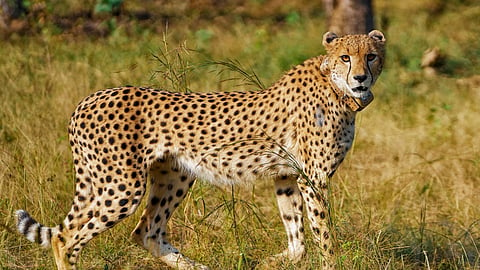
Cheetah count at Gandhi Sagar rises to four as Botswana female ‘Radha’ gets new home
The cheetah population at Madhya Pradesh’s Gandhi Sagar Wildlife Sanctuary (GSWS), India’s second home for the species under the ambitious reintroduction programme, increased to four on Sunday after a three-year-old female cheetah from Botswana was shifted there from Kuno National Park.
Chief Minister Mohan Yadav renamed the cheetah, previously identified as CCB-2, as “Radha” before releasing her into a protective enclosure at the sanctuary. The naming came a day after Radha Ashtami, a festival dedicated to Radha, was celebrated.
With Radha’s arrival, Gandhi Sagar now houses two male and two female African cheetahs. The males are Prabhas and Pawak, while the other female is Dheera.
Shifted from Kuno
Radha was among the nine cheetahs brought from Botswana to Kuno National Park on February 28 this year as part of the latest phase of Project Cheetah. She has now been moved from Kuno, the first site selected for the reintroduction programme, to Gandhi Sagar as authorities seek to establish viable populations at multiple locations.
Officials said Radha had been placed in an enclosure separate from the three South African cheetahs already living at Gandhi Sagar.
Prabhas and Pawak were shifted from Kuno to Gandhi Sagar in April 2025 and are housed together, while Dheera was moved to the sanctuary in September 2025.
The animals are currently being maintained in secured enclosures, with Radha’s enclosure located away from those housing the South African cheetahs as she adjusts to her new surroundings.
Genetic diversity boost
The movement is part of the longer-term strategy under Project Cheetah to establish multiple populations rather than concentrate all the animals at Kuno.
Officials said the presence of cheetahs originating from both South Africa and Botswana at Gandhi Sagar could also help improve genetic diversity if animals from the different genetic lines breed in the future.
Gandhi Sagar, spread across the Mandsaur and Neemuch districts, was developed as the second major habitat for the species after Kuno. Preparations included habitat management, prey augmentation, secured enclosures and measures to manage potential human-wildlife conflict.
India now has 56 cheetahs
India’s cheetah population now stands at 56, according to officials. Of these, four are at Gandhi Sagar, while 52 African cheetahs and India-born cubs are at Kuno National Park.
Authorities are simultaneously preparing additional sites to expand the programme. Veerangana Durgavati Tiger Reserve in Madhya Pradesh’s Bundelkhand region has been readied to receive cheetahs, with five secured enclosures prepared at the reserve.
The move towards multiple habitats is considered crucial to the long-term objectives of the programme, reducing dependence on a single landscape while creating the possibility of establishing separate breeding populations.
Project launched in 2022
India launched the intercontinental cheetah translocation programme in September 2022, more than seven decades after the animal was declared extinct in the country.
Eight cheetahs from Namibia formed the first batch and were released at Kuno in September 2022. Another 12 arrived from South Africa in February 2023. The programme entered its latest phase on February 28 this year when nine more cheetahs were brought from Botswana to Kuno. Radha’s transfer to Gandhi Sagar marks another step towards the programme’s broader objective of establishing a sustainable metapopulation of cheetahs across suitable landscapes in India.


