.png)
Keralam power crisis deepens as demand hits record high; CM sets September 15 target for relief

Keralam is grappling with a growing power shortage as a spell of weak monsoon and unusually high temperatures push electricity demand to a record level, forcing the state to impose partial restrictions during peak hours.
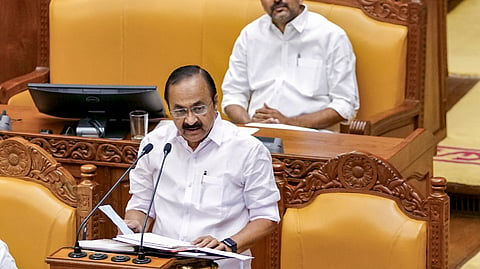
Chief Minister V D Satheesan on Wednesday said the government was taking steps to bring in additional power and aimed to resolve the shortage by around September 15.
The state recorded its highest-ever daily power consumption of 94.76 million units (MU) on Tuesday, according to Kerala State Electricity Board (KSEB) data. Of this, 22.85 MU was generated within the state, while the remaining 72.91 MU had to be purchased from outside.
The state's maximum demand stood at 4,851 MW, with peak demand recorded at around 6.44 pm.
Power demand hits record high
The sharp rise in consumption has come as rains have weakened and temperatures have remained higher than usual at several places, prompting households and commercial establishments to rely more on fans, air-conditioners and other cooling appliances.
The pressure on the power system was felt most during the evening peak on Tuesday when electricity was not available in the required quantity through the power exchange and grid frequency fell. Partial power restrictions were imposed between 6.30 pm on Tuesday and 1.00 am on Wednesday.
The problem has been aggravated by rising demand across the country, which has reduced the availability of electricity through the power exchange. A notification from the Grid Controller of India said the country was facing a power availability shortage of around 12,000 MW.
There was also an unexpected reduction in the availability of electricity from central generating stations, adding to the pressure on Keralam's power system.
Government seeks additional power
Satheesan, who spoke to reporters after the Cabinet meeting, said the state was facing a shortage because of increased consumption, poor rainfall and inadequate inflows into reservoirs. Procuring electricity from neighbouring states had also become difficult, particularly during peak hours, he said.
The chief minister blamed the cancellation of a long-term power purchase agreement by the previous Left Democratic Front government for adding to the state's present difficulties.
The agreement, entered into during the Oommen Chandy-led UDF government, had provided electricity at around Rs 4.29 per unit. After its cancellation, the state is now having to purchase power at much higher rates, with the cost going up to around Rs 10 per unit, Satheesan said.
"If the agreement had continued, this situation would not have arisen. The Congress-led government had taken that decision anticipating such a situation," he said.
"There has been a situation where adequate power is not available. There are problems in several places," Satheesan said.
Despite the difficulties, the government was making every effort to maintain uninterrupted supply without putting an excessive financial burden on consumers, he said.
"With electricity consumption having increased so much, our main objective is to bring in additional power and find a solution to the present power shortage by around September 15," the Chief Minister said.
He said the KSEB would be instructed to take all necessary steps on a "war footing" to tackle the crisis.
High temperatures, low reservoir levels add to pressure
The unusual weather has added to the challenge.
Punalur recorded the state's highest maximum temperature on Tuesday at 35.2 degrees Celsius, 3.3 degrees above normal. Kottayam recorded 34.6 degrees Celsius, which was 3.8 degrees above normal -- the highest departure from normal among the stations monitored.
CIAL Kochi recorded 34 degrees Celsius, while Thiruvananthapuram city recorded 33.6 degrees, Kozhikode 33.5 degrees, and Vellanikkara and Palakkad 33.4 degrees each.
The water position in the state's reservoirs also remains a concern. KSEB data showed storage at 63.55 per cent of the total capacity, while the storage was 80.03 per cent of the level recorded during the corresponding period last year.

