.png)
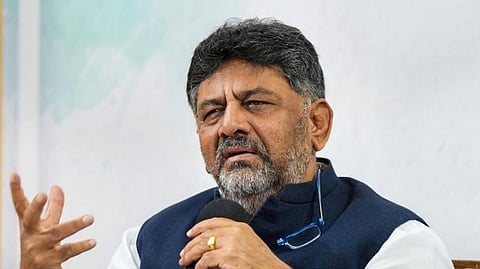
Karnataka to seek PM Modi’s help for Ninth Schedule protection of enhanced SC/ST quotas
Karnataka Chief Minister DK Shivakumar has said the state government will approach Prime Minister Narendra Modi to seek constitutional protection for its enhanced reservations for Scheduled Castes (SCs) and Scheduled Tribes (STs), a day after filing an appeal in the Supreme Court against a High Court verdict striking down the quota increase.
Shivakumar said the government was confident of securing relief from the Supreme Court and would pursue the inclusion of the relevant law in the Constitution’s Ninth Schedule to protect the enhanced quotas for education and government jobs from legal challenges.
The Karnataka government filed a Special Leave Petition (SLP) in the Supreme Court on November 11, challenging the High Court's October 12 judgment. The state Cabinet had approved the move on October 15, with the subsequent government order authorising the appeal issued on October 27.
What the Karnataka High Court ruled
The 2022 law, introduced by the then BJP government led by former chief minister Basavaraj Bommai, increased reservations for SCs from 15% to 17% and for STs from 3% to 7%. With the 32% quota for Other Backward Classes (OBCs) remaining unchanged, the overall reservation in the state rose from 50% to 56%.
On October 12, a division bench of the Karnataka High Court struck down the provisions providing for the enhanced quotas, holding that the increase breached the 50% ceiling established by the Supreme Court in the 1992 Indra Sawhney judgment.
The court also flagged procedural shortcomings in the enactment of the 2022 law, including the failure to consult the constitutional bodies for SCs and STs as required under the Constitution.
The Centre had earlier deferred Karnataka's request to include the 2022 law in the Ninth Schedule, saying on July 25 that the matter was pending before the High Court and that inclusion was therefore not appropriate at that stage.
Shivakumar cites Tamil Nadu's 69% reservation
Shivakumar pointed to Tamil Nadu, which has a 69% reservation framework, as an example of a state whose law was placed in the Ninth Schedule. He said Karnataka was seeking only a six-percentage-point increase over the 50% ceiling.
“There is no point in blaming those who were in power earlier on this issue. Decisions have been made on this in a few other states, and Tamil Nadu has 69% reservation. We are only requesting a six-percentage-point extension beyond the 50% reservation limit,” he said.
The Ninth Schedule was introduced through the First Constitutional Amendment in 1951 to protect specified laws from judicial review. However, such protection is not absolute: the Supreme Court has held that laws placed in the schedule after April 24, 1973, can still be examined if they damage the Constitution's basic structure.
Shivakumar said senior ministers G Parameshwara, HC Muniyappa and Satish Jarkiholi had been assigned to oversee the Supreme Court appeal and coordinate the state's legal response.
He made the remarks after chairing a meeting of the State Scheduled Castes and Scheduled Tribes Development Council at Vikasa Soudha. The meeting reviewed the implementation of the Scheduled Caste Sub-Plan (SCSP) and Tribal Sub-Plan (TSP).
Karnataka seeks release of ₹1,937 crore in central funds
The state government will separately write to the Union government seeking the release of ₹1,937 crore in pending central assistance under Centrally Sponsored Schemes for 2025-26.
Of the ₹3,497 crore allocated as the Centre's share under SCSP and TSP programmes for the financial year, Karnataka had received ₹1,560 crore, leaving ₹1,937 crore pending.
Shivakumar said he had directed the state Finance Department to release Karnataka's share even if the Centre did not provide its contribution.
The state had earmarked ₹6,514 crore as its contribution to the programmes. Of this amount, ₹5,628 crore had been released and ₹5,611 crore spent, he said.
Independent audit to assess welfare spending
The council also decided to commission an independent social audit to assess the impact of SCSP and TSP expenditure over the years.
Shivakumar said legislators had identified instances of overlapping welfare programmes. Reputed institutions would be engaged to examine the allocations and determine whether the funds had delivered the intended benefits to SC and ST communities.


