.png)
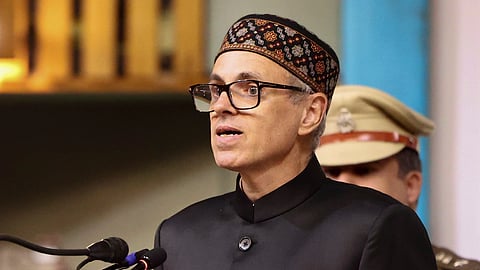
Omar Abdullah sworn in as J&K Chief Minister, optimistic about early restoration of statehood

Chief Minister Omar Abdullah was sworn in on Wednesday as the first chief minister of Jammu and Kashmir following the abrogation of Article 370 in 2019, marking the establishment of the first elected government in the union territory.
The oath of office and secrecy was administered by Lt Governor Manoj Sinha at the Sher-i-Kashmir International Convention Centre (SKICC). Abdullah begins his second term in this role, continuing the legacy of his grandfather, Sheikh Abdullah, and his father, Farooq Abdullah, making him the third generation of the Abdullah family to hold the position. Alongside him, five ministers were also sworn in during the ceremony.
In a statement, Abdullah articulated that the primary goal of his government is to serve as the voice of the people. He expressed confidence that Jammu and Kashmir would not remain a Union territory for long and would soon regain full statehood. "We have the mandate from the people to get to work to resolve their problems, and that is what we aim to do from day one," he stated.
Addressing speculation about a rift between the National Conference and its coalition partner Congress, Abdullah remarked, "If all is not well, why would Congress leaders like Mallikarjun Kharge and Rahul Gandhi be here? Their presence indicates that the alliance is strong, and we will work for the people of J&K."
Regarding the absence of Congress MLAs in his cabinet, he clarified that discussions were ongoing, but noted the limitations imposed by the unicameral structure of the Union territory. "Gone are the days when you would see 40 or 45 ministers," he said, while emphasizing the need to balance representation and practicality in government size.
Abdullah underscored the importance of restoring statehood, stating that the lack of an elected government since 2018 has left the people feeling "voiceless." He asserted that ensuring the public feels represented and heard is crucial for the new government.
In light of the challenges ahead, Abdullah expressed optimism about the potential for generational change in governance. He welcomed input from other leaders, including former Delhi Chief Minister Arvind Kejriwal, who offered to share his experiences governing a 'half-state' like Delhi.
While discussing the current Union territory status, Abdullah referred to it as "unfortunate" and reiterated the commitment from the central government to restore statehood. He stated, "We have commitments from the Government of India, particularly from the Prime Minister and Home Minister, that statehood will be restored to J-K, and we hope that happens at the earliest."
On the remarks made by MP Sheikh Rashid regarding statehood, Abdullah dismissed the need for lessons from him, asserting that the people have made their preferences clear in the recent elections. Abdullah's return to power comes as the political landscape in Jammu and Kashmir has shifted significantly since the region was bifurcated into two Union territories in 2019. His leadership is seen as a pivotal moment in the ongoing governance and development of the region.

