.png)
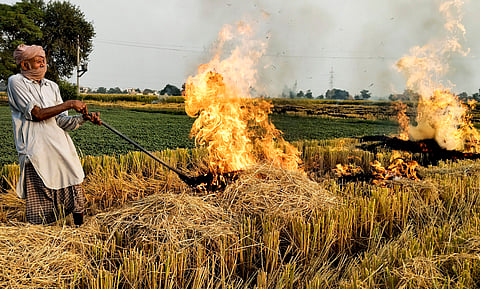
Haryana's stubble burning down 91%, steps up pollution fight ahead of winters
Haryana has recorded a 91 per cent reduction in paddy stubble-burning incidents since 2021 and is stepping up action against road dust, industrial emissions and vehicular pollution as Delhi-NCR heads towards the winter smog season. Chief Secretary Anurag Rastogi, presenting the state’s preparedness at a high-level task force meeting Friday, said the government was pursuing a coordinated strategy covering farm fires, construction waste, transport, industries and air-quality monitoring.
The reduction relates to paddy stubble-burning fire counts recorded in 2025 compared with 2021, rather than incidents during the ongoing 2026 harvesting season. Haryana is now preparing for the new crop-residue cycle with expanded machinery, drone surveillance and greater use of paddy straw outside farms.
7.97 million tonnes of straw
Haryana generates around 7.97 million tonnes of paddy straw annually, making its disposal a crucial part of the state’s winter pollution strategy. The government plans to manage 55 per cent of the residue through in-situ methods, 33 per cent through ex-situ utilisation and the remaining 12 per cent as fodder.
The state has already procured 7,950 crop-residue management machines and is targeting 9,000 machines for the 2026 season. Farmers are also being encouraged to use machinery and supply straw to industries rather than burning it in fields.
Ex-situ utilisation has risen sharply over the past three years, increasing from 1.32 million tonnes in 2023 to 1.55 million tonnes in 2024 and 2.19 million tonnes in 2025. Haryana is targeting 2.71 million tonnes in 2026, which would further increase the amount of crop residue diverted towards industrial and other productive uses.
Drones to track farm fires
Surveillance is being strengthened alongside residue management, with Haryana planning to deploy around 50 drones in stubble-burning hotspots. Low-cost PM2.5 sensors are also proposed in vulnerable villages, while burnt areas will be physically verified through a mobile application developed by ISRO.
The measures follow a separate state action plan under which a “Parali Protection Force” is being deployed at district and block levels. Police personnel, agriculture officials, administrative officers and other field functionaries will participate in monitoring, while late-evening patrols are being intensified during the harvesting period.
Haryana has also offered farmers an incentive of Rs 1,200 per acre for optimal utilisation of crop-residue management machinery. The state’s strategy comes as the Commission for Air Quality Management pursues a target of eliminating paddy stubble burning across NCR states during the 2026 harvesting season.
Road dust under scanner
Farm fires are only one part of Haryana’s pollution-control plan, with the government identifying road dust as another major source of particulate pollution in NCR. Of 1,162 km of roads identified for redevelopment, work on 675 km — around 58 per cent — has been completed.
The state has deployed 78 of the 81 large and medium mechanised road-sweeping machines assessed as necessary for roads wider than 10 metres. It now plans to expand the use of smaller sweeping machines on narrower roads, introduce litter-picking equipment and digitally track mechanised sweepers to monitor their deployment.
The Road Asset Management System is also being used to improve road maintenance, with attention on potholes, damaged footpaths and stretches that generate high levels of dust. Construction and demolition activity is being monitored separately, with 3,211 active sites measuring more than 500 square metres registered on the state’s monitoring portal.
Industries, vehicles face scrutiny
Industrial emissions are another focus area. Of 1,309 industries covered under the state’s pollution-control review framework, 192 have either been exempted or certified as having adequate arrangements, while 1,117 require action relating to air-pollution control devices. Purchase orders for the required equipment have been placed in 383 cases.
Haryana has also reported biomass co-firing of 5.89 per cent at thermal power plants up to August 2026, exceeding the five per cent benchmark. Biomass use at brick kilns in non-NCR Haryana has reached 21.9 per cent and is proposed to rise to 30 per cent from November 1.
Transport remains another challenge. Haryana currently has 1,018 electric city buses against an assessed requirement of 2,900 and 1,276 charging stations against a requirement of 2,500. Of 121 identified traffic-congestion points, 46 have so far been decongested.
Monitoring network to expand
Haryana currently operates 22 continuous ambient air-quality monitoring stations against a proposed network of 45. Three real-time source-apportionment sites have also been finalised, including locations at Maharshi Dayanand University in Rohtak and Indira Gandhi University in Rewari.
The intensified measures come ahead of the period when Delhi-NCR’s air quality typically deteriorates sharply because of a combination of meteorological conditions and emissions from multiple sources. Haryana’s 91 per cent reduction in paddy-fire counts since 2021 represents a substantial decline, but the coming harvest season will test whether those gains can be sustained as authorities pursue the more ambitious target of eliminating farm fires altogether.


