.png)
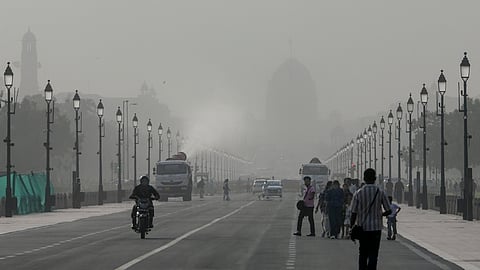
Stubble burning to account for over 13% of Delhi pollution on Thursday
The contribution of stubble burning to Delhi's air pollution is expected to rise sharply to more than 13 per cent on Thursday from around 8 per cent on Wednesday, even as the national capital recorded its first 'poor' air quality day of the season.
According to forecasts issued by the Decision Support System (DSS) for Air Quality Management in Delhi, the share of farm fires in the city's pollution is projected to decline to 10.369 per cent on Friday.
The forecasting system, operating under the Ministry of Earth Sciences, provides estimates of the contribution of different emission sources to Delhi's air pollution.
The projections come amid deteriorating air quality in the national capital, with the Air Quality Index (AQI) settling at 245 on Wednesday, its highest reading in 100 days.
The last comparable pollution level was recorded on July 13, when Delhi's AQI stood at 246.
𝗙𝗮𝗿𝗺 𝗳𝗶𝗿𝗲𝘀' 𝘀𝗵𝗮𝗿𝗲 𝘀𝗲𝘁 𝘁𝗼 𝗿𝗶𝘀𝗲
The DSS forecast indicates that stubble burning could become a more significant contributor to Delhi's pollution over the next 24 hours, with its estimated share increasing by approximately five percentage points.
However, the contribution is expected to moderate by Friday.
The transport sector, another major source of pollution in Delhi, accounted for an estimated 20.513 per cent on Wednesday.
Its contribution is projected to decline to 17.282 per cent on Thursday before increasing marginally to 18.171 per cent on Friday.
The forecasts also indicate fluctuations in pollution originating from neighbouring industrial areas.
The estimated contribution from Sonipat is expected to fall from 4.804 per cent on Wednesday to 2.643 per cent on Friday.
In contrast, Ghaziabad's contribution is projected to increase from 3.04 per cent to 4.77 per cent during the same period.
𝗚𝗥𝗔𝗣 𝗦𝘁𝗮𝗴𝗲 𝗜 𝗶𝗻𝘃𝗼𝗸𝗲𝗱 𝗮𝗰𝗿𝗼𝘀𝘀 𝗡𝗖𝗥
With Delhi's AQI entering the 'poor' category, the Commission for Air Quality Management (CAQM) on Wednesday invoked Stage I of the Graded Response Action Plan (GRAP) across Delhi-NCR.
The measures are aimed at preventing further deterioration in air quality by controlling major sources of pollution.
Stage I includes steps to curb dust emissions from construction and demolition activities, road dust and open burning of municipal waste.
Authorities are also required to strengthen enforcement of existing pollution-control regulations under the preventive framework.
𝗣𝗼𝗼𝗿 𝗮𝗶𝗿 𝗾𝘂𝗮𝗹𝗶𝘁𝘆 𝘁𝗼 𝗽𝗲𝗿𝘀𝗶𝘀𝘁
According to the Air Quality Early Warning System for Delhi, the capital's air quality is likely to remain in the 'poor' category between October 21 and 24.
The outlook for the subsequent six days also suggests that pollution levels may remain in the same category, indicating limited immediate relief for residents.
An AQI between 201 and 300 is classified as 'poor' and can cause breathing discomfort to people with prolonged exposure, particularly those with respiratory or cardiovascular conditions.
The latest forecasts underline the combined influence of agricultural burning, vehicular emissions and pollution from surrounding industrial areas on Delhi's deteriorating air quality as the winter pollution season approaches.


