.png)
Delhi tightens pollution norms for dairies and dhobi ghats to curb Yamuna pollution
Dairy farms, gaushalas, dhobi ghats and laundry units across Delhi will face stricter pollution-control requirements under fresh directions issued by the Delhi Pollution Control Committee (DPCC), as authorities step up efforts to prevent untreated waste and wastewater from contaminating the Yamuna.
The DPCC has made it mandatory for these establishments to secure the necessary environmental consents and meet prescribed waste-treatment standards. Operators failing to comply within the stipulated periods could face punitive action, including closure, disconnection of electricity and water supplies, and environmental compensation.
The new measures have been issued through two separate public notices covering dairy farms and gaushalas, as well as dhobi ghats, laundry units and other washing facilities.
Dairy farms and gaushalas given 15 days to apply
The DPCC has classified dairy farms and gaushalas under Orange and Green categories, respectively, based on their activities and cattle strength.
Owners and operators have been directed to apply for Consent to Establish (CTE) and Consent to Operate (CTO), as applicable, under the Water (Prevention and Control of Pollution) Act, 1974, and the Air (Prevention and Control of Pollution) Act, 1981.
They must submit their applications within 15 days of the notice. Failure to do so could invite further action under the relevant laws.
The move comes against the backdrop of the substantial volume of cattle waste generated in the national capital. Delhi has an estimated cattle population of 1,23,164, according to livestock enumeration figures.
Of these, 22,540 are housed in legal dairies, 60,210 in authorised dairy colonies, 19,638 in government animal shelters and 20,776 in private gaushalas. The Municipal Corporation of Delhi (MCD) estimates that around 500 unauthorised dairies are also operating in the city.
Nearly 1,300 tonnes of cattle waste remain unprocessed daily
Delhi generates an estimated 1,500 tonnes of cattle waste every day, but only about 200 tonnes are currently being utilised. This leaves nearly 1,300 tonnes unprocessed daily, creating a significant waste-management challenge.
Improperly handled cattle waste can enter drains and water bodies, contributing to pollution and placing additional pressure on the city's drainage and sanitation systems.
To address the shortfall, the MCD has signed a memorandum of understanding with the National Dairy Development Board (NDDB) to establish waste-processing plants capable of handling the unprocessed cattle waste.
Laundry units must treat wastewater before discharge
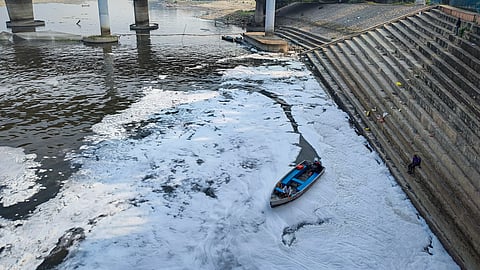
The DPCC has also tightened requirements for dhobi ghats, laundry units and washing facilities, warning that untreated wastewater entering the Yamuna, either directly or through drains, contributes to foam formation and eutrophication.
These establishments have been directed to obtain the necessary licences, install and maintain effluent treatment plants (ETPs), and ensure that wastewater is not released into drains, water bodies or on land without treatment.
They must also use soaps and detergents that comply with prescribed Bureau of Indian Standards (BIS) specifications.
The directions are aimed at reducing the flow of detergent-laden wastewater into the river, particularly in areas where washing activities and inadequate treatment systems contribute to pollution.
How detergents contribute to Yamuna foam
Foam frequently forms in the Okhla stretch of the Yamuna when surfactant molecules, which are present in soap and detergent residues, are agitated in polluted water.
The churning of water at the Okhla barrage intensifies the formation of froth. Lower winter temperatures also help the bubbles remain stable for longer, allowing the foam to accumulate and persist.
Officials have identified several sources of surfactants, including detergents in untreated domestic sewage, industrial pollutants and wastewater from dhobi ghats.
A study conducted by The Energy and Resources Institute (TERI) also identified dhobi ghats as a source of these substances.
The DPCC has previously issued directions prohibiting the sale, storage, transportation and marketing of soaps and detergents that do not conform to BIS standards in Delhi.
Enforcement drive against non-compliant dhobi ghats
The latest directions come amid a wider enforcement drive against washing facilities violating pollution-control norms.
In October, the MCD sealed three unauthorised dhobi ghats in Old Delhi following inspections that found deficiencies in effluent treatment plants, missing DPCC consent to operate and the use of soaps and detergents that did not meet BIS standards.
The civic body has also issued show-cause and compliance notices to defaulting establishments and initiated steps to disconnect electricity and water connections where required.
The DPCC has warned that violations of the latest directions could attract statutory penalties, including environmental compensation and the disconnection of essential services.
Officials are expected to intensify inspections once the compliance deadlines expire, requiring establishments not only to obtain routine permissions but also to demonstrate that their waste and wastewater are being treated in accordance with pollution-control standards.


