.png)
Delhi SIR: 4.7 million deleted names trigger rush to special camps
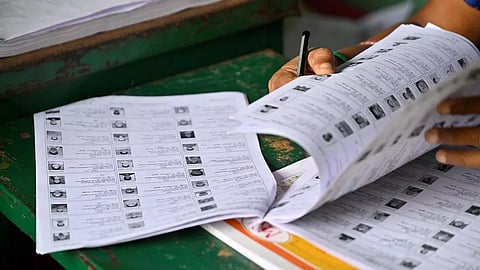
Thousands of people whose names were removed from Delhi’s draft electoral rolls are turning to special camps to seek inclusion ahead of the October 30 deadline, with address verification and rejected online applications emerging as major hurdles.
At a Special Intensive Revision (SIR) camp at Delhi Technological University’s east Delhi campus on Sunday, 48-year-old Ram Dev Prasad waited with a bundle of documents after discovering that his name had been dropped from the electoral rolls. A Booth Level Officer (BLO) had visited his brother’s address, which appears on all his documents, but his brother reportedly told the official that Prasad did not live there.
“All my documents have my brother’s address on them, however, due to a rift in the family we don’t live together. So, when the BLO visited his house, my elder brother simply said that I don’t reside there. That’s how my name was dropped from the rolls,” Prasad said.
Prasad is among the 4.7 million people whose names were removed from the draft rolls. Special camps are being held on two consecutive Sundays, October 18 and 25, to help eligible voters verify their details and submit claims or objections before the October 30 deadline.
Migrant workers face difficulties during verification
During visits to three camps, two in east Delhi and one in south Delhi, people reported problems ranging from rejected online applications to deletions resulting from officials being unable to verify their addresses.
In Ambedkar Camp, an authorised colony with a predominantly migrant-worker population, officials said around 431 notices had been issued.
Munesh Kumar, 36, a government school teacher who also works as a BLO, said many residents were migrant workers, particularly men whose families remained in villages in Bihar and Uttar Pradesh. Workers were often away from home when verification visits took place, while their families could not be approached, making the process more difficult.
“I am in school between 12.30pm to 6.30pm so managing the SIR work before and after that is challenging,” Kumar said, describing the additional workload involved in carrying out the revision alongside his teaching duties.
Frequent relocation complicates address checks
Turnout at the east Delhi camps was relatively low. At a camp in Pillanji Village in Sarojini Nagar, around 30 people arrived over a two-hour period.
Bhupendra, 26, who had moved from Pillanji Village to neighbouring Laxmibai Nagar, said repeated unsuccessful attempts to resolve his problem online had left him with no choice but to visit a camp. His name had been deleted over an address-related issue, and his application through Form 6 had been rejected.
A BLO at the camp, who requested anonymity, said nearly 95% of Pillanji Village’s population comprised tenants who frequently changed addresses. This made it difficult for officials to establish whether voters continued to live at the addresses recorded in the electoral rolls.
“We initially had around 200 notices, most of them concerning people who had lived here as tenants and subsequently moved. When we contacted the landlords, they told us that these voters no longer lived at the given addresses,” the BLO said.
The experiences at the camps highlight the challenges faced by voters whose official documents carry addresses where they no longer reside, as well as those who are difficult to reach during verification visits.
Inclusion applications approach 450,000
According to the Delhi chief electoral officer’s bulletin issued on October 18, authorities received 235,351 Form 6 applications seeking inclusion in the electoral rolls between August 31 and October 17. This took the cumulative number of such applications to 447,751.
During the same period, officials received 13,773 Form 7 applications seeking deletion of names and 89,577 Form 8 applications for corrections.
Special camps will be held again at all polling station locations on October 25. Eligible citizens whose names are missing from the draft electoral roll can seek inclusion by submitting Form 6, along with the prescribed declaration and supporting documents, before the October 30 deadline.


