.png)
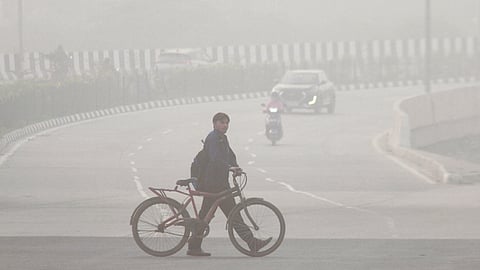
Delhi sees season's first single-digit temperature as AQI stays in 'poor' zone
Delhi experienced its first single-digit minimum temperature of the season on Thursday, with the mercury dropping to 9 degrees Celsius at the Safdarjung weather station. However, the arrival of cooler conditions brought little relief from pollution, as the city's air quality remained in the 'poor' category.
According to the India Meteorological Department (IMD), Safdarjung's minimum temperature was 2.3 degrees Celsius below normal and one degree lower than Wednesday's reading of 10 degrees Celsius.
Among other weather stations, Palam recorded 9.9 degrees Celsius, while Lodhi Road registered 9.4 degrees Celsius. The minimum temperatures at Ridge and Ayanagar stood at 11.4 degrees Celsius and 10.5 degrees Celsius, respectively.
Safdarjung recorded a maximum temperature of 28 degrees Celsius, 1.3 degrees above normal. No rainfall was reported at any of the five monitoring stations.
Weak winds keep pollution trapped
Despite the dip in temperature, Delhi's air quality remained a concern. The Air Quality Index (AQI) stood at 226 at 7.05 am on Thursday, compared with 220 a day earlier.
According to the Central Pollution Control Board (CPCB), 13 of the city's 56 monitoring stations recorded 'very poor' air quality, while 25 were in the 'poor' category and 18 reported 'moderate' levels.
Anand Vihar registered the highest AQI at 355, while Sri Aurobindo Marg recorded the lowest at 131.
Weak winds and a strong temperature inversion prevented pollutants from dispersing. At 4.30 am, air around 150 metres above the ground was 10 degrees Celsius warmer than the surface air, creating a layer that restricted the upward movement of pollutants.
Wind speed was around 5 kmph, down from 15 kmph recorded at the same time on Wednesday.
Punjab, Haryana report farm fires
Meanwhile, NASA satellite data detected 5,480 farm fires across Punjab and Haryana, including 4,864 in Punjab and 616 in Haryana.
The actual number could be higher, as satellite monitoring takes place around 1.45 pm and some farmers are reportedly burning crop residue later in the day to avoid detection.
