.png)
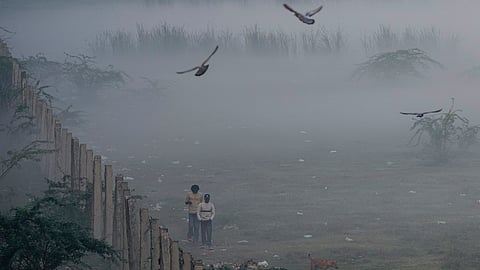
Delhi AQI turns severe at 403 as thick smog engulfs Capital, IIT Delhi records 488
Delhi's air quality slipped into the severe category on Friday morning, with the Air Quality Index (AQI) climbing to 403 at 7.30am, amid a thick blanket of smoky haze across the national capital. The reading was 82 points higher than the corresponding figure 24 hours earlier, according to Hindustan Times' real-time air quality dashboard and the Central Pollution Control Board (CPCB).
The deterioration comes after pollution levels rose sharply on Thursday, with unfavourable weather conditions and a lack of wind allowing pollutants to accumulate over the city. Delhi had last recorded severe air quality on January 19, when the AQI reached 410.
The situation remained particularly alarming across several parts of the city, with IIT Delhi recording the highest AQI of 488. According to HT's dashboard, 32 of the 59 reporting monitoring stations were in the severe category, while PM2.5 was the dominant pollutant at 48 of Delhi's 58 monitoring stations.
Still winds contribute to pollution build-up
The latest deterioration follows a sharp increase in particulate pollution on Thursday. Delhi's PM2.5 concentration more than doubled within 24 hours, reaching 244 micrograms per cubic metre by 6pm, four times the national standard.
Calm wind conditions persisted throughout Thursday night at Safdarjung, with all 11 observations recorded between 8pm and 6.30am reporting still air. The absence of wind restricted the dispersion of pollutants, allowing concentrations to build up overnight and worsening the air quality.
The AQI is categorised into six levels by the CPCB. A reading between 0 and 50 is classified as good, 51-100 as satisfactory, 101-200 as moderate, 201-300 as poor, 301-400 as very poor and 401-500 as severe.
The severe category represents the worst level on the government's pollution scale and poses serious health concerns, particularly for people with existing respiratory and other health conditions.
Farm fires continue across Punjab and Haryana
Stubble burning in neighbouring Punjab and Haryana remains another factor contributing to the pollution burden in the region. NASA satellite data detected 4,107 farm fires across the two states between October 1 and November 12. Of these, 3,729 were recorded in Punjab and 378 in Haryana.
As many as 96 farm fires were detected on November 12 alone. During the corresponding period last year, the satellite had recorded 4,220 fires, marginally higher than this season's count.
However, a direct comparison between the two seasons needs to account for changes in the timing of stubble burning. According to HT's analysis, the burning activity has increasingly shifted towards later hours over the years.
Around 98% of the fire heat detected by the Meteosat satellite in 2025 occurred after 3pm, compared with 94% in 2024. This shift can contribute to differences in the recorded fire counts between seasons.
The satellite data also represents an undercount of the actual number of farm fires, as much of the burning now takes place after the satellite's passage over the region at approximately 1.45pm.
Meanwhile, the latest monitoring data showed IIT Delhi recording an AQI of 488, placing it among the worst-affected locations in the Capital as Delhi's overall air quality entered the severe category on Friday.


