.png)
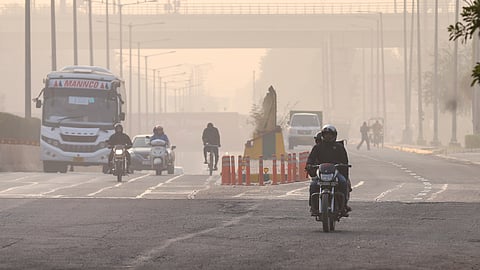
Delhi air quality worsens to 83-day high, 16 stations slip into ‘poor’ category
Delhi’s air quality deteriorated to its worst level in 83 days on Sunday, with the city recording an Air Quality Index (AQI) of 187 as pollution increased across the Capital and 16 monitoring stations slipped into the ‘poor’ category.
The city also experienced above-normal temperatures, with the maximum at Safdarjung settling at 36.4 degrees Celsius, 2.2 degrees above normal. The minimum was 24.1 degrees Celsius, 1.8 degrees above normal.
Worst since July
Sunday’s AQI of 187 remained in the ‘moderate’ category but marked Delhi’s highest pollution reading in nearly three months. The city had last recorded a higher AQI on July 13, when the index reached 246.
Data from the Sameer app showed considerable variation across Delhi, with several areas already experiencing air quality considerably worse than the citywide average.
Of the monitoring stations reporting data, 16 recorded ‘poor’ air quality. Mundka was the most polluted location with an AQI of 273, followed by Narela at 257.
Another 26 monitoring stations remained in the ‘moderate’ category. Burari was the only station to record ‘satisfactory’ air quality.
Pollution levels rise
Under the Central Pollution Control Board’s classification, an AQI between zero and 50 is considered ‘good’, 51-100 ‘satisfactory’, 101-200 ‘moderate’, 201-300 ‘poor’, 301-400 ‘very poor’ and 401-500 ‘severe’.
The increase comes as Delhi approaches the period when air pollution typically becomes a growing concern, with changing meteorological conditions affecting the dispersion of pollutants.
Agricultural fires in neighbouring and nearby states are also being monitored as the harvesting season progresses, although the number of reported incidents remains relatively limited at this stage.
203 farm fires recorded
According to the Indian Agricultural Research Institute, 203 stubble-burning incidents were recorded across Punjab, Uttar Pradesh and Madhya Pradesh between September 15 and October 3.
On October 3 alone, Punjab recorded one incident, Uttar Pradesh reported 12 and Madhya Pradesh 15.
Delhi recorded one stubble-burning incident during the September 15-October 3 period. The September 19 incident was the Capital’s first reported farm fire of the season.
The figures indicate that Uttar Pradesh and Madhya Pradesh accounted for most of the farm fires reported on October 3, while Punjab recorded only one.
Heat stays above normal
Alongside worsening air quality, Delhi continued to experience warmer-than-normal conditions on Sunday.
Ayanagar was the hottest monitoring location, recording a maximum temperature of 37 degrees Celsius. Safdarjung followed at 36.4 degrees Celsius, while Lodi Road recorded 36.3 degrees, Ridge 35.8 degrees and Palam 34.6 degrees.
Minimum temperatures showed greater variation across the Capital. Safdarjung recorded 24.1 degrees Celsius, Lodi Road 23.2 degrees, Ayanagar 22.8 degrees, Palam 22.4 degrees and Ridge 21 degrees.
Relative humidity stood at 51% at 5.30 pm.
Clear Monday forecast
The India Meteorological Department has forecast clear skies over Delhi on Monday, with no significant change expected in daytime temperatures.
The maximum temperature is likely to remain around 36 degrees Celsius, while the minimum is expected to settle near 24 degrees Celsius.
With pollution already rising at several monitoring stations, attention will increasingly turn to wind conditions, agricultural fires and other local and regional pollution sources as Delhi moves deeper into October.


