.png)
Days after denotification as protest site, Jantar Mantar to host India Biennale 2026
Jantar Mantar, the historic astronomical observatory in central Delhi, has been included among the venues for India Biennale 2026, days after a stretch of the adjoining road was denotified as a designated protest site.
The Ministry of Culture updated the event's official website on Thursday to include the 18th-century monument, which has long been associated with public demonstrations and political gatherings in the national capital.
The India Art, Architecture and Design Biennale will begin on December 4 and continue until March 21, 2027, bringing exhibitions, installations and cultural programmes to several heritage sites and institutions across Delhi.
𝗕𝗶𝗲𝗻𝗻𝗮𝗹𝗲 𝘁𝗼 𝘀𝗽𝗮𝗻 𝗗𝗲𝗹𝗵𝗶 𝗹𝗮𝗻𝗱𝗺𝗮𝗿𝗸𝘀
The 108-day festival is being planned across more than a dozen prominent locations, including the Red Fort, Qutub Minar complex, Agrasen ki Baoli, Safdarjung Tomb and Lodhi Gardens.
The 16th-century Purana Qila is expected to serve as the principal venue, hosting the Ministry of Culture's flagship exhibition.
Other participating institutions include the National Gallery of Modern Art, Kiran Nadar Museum of Art, Nita Mukesh Ambani Cultural Centre, JSW Foundation and DAG, formerly Delhi Art Gallery.
The event is intended to transform historic monuments and public spaces into platforms for contemporary art, architecture and design, bringing together Indian and international participants.
Culture Secretary Vivek Aggarwal had earlier outlined the ministry's intention to make the festival a citywide cultural experience rather than confining it to conventional exhibition spaces.
The initiative also envisages participation from architecture and design firms, private cultural organisations, galleries and embassy precincts.
𝗣𝗿𝗼𝘁𝗲𝘀𝘁 𝘀𝗶𝘁𝗲 𝘀𝘁𝗮𝘁𝘂𝘀 𝘄𝗶𝘁𝗵𝗱𝗿𝗮𝘄𝗻
Jantar Mantar's inclusion comes shortly after the October 11 decision to remove a stretch of Jantar Mantar Road from the list of designated protest locations.
The area has historically served as a gathering point for political organisations, trade unions, civil society groups and activists seeking to raise demands before the Union government.
Following the denotification, authorities identified Ramlila Maidan, Burari Ground in north Delhi and CBD Ground in east Delhi as alternative venues for demonstrations.
The decision followed observations made by a Supreme Court bench headed by Chief Justice Surya Kant on October 9, emphasising the need for larger and better-equipped protest locations while balancing public safety with the right to demonstrate.
The development came against the backdrop of several major protests in the national capital this year.
𝗛𝗶𝘀𝘁𝗼𝗿𝗶𝗰 𝗺𝗼𝗻𝘂𝗺𝗲𝗻𝘁 𝗴𝗲𝘁𝘀 𝗰𝘂𝗹𝘁𝘂𝗿𝗮𝗹 𝗿𝗼𝗹𝗲
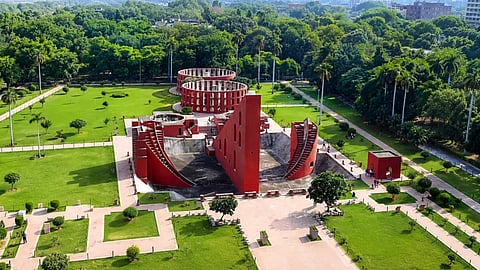
Built in 1724 by Maharaja Sawai Jai Singh II of Jaipur, Jantar Mantar is one of five astronomical observatories commissioned by the ruler.
The monument contains large masonry instruments designed to study celestial movements, determine astronomical positions and measure time.
Its inclusion in the Biennale places the protected heritage site within a broader programme aimed at connecting India's architectural legacy with contemporary creative practices.
The upcoming edition follows the inaugural India Art, Architecture and Design Biennale held at the Red Fort in 2023.
The Ministry of Culture has expanded the programme for 2026, with exhibitions, performances, discussions and student participation planned across the city.
While Jantar Mantar has been included among the proposed heritage venues, the ministry's published venue list remains indicative, with further site-specific programming and arrangements to be finalised.
