.png)
CJP’s Saurav Das questions opposition unity after ABVP wins three posts
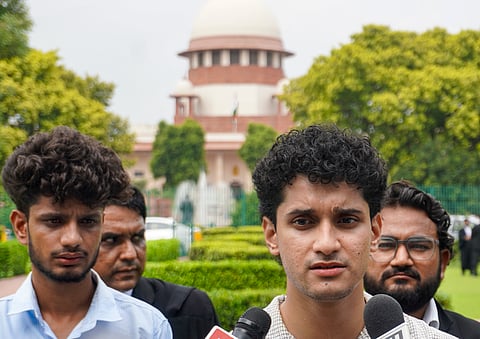
The Delhi University Students' Union (DUSU) election results have triggered a debate over the state of opposition student politics, with CJP co-convenor Saurav Das arguing that a divided vote helped the Akhil Bharatiya Vidyarthi Parishad (ABVP) secure three of the four central panel posts.
Reacting to Saturday's results, Das said a majority of students were against what he described as the “present regime”, but claimed that their votes remained fractured. He argued that the outcome should not be interpreted as a mandate from a majority of students.
“A majority of students are against the present regime, but fractured, and hence it benefits the regime. But this is a silver lining. Those bagging positions must remember they are not kings or queens. The majority DID NOT vote for them,” Das wrote on X.
ABVP takes three central panel posts
ABVP's Yash Dabas was elected DUSU president, defeating NSUI's Vijai Shankar Meena by 2,053 votes. Dabas secured 24,576 votes against Meena's 22,523. Left candidate Anaya Raturi finished third with 5,377 votes, while ASAP's Ashmit Kumar polled 1,388.
ABVP also won the secretary and joint secretary posts. Riya Chhawdi was elected secretary with 21,650 votes, defeating NSUI's Namrata Chaudhary, who secured 14,869 votes. Lakshya Raj Singh won the joint secretary post with 16,615 votes, narrowly ahead of independent candidate Vishesh Yadav, who received 15,778 votes.
The vice-president's post, however, went to independent candidate Deepanshu Shokeen, who secured 30,615 votes. Shokeen had previously sought an NSUI ticket but contested as an independent after he was denied the nomination.
The final outcome meant that NSUI did not win any of the four central panel posts, while ABVP secured three and an independent candidate took the remaining position.
Das targets Congress and sections of Left
Das used Shokeen's victory to question the functioning of Congress and its student organisation. He criticised the Congress and what he called its “bureaucratic wings”, arguing that they should focus on resolving organisational issues rather than concentrating on “hounding the CJP”.
He said attempts to address these issues had continued for 12 years and claimed that people were losing patience. Referring to Shokeen's victory, Das highlighted that the candidate had won the vice-president's post after being denied the NSUI ticket.
Das also questioned the approach of sections of the Left, while stressing that his criticism did not apply to all Left groups. He said some sections were overly focused on “ideological purity and exclusivity” and argued that such groups needed to recognise that people were not seeking their validation.
“If this is the opposition ‘unity’, then I’m afraid they will continue to remain in Opposition,” Das said.
Das cautions against reading too much into one poll
Das also rejected the idea of using a single student-union election as a complete measure of the political mood among young people.
He argued that an entire generation facing issues including joblessness, what he described as a “broken education system”, dilapidated schools, inflation and “mass despair” could not be assessed through the outcome of one student election.
He further criticised what he described as an election “completely run on money and muscle power”, saying that reducing the political mood of young Indians to its result would not amount to sound analysis.
Das also questioned the idea that elections should be the only barometer of public sentiment. According to him, the fractured opposition vote was an important factor in the result, and he again warned that continued divisions could leave opposition groups in opposition.
Higher turnout and independent victory
The 2026 DUSU election recorded a 40.46% voter turnout, the highest in the past three years, according to reported election data. Polling was conducted across 52 centres.
The election also saw a significant number of votes going to NOTA. Reported figures show that NOTA received 23,942 votes across the four central panel contests, including 4,310 for president, 4,359 for vice-president, 7,884 for secretary and 7,389 for joint secretary.
Shokeen's victory was particularly notable because he contested independently after not receiving the NSUI nomination. His 30,615 votes were more than the winning totals recorded in the presidential, secretary and joint secretary contests.
NSUI faces setback after youth outreach campaign
The results represent a setback for the Congress-backed NSUI, which failed to secure any of the four central posts. The outcome came after Congress leader Rahul Gandhi's youth outreach campaign, ‘Chhatron ki goonj’, which focused on issues including examination irregularities.
The campaign was part of a wider effort to engage young people, but its impact on the DUSU election was questioned following the results. NSUI's defeat was also notable given its previous presence in DUSU politics.
Following ABVP's victory, Dabas described the result as a “victory for the students, harmony, Sangh, and for patriots”. He also said the result represented a rejection of what he called a “fake narrative” and claimed that students had demonstrated support for ABVP. These are his political characterisations of the result.
The results have therefore produced two distinct readings: ABVP has secured three of the four central posts, while the vice-president's position has gone to an independent former NSUI aspirant. Das, meanwhile, has interpreted the result through the lens of opposition fragmentation and called for changes within Congress and sections of the Left.


