.png)
CJP leaders allege phone hacking, illegal detention and police harassment after release in Delhi
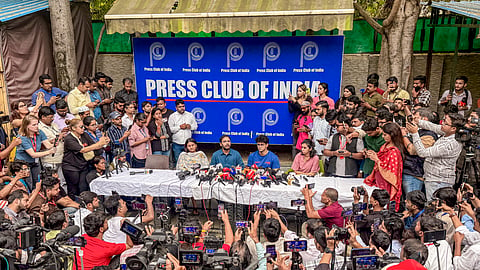
Cockroach Janata Party (CJP) leaders Ashutosh Ranka and Saurav Das launched a sharp attack on the Centre and Delhi Police after their release from around 24 hours of detention, alleging that restrictions on transport, internet access and public gatherings were intended to undermine their movement against Chief Election Commissioner Gyanesh Kumar.
Addressing their first press conference after being released on Sunday, the leaders accused the authorities of using preventive detention and heavy security deployment to prevent protesters from reaching Jantar Mantar. They also alleged that they had been denied basic legal safeguards during their detention.
“Entire Delhi is like a fort with 40,000 personnel. They are trying to give a negative image to our movement... by shutting 50+ metro stations, shops, roads. They want to put the Gen Z movement in bad light,” Das told reporters.
The CJP has been demanding Kumar’s resignation over alleged irregularities in the Special Intensive Revision (SIR) of electoral rolls. The planned demonstration on October 10 was met with extensive security arrangements, restrictions on public movement and the detention of protesters across the national capital.
Das alleges leaders were taken off plane and denied legal assistance
Recounting the circumstances of his detention, Das said the leaders had anticipated police action but were surprised by the manner in which it was carried out after their flight landed in Delhi.
“When we landed, police immediately jumped into the stairs leading to the plane and abducted us,” he said.
Das alleged that police personnel seized their mobile phones and told them they would not be provided with lawyers while in detention. He also claimed that the authorities did not give them any documents explaining the grounds for their detention.
“They gave us no papers or grounds of detention. They seized our phones forcefully using female cops. We still gave our phones and asked for seizure memo but they refused to do so... We have a legal right to a lawyer but police said no. They said that under detention, we have no rights. Imagine what they must be doing to others,” he said.
Das further alleged that the authorities may have accessed or tampered with their devices during the period they were held. He said the leaders suspected their phones could have been hacked or cloned and that evidence might have been planted.
“We suspect what all they must have done to our phones. We think they hacked our phones. Or cloned our phones. Maybe they planted evidence. And this is a rational doubt. Since they gave us no document and had our phones for over 24 hours,” he said.
Das did not provide evidence to substantiate the allegations of phone cloning or the planting of evidence.
He accused the government of attempting to suppress the protest against Gyanesh Kumar, whom he described as a traitor, and argued that the detention was part of a wider effort to discredit the movement.
Ranka questions peace bond condition
Ranka also criticised the condition attached to his release requiring him not to breach the peace. He argued that the authorities themselves were responsible for disrupting public order, while the CJP was seeking permission to demonstrate peacefully at Jantar Mantar.
“Only Modi, Shah and Delhi Police are breaching peace. We just want to peacefully protest at Jantar Mantar,” Ranka said, referring to Prime Minister Narendra Modi, Union Home Minister Amit Shah and the Delhi Police.
The three prominent CJP leaders, including founder Abhijeet Dipke, were detained shortly after arriving at Delhi airport on Saturday, October 10, ahead of the proposed demonstration. They were subsequently produced before an executive magistrate and released on Sunday, subject to a condition to maintain peace and good behaviour for a year.
The police action came amid heightened security across Delhi, with authorities preventing demonstrators from reaching the planned protest site. The restrictions also affected public transport, with access to several metro stations curtailed and some train services disrupted.
CJP legal affairs head alleges harassment of protesters and families
CJP legal affairs head Ratna Singh separately accused Delhi Police of intimidating volunteers and their families in the run-up to the demonstration. She alleged that officers visited the homes of protesters and pressured their parents between Friday night and Saturday.
Singh described the government as “scared” of the movement and alleged that police personnel were acting on instructions from senior authorities. She also claimed that she was followed by the Intelligence Bureau after arriving in Delhi.
Recalling her own experience, Singh alleged that police personnel tracked her movements and surrounded her car before detaining her in Jangpura.
“Four police personnel came to my apartment. They harassed my flatmates by ringing doorbell in the morning. Later, when I left and was sitting in car. All of a sudden, four cars came and detained me by surrounding me from two sides. I was sitting between four cars for nine hours in Jangpura,” she said.
Singh claimed the incident caused inconvenience to residents in the area. She further alleged that around 30 to 35 officials arrived and told her that she would either have to accompany them to a detention centre or remain under house arrest.
“They kept saying they got orders from above. Thirty to 35 officials came and said either I should come to detention centre or get house arrested. How can you wrongfully confine us,” she said.
Singh also alleged that officers followed her as though she were a criminal. The allegations made by the CJP leaders and Singh could not be independently verified.
Protests continue over demand for CEC’s resignation
The detention of CJP leaders came as the organisation attempted to mobilise supporters against the Election Commission’s electoral-roll revision exercise and demand Kumar’s resignation. The movement has alleged that the SIR process could disenfranchise eligible voters, while the Election Commission’s exercise and the government’s position have faced criticism from opposition parties and activists.
The proposed Jantar Mantar protest was prevented from proceeding as planned, prompting demonstrations and detentions at multiple locations. Police action also drew scrutiny over restrictions on movement, the closure of metro stations and the treatment of protesters.
The Supreme Court has separately intervened over restrictions imposed during the protests, directing authorities to review barricades, safeguard public movement and ensure that peaceful protesters and lawyers are not unlawfully prevented from exercising their rights.
The CJP leaders have maintained that their campaign will continue despite the detentions. Their latest allegations have added to the controversy surrounding the police response, with questions over the grounds for preventive detention, access to legal assistance and the handling of protesters remaining central to the dispute.


