.png)
Burari Ground’s new role as protest site raises concerns over access, traffic and livelihoods
Burari Ground, a sprawling open space in north Delhi that has long served as a recreational hub for residents, is facing a significant change after Delhi Police designated it as one of three alternative venues for protests following the de-notification of Jantar Mantar. The move has raised questions about the future of the ground, its accessibility to local communities and the potential impact of demonstrations on the already congested Outer Ring Road.
Spread across nearly 23 hectares, the Delhi Development Authority (DDA)-owned ground, also known as Nirankari Ground, was notified as an alternative protest venue on Monday. Located around 18 kilometres by road from Jantar Mantar, it is more than twice as far from the Capital’s established protest hub as the crow flies.
The ground is situated alongside the Outer Ring Road, with the Nirankari Sarovar complex on one side. Burari and Majlis Park are the nearest metro stations. Its location makes it accessible to residents of several surrounding neighbourhoods, including Burari, Gopalpur village, Mukundpur, Nirankari Colony, Mukherjee Nagar, Kingsway Camp, Majnu Ka Tila, Jahangirpuri, GTB Nagar and Azadpur, where open spaces for recreation are increasingly scarce.
For years, the ground has offered residents an informal public space for outdoor activities without an entry fee, despite lacking basic amenities such as proper pitches, toilets and adequate lighting. Its possible transformation into a designated protest venue has therefore prompted concerns about whether local people will continue to have access to one of their few readily available recreational spaces.
Restrictions begin as residents face uncertainty
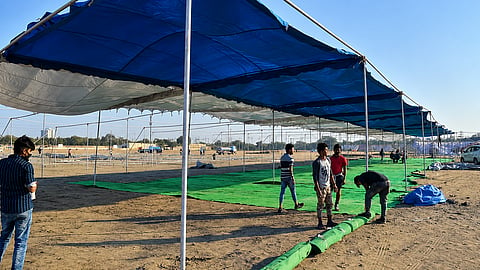
Signs of change were already visible when the ground was visited on Tuesday. Residents said access had been restricted over the preceding few days, with barbed-wire fencing installed along the perimeter and wide pits dug at entry points to prevent vehicles from entering. Those who used the space to practise driving were among the first to be affected.
The ground has waterlogged patches, uneven surfaces and a combination of tarred and unpaved tracks. Around 25 to 30 children and adults were seen playing at different spots during the visit. A handful of two-wheelers and scooters remained visible, although residents said vehicle access for driving practice had been stopped.
Two guards from the Nirankari Mission were informing visitors about the restrictions. Sanjay Chaudhary, one of the guards, said people continued to arrive hoping to enter the ground.
“As three sides of the Burari Ground have been fenced with barbed wires, people try to enter the space through our gates. Since morning, I have turned away 20 people, who wanted to access the ground to learn driving. We told them our gates are permanently closed,” he said.
Some residents associated the fencing with security concerns following last month’s Aastha Kunj Park gang-rape case, while others believed it was connected to preparations for the ground’s new role. However, the reason for the restrictions could not be independently established.
The uncertainty comes at a time when the ground continues to serve a wide range of users. Children and adults regularly play cricket and football, while gilli-danda remains another popular activity. Driving learners practise on two-wheelers, three-wheelers, cars and even heavy vehicles. Kite-flyers, physical training groups and cattle grazing on the grass are also a familiar sight.
Mohammad Adil, a 32-year-old electrician from Mukundpur, was playing gilli-danda with seven friends when he described the importance of the space to the neighbourhood.
“As there are no big open spaces available in our neighbourhood, Burari Ground has remained our favourite playground to play various outdoor games since childhood. This one ground provides free space for multiple activities all the time,” he said.
Adil added that the ground becomes particularly busy at weekends, when 40 to 50 groups gather to play cricket, football, gilli-danda and other games.
Traffic concerns and business opportunities
Beyond the loss of recreational space, residents are divided over the implications of hosting large demonstrations at the site. Some fear that the change could place additional pressure on the Outer Ring Road, an important route for commuters travelling through north Delhi.
Sahil Mahlawat, a 22-year-old resident of Kingsway Camp, said the road was already struggling with congestion caused by growing residential development and an increasing population.
“The Outer Ring Road is a key corridor. Due to rise in the local real estate leading to increased population, the route remains congested for a large part of the day,” he said.
Mahlawat warned that a large number of protesters arriving in vehicles could worsen traffic conditions, particularly during peak hours. The ground’s location alongside a major arterial road has consequently become a source of concern for residents who depend on the corridor for their daily journeys.
Not everyone, however, views the proposed change negatively. Prashant Chauhan, who runs a grocery shop in Sant Nagar, Burari, believes demonstrations could bring additional business to local traders and vendors.
“When people in large numbers gather in an area, they need food, water, transport and other basic services. Small shopkeepers and vendors could benefit from the additional footfall,” he said.
The prospect of increased activity could therefore offer commercial opportunities for some businesses, even as residents remain uncertain about the longer-term effects on the neighbourhood and the ground’s existing uses.
A distant alternative to Jantar Mantar
Burari Ground has been considered as a potential protest venue before. During the farmers’ protests of 2024-25, authorities offered it as a possible location for demonstrations, but farmers’ unions rejected the proposal, describing it as an “open jail”.
The unions argued that the ground’s fenced-off and outlying location would isolate protesters from public view and reduce the impact of their agitation. That objection could become relevant again as the site assumes its new role.
Jantar Mantar, by contrast, is situated close to central Delhi and the government institutions that demonstrators often seek to address. Burari Ground lies considerably farther from the Capital’s administrative centre, potentially making it less convenient for protesters as well as those seeking to engage with their demonstrations.
For residents, the immediate concern is more practical: whether the open space they have used for years will remain accessible for everyday activities. For commuters, the question is whether demonstrations will add to congestion on an already strained road network. Local traders, meanwhile, see the possibility of increased business.
As Burari Ground transitions from an informal community recreation space to a designated protest venue, its future will affect not only those who wish to demonstrate there but also the neighbourhoods that have long relied on it as an accessible, free and open part of the city.


