.png)
Air purifiers, masks and indoor venues: Delhi weddings adapt to pollution season
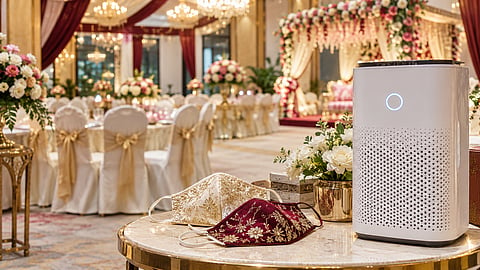
Flowers, elaborate menus and designer outfits remain central to Delhi's winter weddings, but worsening air pollution has added another concern to the celebrations. From air purifiers and indoor venues to masks matching bridal outfits, families are increasingly factoring air quality into their wedding arrangements.
At a five-star hotel in Lutyens' Delhi, a wedding in mid-October featured the usual elaborate decorations, food and festivities. However, the bride's family, which had travelled from Vancouver, Canada, made an unusual request to the organisers — air purifiers for the residential wedding.
"The bride's family, who had travelled from Vancouver, Canada, was concerned about Delhi's air quality and approached the organisers to arrange air purifiers for the residential wedding," said Mohsin Khan of Vivah Luxury Weddings.
According to wedding planners, such requests are becoming increasingly common as the peak wedding season in November and December coincides with deteriorating air quality in the national capital.
Families are reconsidering venues, catering arrangements and guest comfort, with some shifting celebrations indoors and others choosing destinations outside Delhi.
𝗔𝗶𝗿 𝗽𝘂𝗿𝗶𝗳𝗶𝗲𝗿𝘀 𝗷𝗼𝗶𝗻 𝘄𝗲𝗱𝗱𝗶𝗻𝗴 𝗯𝘂𝗱𝗴𝗲𝘁𝘀
Khan said demand for air purifiers was particularly noticeable among non-resident Indian families, although the additional expense meant such arrangements remained largely limited to financially well-off households.
"Most of the requests for air purifiers come from NRI families. Very few other families ask for them," he said.
Some families are replacing open-air lawns with covered banquet halls, while others are considering wedding destinations such as Mussoorie, Jim Corbett, Jaipur and Goa to avoid Delhi's pollution.
The shift towards indoor celebrations is also becoming visible among middle-class families.
Sangeeta, a wedding planner from south Delhi, said banquet halls were increasingly being preferred by families seeking relatively affordable indoor venues.
"They cannot afford sprawling outdoor lawns, so banquet halls are their safest bet. And many health-conscious clients are asking for air purifiers there too," she said.
Earlier, indoor weddings during winter were largely preferred because of the cold. Now, air pollution has emerged as another consideration, particularly when guest lists include children, elderly people and those with existing health concerns.
𝗠𝗮𝘀𝗸𝘀 𝗳𝗼𝗿 𝗺𝗼𝗿𝗻𝗶𝗻𝗴 𝗿𝗶𝘁𝘂𝗮𝗹𝘀
For families following traditional wedding customs, pollution-related challenges can begin even before the main celebrations.
Early morning rituals and pujas, often scheduled at specific auspicious hours, may require families to visit temples or organise ceremonies outdoors when smog is particularly noticeable.
Sangeeta said wedding planners had begun keeping masks available for such occasions.
"We always keep a box of masks ready, especially for small morning pujas. There may be children and elderly people attending, and we want to make sure they have masks available," she said.
She added that some families were allocating separate budgets for arrangements intended to reduce exposure to polluted air.
The concern has also entered wedding fashion.
A wedding planner from west Delhi recalled a bride who wore a mask matching her outfit during some wedding functions and ensured that the groom wore one as well.
Guests are increasingly arriving prepared with their own masks.
"At a recent early morning function, half the guests arrived with their own masks," the planner said.
𝗢𝘂𝘁𝗱𝗼𝗼𝗿 𝗰𝗮𝘁𝗲𝗿𝗶𝗻𝗴 𝗽𝗼𝘀𝗲𝘀 𝗰𝗵𝗮𝗹𝗹𝗲𝗻𝗴𝗲
Despite the growing preference for indoor celebrations, wedding planners said moving guests inside did not necessarily address every concern associated with pollution.
Vitnesh Gaur of Wedding Decors by Gaur Planners said catering arrangements remained a challenge because food was frequently prepared outdoors even when meals were served inside banquet halls.
He suggested that food preparation should also be moved indoors wherever feasible to reduce the exposure of catering staff and preparation areas to outdoor pollutants.
Banquet owners said the effectiveness of pollution-control arrangements depended considerably on the type of venue.
Vinay Mehra, a Delhi-based banquet owner, explained that weddings in the capital were generally held at hotels, banquet halls or farmhouses.
While banquet halls largely offered enclosed spaces, farmhouses typically featured extensive outdoor areas, making air-quality management difficult.
"In farmhouses, it is practically impossible to manage air quality in the way people would want. To be very honest, this has become a general issue now. It is not a singular problem that can be solved," Mehra said.
Hotels, on the other hand, were relatively better equipped, with some properties already having built-in air-quality management systems.
Certain hotels also displayed indoor and outdoor Air Quality Index readings, allowing guests to compare pollution levels.
As Delhi's wedding season gathers momentum, planners and families are increasingly treating pollution precautions as part of routine preparations.
From air purifiers in hotel rooms to masks at morning ceremonies, the city's wedding industry is adapting to an environmental challenge that is reshaping how celebrations are organised.


