.png)
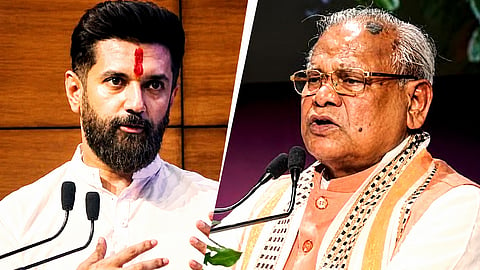
Chirag Paswan, Jitan Ram Manjhi clash over SC-ST quotas, demand each other’s resignation

A dispute over Scheduled Caste and Scheduled Tribe reservations has triggered an unusually sharp public confrontation between Union ministers Chirag Paswan and Jitan Ram Manjhi, with the two NDA allies calling for each other’s resignation. The row erupted after Bihar minister Santosh Kumar Suman, Manjhi’s son and a senior Hindustani Awam Morcha (Secular) leader, sought a review of the existing reservation framework. He backed sub-categorisation within SC and ST quotas, arguing that the benefits of affirmative action have not reached all communities equally.
Suman maintained that the demand was not aimed at dismantling reservation but at examining whether its benefits were reaching groups at the lowest levels of the social hierarchy. He cited the limited representation of the Musahar community in senior government positions as an example of the disparities that, according to him, warranted closer scrutiny.
Paswan rejects creamy layer proposal
Paswan, the Lok Janshakti Party (Ram Vilas) chief and Union Food Processing Industries Minister, strongly opposed the proposal, arguing that reservation for Scheduled Castes was rooted in social discrimination rather than economic circumstances. He said those advocating a creamy layer provision should first give up the benefits they themselves receive under the reservation system.
Targeting Manjhi directly, Paswan said the Union minister should resign if he supported introducing such a mechanism. He also called upon Suman to step down. Paswan argued that applying economic criteria to SC reservation would run contrary to its fundamental purpose. According to him, reservation was designed to address historical discrimination, particularly untouchability, and could not be viewed solely through the prism of income or economic advancement. The LJP(RV) has consistently opposed attempts to create sub-quotas within the Scheduled Caste category, maintaining that such divisions could weaken Dalit unity and undermine the larger struggle for social justice.
Manjhi hits back at Cabinet colleague
Manjhi responded by turning the resignation demand back on Paswan, accusing his Cabinet colleague of failing to protect the interests of the poorest and most marginalised sections. The HAM(S) founder argued that without a more equitable distribution of reservation benefits, some communities would continue to remain deprived despite decades of affirmative action. Manjhi said sub-categorisation was necessary in the wider public interest and suggested that Paswan should resign if he was unwilling to support measures intended to benefit the most disadvantaged groups.
The exchange has brought into the open a longstanding political difference between the two Bihar-based NDA constituents, both of which draw significant support from Dalit communities but represent different social constituencies.
Supreme Court ruling at centre of debate
The latest political confrontation comes against the backdrop of the Supreme Court’s 2024 judgment permitting states to sub-classify Scheduled Castes and Scheduled Tribes to ensure that communities lagging behind within these categories receive a fairer share of reservation benefits. Several judges on the Constitution Bench had also raised the question of whether a creamy layer principle could be considered for SCs and STs. The Centre, however, has subsequently maintained before the Supreme Court that the creamy layer principle cannot be extended to Scheduled Castes and Scheduled Tribes under the existing framework. The mechanism currently applies to Other Backward Classes. The Paswan-Manjhi confrontation has now taken that larger constitutional and social debate into the political arena, exposing differences within the NDA over how reservation benefits should be distributed among Dalit communities.

