.png)
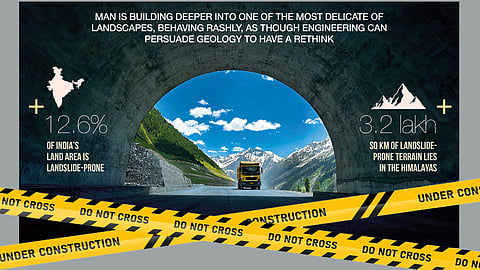
When the mountains send the bill: Rethinking development in the Himalayas
There was a time when reaching the Himalayas was itself an adventure. There were few motorable roads, journeys were slow, towns were small, and the mountains dictated the terms. That is changing. Today, the Himalayas are one of India’s great infrastructure frontiers. Highways snake up slopes that once seemed inaccessible. Tunnels race through mountains. Bridges jump deep valleys. Hydropower projects harness rushing rivers. Railway locomotives and coaches push deep into terrain that trains once had no business entering. Hill towns are exploding, hotels multiplying and tourism turning remote landscapes into hot destinations.
It is development. And much of it is necessary, even desirable. The problem is that the Himalayas are not a normal development zone. They are young, restless mountains, still being pushed upwards by tectonic collision. Their slopes are steep, rocks fractured, rivers powerful and geology unstable. Add massive rainfall, cloudbursts, earthquakes, melting snow and changing weather patterns, and the margin for error forgets how to forgive.
Simply put, the mountain does not give a damn about which project is being inaugurated. Or by whom.
Unstable bargain
Every road cut, tunnel bored, dam put up and building that goes vertical changes something. A slope is gouged. A drainage channel is altered. Vegetation is removed. Water finds a new path. The hillside’s weight distribution changes. Most of the time, nothing dramatic happens. And that is precisely why the danger is easy to underestimate. A mountain can absorb intervention for years and then, without warning, send a section scooting downhill. Landslides are nothing new. Neither are earthquakes, flash floods or rockfalls. What is changing is the scale of human activity taking place in this same landscape.
The result is peculiar: we are asking an exceptionally dynamic landscape to support infrastructure designed on the assumption of stability. That assumption can be extremely expensive. Tragedy, when it comes, is described in deceptively simple language. A road collapsed. A hillside gave way. A town subsided. A bridge was washed away. Short headlines, but carrying a brutal body copy.
And the failure is rarely just one thing. It is geology meeting rainfall meeting construction meeting inadequate drainage meeting an expanding population meeting a landscape never really interested in accommodating any of them.
The towns below
Nowhere is this tension more visible than in the Himalayas’ lap, and in its meandering ankles and toes. Hill settlements are no longer just places where people live. They are economic hubs, destinations for tourist, transport nodes and gateways to pilgrimage and adventure. As visitors arrive, buildings rise, roads widen and demand for hotels, parking, shops, water and electricity grows.
Without notice, the mountain town begins to mimic a city. But it is still a town sitting on a mountain. A flat city can expand outward and add infrastructure with ease. A Himalayan town has a finite amount of safe, buildable land. The temptation is to hoard slopes, fill valleys, cut hillsides and build vertically.
Unfortunately, modern engineering makes much of this possible. But it cannot make the underlying geology disappear. The lesson is not that towns should be frozen in time. People need homes. Business needs infrastructure. Tourists need access. Communities need connectivity. The lesson is that where and how we build matter as much as what we build. And it becomes far less obvious when land is scarce, investment is flowing and everybody wants the hill economy to grow and start paying back.
Tunnel vision
There is an irony in the gleeful push for tunnels. They are, in many cases, a sensible solution. Instead of repeatedly cutting roads across unstable slopes, tunnelling can reduce surface disturbance and improve connectivity. But tunnels are not perpendicular magic holes in a mountain; they are deep excavations inside a geological system whose weaknesses are not always visible on the surface. Water seepage, fractured rock, pressure changes and unexpected formations often play monkey with construction and maintenance.
The same applies to hydropower. The rivers descending from the mountains represent enormous energy potential, vital for a growing economy seeking cleaner electricity and greater energy security. But these rivers are not passive channels. They carry enormous sediment loads, reshape valleys and can respond violently to extreme rainfall.
The question is not whether India should develop the Himalayas. It is whether we are developing them with the humility demanded by the landscape.
Different risks
Climate change makes the calculation harder. A warmer atmosphere holds more moisture. Rainfall patterns are less predictable. Extreme precipitation can produce extraordinary amounts of water over short periods. Glaciers and snowfields are changing. Glacial lakes can pose risks downstream.
None of this means that all Himalayan disasters can be blamed on climate change. That would be as simplistic as blaming every landslide on a poor, defenceless road. Natural hazards become disasters when people and infrastructure occupy places where those hazards can cause damage.
A landslide in an empty valley is geology. A landslide taking out a highway, power line, hotel or village is a societal crisis. The real story is not that the Himalayas have suddenly become dangerous. They were always dangerous. Man has simply increased the number of things that can be damaged when mountains behave like mountains. That is the uncomfortable wedge.
Building smarter
There is no realistic case for turning the Himalayas into a museum. We need connectivity. Border areas need roads and communications. Mountain people need jobs and services. Hydropower matters. Tourism supports livelihoods. Better transport can reduce isolation and open economic opportunities.
The answer is not to build nothing. It is to build differently. That means understanding geological vulnerability before construction begins, rather than after things go wrong. It means better mapping of landslide-prone slopes, stronger drainage systems, enforcement of building norms and greater respect for natural waterways. It means asking whether every slope really needs a building on it.
It also means recognising that the cheapest project on paper can become the most expensive one when the mountain sends the bill later. And it means accepting an increasingly unfashionable idea in an age obsessed with speed: sometimes the most sophisticated infrastructure answer is to say no.
Mountain decides
The Himalayas will continue to rise, erode, fracture, slide and reshape themselves. They will outlast highways, governments, corporations, tourist seasons and political slogans. That is not an argument against ambition; it is an argument for perspective. The mountain is not the obstacle standing between India and development. It is part of the country’s economic, ecological and strategic future.
That future comes with terms and conditions. We can build roads on mountains, tunnels through them, dams beside them and towns cascading down their slopes. What we cannot do is repeal geology. That is the moot lesson the Himalayas are teaching us: real development is not the art of making nature surrender; it is the art of knowing where, when and how far to push. The mountains have already learnt this lesson. They have been around long enough to know it by heart.


