.png)
Was the new Parliament built keeping delimitation in mind? Here's what we know
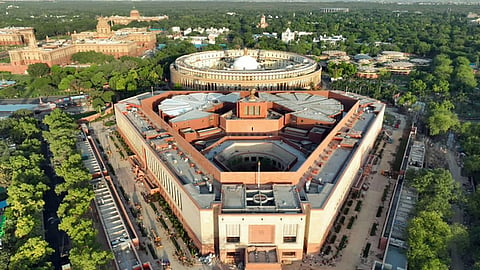
India's new Parliament building was designed with a significantly larger Lok Sabha in mind, even though the Lower House currently has only 543 members. The Lok Sabha chamber in the triangular Sansad Bhavan, inaugurated by Prime Minister Narendra Modi in May 2023, has 888 seats, leaving considerable room for an expansion in parliamentary strength.
More than three years after the building was inaugurated, the Centre is preparing to push through a constitutional amendment that could bring the House closer to its planned capacity. The Union Cabinet cleared a revised package of delimitation and women's reservation proposals on Friday, ahead of the special sitting of Parliament beginning November 30, 2026.
The proposed changes seek to increase the constitutional ceiling for Lok Sabha seats from 550 to 850, potentially paving the way for a larger House and the implementation of 33 per cent women's reservation.
Why the new Parliament has 888 Lok Sabha seats
The old Parliament building, constructed in 1927, had limited space for accommodating an increase in the number of lawmakers. Its Lok Sabha chamber could hold around 552 members, while the Central Hall, used for joint sittings, had a capacity of 436.
The new Sansad Bhavan was designed to address these limitations. Its Lok Sabha chamber has 888 seats, with the capacity to accommodate up to 1,272 members during joint sittings. The Rajya Sabha chamber has 384 seats.
The building also features digital voting consoles at individual desks, reflecting the requirements of a larger legislature.
How delimitation could change Lok Sabha strength
Under the proposed framework, the Lok Sabha's strength could increase by 50 per cent, from 543 to around 816 seats, ahead of the 2029 general elections.
The expansion is also linked to the implementation of 33 per cent reservation for women. The proposed arrangement would set aside 273 seats for women while retaining 543 unreserved seats, according to the framework cleared by the Cabinet.
This would allow women's reservation to be introduced without reducing the existing number of unreserved seats.
Why the 25-year freeze matters
The proposed expansion also seeks to address concerns raised by southern states over their share of parliamentary representation. States with slower population growth have expressed concerns that delimitation could reduce their relative political weight.
To address this, the revised framework proposes a 50 per cent increase in representation across states while maintaining their existing proportion of Lok Sabha seats for another 25 years, until 2051.
The earlier version of the legislation failed to secure the required two-thirds majority in April 2026. The upcoming Parliament sitting will be crucial in determining whether the proposed expansion and women's reservation framework can move forward.


