.png)
Ukraine leads global arms imports; India second, Saudi Arabia third

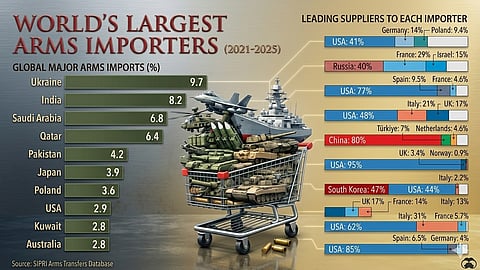
India remained among the world’s largest importers of major arms during the 2021–2025 period, accounting for 8.2 per cent of global arms imports, according to data released by the Stockholm International Peace Research Institute (SIPRI). The figures place India as the second-largest arms importer globally, behind Ukraine, which accounted for 9.7 per cent of global imports, largely driven by the ongoing war with Russia and the urgent need to replenish military capabilities. Saudi Arabia ranked third with 6.8 per cent, followed by Qatar at 6.4 per cent, Pakistan at 4.2 per cent, and Japan at 3.9 per cent. Other countries among the top ten importers include Poland with 3.6 per cent, the United States at 2.9 per cent, Kuwait at 2.8 per cent, and Australia also at 2.8 per cent of global major arms imports. The data highlights how geopolitical tensions, regional security concerns and strategic modernisation programmes continue to drive defence procurement worldwide. In India’s case, the continued reliance on imports reflects the scale of its defence requirements as the country modernises its armed forces across air, land and maritime domains while simultaneously attempting to strengthen domestic defence manufacturing through initiatives such as ‘Make in India’. Despite increasing emphasis on indigenous production, imports remain a significant component of India’s defence acquisition strategy, particularly for advanced platforms and technologies that require long development cycles. The SIPRI data illustrates how global defence markets remain heavily influenced by security crises and alliances, with countries turning to trusted suppliers to strengthen their military capabilities in an increasingly uncertain international environment.
The data also provides insight into the sources of arms imports for major buyers, revealing how longstanding defence partnerships shape procurement patterns. For India, Russia continues to be the largest supplier, accounting for about 40 per cent of its arms imports, reflecting a decades-old defence relationship that dates back to the Cold War period. However, the figures also show a gradual diversification of India’s suppliers, with France contributing 29 per cent of imports and Israel accounting for 15 per cent, indicating New Delhi’s effort to reduce dependence on any single source. This diversification strategy has been visible in major acquisitions ranging from advanced fighter aircraft and missile systems to surveillance technology and naval equipment. The SIPRI data also underscores the dominance of the United States as a global arms supplier, particularly to its strategic partners. Ukraine’s arms imports, for instance, were led by the United States with 41 per cent, followed by Germany at 14 per cent and Poland at 9.4 per cent, reflecting Western military support to Kyiv during the conflict with Russia. Saudi Arabia, another major buyer, sourced a massive 77 per cent of its arms imports from the United States, with Spain and France accounting for smaller shares. Similarly, Qatar relied on the United States for 48 per cent of its imports, followed by Italy at 21 per cent and the United Kingdom at 17 per cent. These figures highlight how defence trade is often closely linked with geopolitical alliances and strategic partnerships, where arms deals not only enhance military capabilities but also reinforce diplomatic and security ties between nations.
Beyond India and the Middle East, the data reveals distinct patterns across other regions as well. Poland, which has significantly increased its defence spending in response to security concerns in Europe, sourced 47 per cent of its imports from South Korea and 44 per cent from the United States, demonstrating how emerging defence exporters are reshaping global supply networks. Pakistan, meanwhile, remains heavily dependent on China, which accounts for about 80 per cent of its arms imports, with smaller contributions from Türkiye and the Netherlands. Japan, traditionally reliant on US defence cooperation, sourced an overwhelming 95 per cent of its arms imports from the United States, reflecting the depth of their security alliance. Interestingly, the United States itself also appears on the list of top importers, accounting for 2.9 per cent of global arms imports, with the United Kingdom, France and Italy acting as suppliers. Meanwhile, Kuwait imported 62 per cent of its arms from the United States, followed by Italy and France, while Australia sourced about 85 per cent of its arms imports from the United States, underscoring Washington’s central role in global defence trade. Together, these figures illustrate the structure of the global arms market, where a small number of exporting nations supply advanced military equipment to a wide range of countries responding to evolving security challenges. The SIPRI data ultimately reflects a world where military procurement continues to expand amid geopolitical competition, regional conflicts and the pursuit of technological superiority, reinforcing the strategic importance of defence partnerships in shaping the global security landscape.

