.png)
Justice at half-speed | India's fast-track courts are falling behind!

The phrase "justice delayed is justice denied" has rarely appeared as relevant as it does today. The latest government data presented in Parliament paints a troubling picture: India's fast-track special courts (FTSCs), established specifically to expedite trials in rape and Protection of Children from Sexual Offences (POCSO) cases, are themselves moving slowly. Instead of reducing pendency, the backlog has continued to grow.
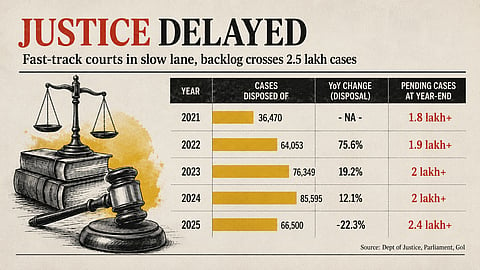
At the end of 2025, pending cases before fast-track courts crossed 2.5 lakh. During the year, more than 1.4 lakh new rape and POCSO cases were registered, but only around 66,500 were disposed of. The disposal rate has declined sharply from previous years, indicating that these courts are increasingly unable to keep pace with fresh filings. The numbers expose a structural challenge rather than a temporary slowdown.
The Promise That Hasn't Been Delivered
Fast-track courts were never meant to become another layer of an overburdened judicial system. They were designed to ensure that survivors of sexual violence receive timely justice, reducing the emotional and financial costs of prolonged litigation. Following the nationwide outrage after the 2012 Delhi gang rape, judicial reforms increasingly focused on speedy investigation and trial. Later, after amendments to the POCSO Act and the Criminal Law framework, the Centre launched the Fast Track Special Courts Scheme in 2019 to exclusively handle rape and child sexual abuse cases.
The objective was ambitious but straightforward: conduct day-to-day hearings and conclude trials within a year wherever possible. Seven years later, that ambition remains largely unrealised. Government data shows that case pendency has remained above two lakh for most of the scheme's existence despite repeated extensions and continued financial support. The latest extension takes the programme until September 2030, indicating that policymakers themselves recognise the need for the scheme. The question is whether merely extending it addresses the underlying problems.
The Numbers Tell Two Stories
At first glance, the growing backlog could simply reflect a rise in reporting of sexual offences—a development that, in itself, may indicate greater public confidence in the legal system. More victims are coming forward. Police are registering more FIRs. Awareness surrounding child sexual abuse has improved. These are positive trends. However, the second story is far less encouraging. Disposal has failed to keep pace with institution. In 2025, disposals reportedly fell by more than 22 percent compared with the previous year. Every year that courts dispose of fewer cases than they receive, pendency inevitably rises. This is not merely a statistical issue. Every pending case represents a survivor waiting for closure, an accused awaiting trial, witnesses whose memories fade over time, and families trapped in prolonged uncertainty.
Speed Cannot Depend Only on Courts
Public discourse often blames judges when cases linger for years. But criminal trials are only as efficient as the weakest link in the justice chain. Investigations remain delayed because police forces are understaffed and often lack specialised training for handling sexual offences. Forensic laboratories continue to face severe shortages, leading to months-long waits for DNA reports and scientific evidence. Public prosecutors frequently handle overwhelming caseloads, while defence lawyers seek repeated adjournments. Witnesses turn hostile or fail to appear because of inadequate protection mechanisms. Even when a fast-track court is ready to hear a case, delays in any one of these stages can halt proceedings. In other words, speeding up only the courtroom does not necessarily speed up justice.
Vacancies Continue to Hurt
Perhaps the most persistent problem is judicial vacancies. Successive Chief Justices, Law Commission reports and parliamentary committees have repeatedly highlighted the shortage of judges in district courts, where most criminal trials are conducted. Fast-track courts often rely on judges temporarily drawn from the existing judicial system rather than entirely new appointments. Consequently, they may reduce pressure in one category of cases while increasing it elsewhere.
The Centre has emphasised that recruitment of judges falls within the domain of states and High Courts. Constitutionally, that is correct. Yet the practical outcome is fragmented implementation across the country, with some states filling vacancies faster than others. Without a sustained increase in judicial capacity, fast-track courts risk becoming an exercise in redistribution rather than expansion.
Infrastructure Is More Than Buildings
Funding has not been insignificant. Under the Centrally Sponsored Scheme, the Union government and states share expenditure in a 60:40 ratio for most states, with different formulas for northeastern and Himalayan states. Funds cover judicial officers, support staff and operational expenses. Yet infrastructure extends beyond courtrooms. Many districts continue to lack adequate video-conferencing facilities, digital evidence management systems, child-friendly deposition rooms and trained support personnel. POCSO cases, in particular, require specialised handling to minimise trauma for child victims. A fast-track court without modern infrastructure cannot function substantially faster than an ordinary court.
The Conviction Question
An equally important but less discussed issue is conviction quality. Pressure to dispose of cases quickly must never come at the cost of procedural fairness. Courts dealing with sexual offences must balance urgency with due process. Poor investigations often result in acquittals, regardless of how quickly a trial is completed. Similarly, rushed proceedings may increase the likelihood of appeals, ultimately prolonging litigation. The goal should not be merely faster judgments but legally robust ones. Justice delayed is undesirable. Justice compromised is equally problematic.
What Needs to Change
Expanding the number of fast-track courts alone is unlikely to solve the problem. Reforms must address the criminal justice ecosystem comprehensively. Police investigation units dealing with sexual offences require greater specialisation. Forensic laboratories need substantial investment to eliminate bottlenecks. Judicial vacancies must be filled on priority, particularly in district courts. Digital case management should reduce procedural delays, while witness protection and victim support systems require greater institutional attention.
Equally important is rigorous monitoring. Measuring success solely through the number of courts established or funds allocated obscures the real question: Are cases actually being concluded within reasonable timeframes?
Beyond the Headlines
The latest figures should not be interpreted as evidence that fast-track courts have failed altogether. Thousands of victims have undoubtedly benefited from dedicated courts that might otherwise not have existed. But neither should the numbers be dismissed as routine administrative fluctuations. When pendency climbs to 2.5 lakh cases in courts specifically designed to prevent delay, the problem is systemic. Fast-track justice cannot depend solely on creating more courts. It requires faster investigations, better prosecution, stronger judicial capacity and modern infrastructure working together.
India's justice system cannot solve a structural crisis by accelerating only one part of the process. Unless every link in the criminal justice chain becomes stronger, fast-track courts will continue to move in the slow lane—and the promise of timely justice will remain unfinished.

